Fordham University School of Law’s Natural Law Colloquium Fall 2014 lecture will be held on November 19th. Jennifer Nedelsky (University of Toronto) will speak on “Part-time for All: Creating New Norms of Work and Care.” CLE credit is available for this lecture.
Colonialism was much more than another account of imperialism in human history. It introduced European categories and concepts into everyday habits of thought of the colonized. Focusing on writings of Vakkom Moulavi, who is known as the father of ‘Islamic reform’ in Kerala, South India, Abraham argues that the socio-religious reform movements of the colonial period was largely shaped by the discourse on modernity. In the wake of the socio-political changes initiated by colonial rule in Kerala, Vakkom Moulavi motivated Muslims to embrace modernity, especially modern education, in order to reap maximum benefit. In this process, to counter the opposition of conservative leaders and their followers, he initiated religious reform arguing that the major themes of colonial discourse were fully compatible with Islamic traditions. However, though modernization was the overall purpose of his socio-reform movement, he held fairly ambivalent attitudes towards individualism, materialism and secularization and defended Islam against the attacks of Christian missionaries.
God WillsIt is a comprehensive study of presidential religious rhetoric. Using careful analysis of hundreds of transcripts, David O’Connell reveals the hidden strategy behind presidential religious speech. He asks when and why religious language is used, and when it is, whether such language is influential.
Case studies explore the religious arguments presidents have made to defend their decisions on issues like defense spending, environmental protection, and presidential scandals. O’Connell provides strong evidence that when religious rhetoric is used public opinion typically goes against the president, the media reacts harshly to his words, and Congress fails to do as he wants. An experimental chapter casts even further doubt on the persuasiveness of religious rhetoric.
God Wills It shows that presidents do not talk this way because they want to. Presidents like Jimmy Carter and George H.W. Bush were quite uncomfortable using faith to promote their agendas. They did so because they felt they must. God Wills It shows that even if presidents attempt to call on the deity, the more important question remains: Will God come when they do?
This month, Routledge Publishing releases “Politics, Landlords and Islam in Pakistan” by Nicolas Martin (University College London). The publisher’s description follows:
Politics, Landlords and Islam in Pakistan explores the linkages between politics, religion, class, and caste in politics in rural Pakistan. It documents how landlords continue to wield arbitrary and despotic power over much of Pakistan’s rural population in the 21st century, and how participatory democracy has been subverted and has largely benefitted rural elites.
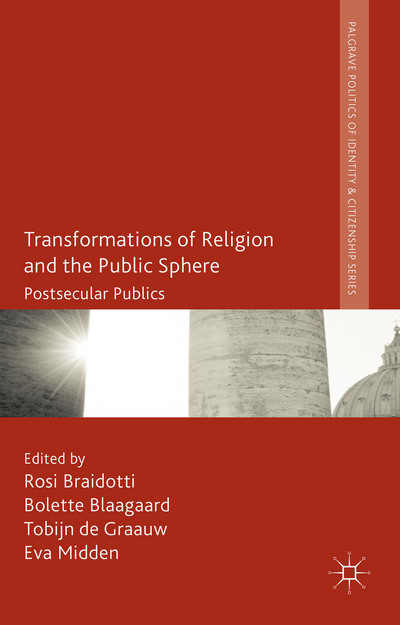
Next month, Palgrave Macmillan will release “Transformations of Religion and the Public Sphere: Postsecular Publics” edited by Rosi Braidotti (Utrecht University), Bolette Blaagaard (Aalborg University), Tobijn de Graauw (Utrecht University), and Eva Midden (Utrecht University). The publisher’s description follows:
Transformations of Religion and the Public Sphere: Postsecular Publicscontributes a counter-discourse to the myth of secularism. This myth is a strongly-held belief, predominantly advocated in the westernised world, that progress and modernity is intimately linked to secular politics and social relations. This book develops a range of critiques of this myth through discussions on the current political, social, and technological conditions in which we find ourselves. It explores the political implications of the myth, as well as exploring postcolonial relations, liberal-secularism and religious sentiments, and the mediated public sphere, with an in-depth focus on the Dutch case. Transformations of Religion and the Public Sphere: Postsecular Publics takes issue with the secular condition and accepted beliefs of its liberal emancipatory foundations.
On November 12-13, the Faculty of Law, Canon Law, and Administration at John Paul II Catholic University of Lublin (KUL), along with The Polish Catholic Institute “Sursum Corda,” will be hosting an international conference entitled “The Presence of the Cross in the Public Spaces of the European States.” The conference will discuss the legal approaches taken by the European Union and specific member states of the European Union to the issue of religious symbolism in public spaces.
Not long after his election, the new Pope explained why he had taken the name “Francis”: “Ah, how I would like a church,” he said, “that is poor and is for the poor.” It was refreshing: the Pope was going to change the basic terms of the conversation between the Church and the world. Instead of waging a grinding “culture war” against a secular West, the Church would instead speak to the most urgent concerns of the global East and South. The first Pope to come from beyond Europe and the Mediterranean basin promised to be the champion of those who lived in the parts of the earth where hunger, injustice and persecution abounded. Places like the Philippines, Mexico, and Nigeria had already become the true center of gravity of a global Church, displacing Quebec, Chicago, Milan and Vienna. The new Pope would speak for the populations of the emerging world – for their suffering, their desperation, their resilience, their energy, their sense of hope. The “North/South” polarity would supplant the “Left/Right” one. The Church would make the pivot to poverty. In making that turn, it would address the West too – but by awakening it from the deadly self-absorption of the affluent.
So when one learns that the Synod of Catholic cardinals and bishops summoned by the same Pope has returned the conversation to the culture wars of the West – though with unmistakable overtones of capitulation on many of the bishops’ part — it is, to say no more, a disappointment. Try as it may, the Church under Francis seems to be unable to resist scratching the sores of Western sexuality. The consuming obsessions of the West, now in the terminal phases of the sexual and cultural revolutions that have swept over it for more than half a century, are dominating the Church’s agenda once again. At the Pope’s insistence, the bishops did a reset, plunging the Church into renewed debate over divorce and homosexuality and cutting short the conversation that the Pope had earlier invited over famine, persecution and want. With Islamist terrorist groups like Boko Haram recently murdering 2500 Catholics in one Nigerian diocese alone, and with Christian children being crucified or cut in half by ISIS, you might think that the world’s bishops would have more pressing things on their mind than the compatibility of same-sex unions with Church teaching. You would, of course, be wrong.
Indeed, even considering “family” issues alone, the non-Western Church was short-changed: how much attention was given to the question of inter-faith marriages, despite its being a major concern for the Church in India? In the Philippines, many marriages break up because poverty forces a spouse or parent to migrate overseas in search of employment, leaving home, spouse and children behind. Philippine Cardinal Luis Tagle noted this problem, saying that poverty “goes right at the heart of the family” in his country ; but how much attention did this issue get?
What is more, the organizers of the Synod openly expressed their indifference to – if not contempt for – the opinions of the leaders of the non-Western Church. They spoke as if the opposition of the African bishops to their “modernizing” program could stem only from irrational hatred and prejudice. What the Africans needed, they seemed to be saying, was a good, stiff dose of Richard Posner’s writings. In the controversy over the initial draft of the Synod’s statement, Cardinal Walter Kasper, an octogenarian German theologian and a favorite of the Pope’s, infamously said:
Africa is totally different from the West. Also Asian and Muslim countries, they’re very different, especially about gays. You can’t speak about this with Africans and people of Muslim countries. It’s not possible. It’s a taboo. For us, we say we ought not to discriminate, we don’t want to discriminate in certain respects.
Kasper later denied having made those revealing remarks – a denial that was then proven to be false. In any case, the remarks hardly seemed out of character for the Cardinal. In an interview with the German magazine Focus published under the heading “Third World Land,” Kasper was reported to have said, “When you land at Heathrow you think at times you have landed in a Third World country.” The German Cardinal obviously notices different things when he is at the airport from what Cardinal Tagle does. The Philippine prelate spoke of his anguish in watching Filipino mothers at airports forced to part from their children because their poverty is so desperate that they must leave their families and search for work abroad.
Not Just Cardinal Kasper
Even if Cardinal Kasper’s statement were merely condescension on the part of the passenger with the first-class cabin towards the passengers in steerage, it would be bad enough. But Kasper and those like him simply did not seem to understand the position. Perhaps the Africans and Asians are not just squinting narrowly at the issue of homosexuality, but rather looking at the state of Western culture as a whole? And perhaps they do not like what they see? Perhaps the cultural exports of the secular West – its current practices regarding marriage, abortion, childbirth, the family, the relations between the sexes – are no more wanted in Africa and Asia than the West’s toxic wastes and sewage effluents? (New York Cardinal Dolan’s wonderful defense of the “prophetic” African Church effectively made these points. )
But the problem with the Synod went far beyond the tactlessness and incomprehension of elderly European churchmen. Apparently at the Pope’s insistence, the Synod’s final report included three controversial articles that had received the approval of a Synod majority, but not the supermajority required for consensus. The final report will now go to the Church throughout the world for discussion and debate before the Synod reconvenes. You can be sure that the media coverage of the debate in this intervening period will focus overwhelmingly on the articles that the Pope reinstated. Cui bono? In their effort to get the conversation back on the familiar tracks of the Western culture wars, the Pope and his bishops are doing serious harm to millions of faithful Catholics trying to live out the Gospel in hostile and often dangerous conditions in the emerging world.
My former student, Andrew Ratelle, makes the point forcefully:
By upholding the nuclear family, the Church made what was perhaps the most important social investment in history. People in the poorer, more pagan regions of the world where polygamy, polyandry, arranged and child marriages were common, now had a place to look for support when it came to building a life that was most beneficial for themselves and their children. By weakening this support, or at the very least dispersing it to include more “diverse” arrangements, these bishops have weakened the very shield from which the nuclear family has received so much protection. Even in our own country, where “diverse” familial arrangements have almost become synonymous with urban poverty and crime (at least for those who have no gilded safety net to fall into), where should families look to now, since the Church has seen fit to dilute the medicine they have thrived on for so long?
Church leaders in the developing world understand this perfectly well. South African Cardinal Wilfrid Napier, for instance, wondered how he could deny communion to an African man living in polygamy in accordance with local culture and tradition, if he had to administer the sacrament to a divorced man married to his second wife? “Successive” polygamy, Napier pointed out, is hardly distinguishable from “simultaneous” polygamy.
Pope Francis was right (at first): it really is time to change the conversation. The global Church is not the parochial Western Church; the Church of the poor and the marginal is not the affluent, greying Church of Western Europe and North America. The Church should not be shadowing the West’s cultural trajectory all the way downwards. The future of the Church lies elsewhere. Ex oriente, lux.
There is a great difference between a war being categorized as “religious” and religion being politicized for the purpose of achieving a political goal. However it can at times be hard to tell difference between the two. It can be especially hard to do so when the difference between “pretend to be” and “is” is obscured almost to a point beyond recognition. Volume one analyzes the mass production and use of counterfeit religious symbolism used for political purposes. Volume two of this book focuses more on the actual practical application of the symbolism within the context of state, nation and faith: the use of counterfeit religious symbolism to blur the essential distinction between “what is a real danger to a nation” and “what is not.”
While most scholarship on nationalism have focused on the recent secular foundations of nationalism, this work examines the religious roots of nationalism and specifically the (Neo) Shaivite roots of Tamil nationalism and the Dravidian movement. The book traces the anti-Aryan, anti-Brahmin character of Tamil nationalism and the Dravidian movement to the Tamil Neo-Shaivite movement that emerged against the background of Neo-Vedantic and Vaishnavite revivalist current that accompanied the rise of pan-Indian nationalism. Drawing from a range of influences including European Orientalist and Missionary critiques of the philosophical idealism found in Brahmanism and Neo-Vedantic thought, the Neo-Shaivite articulation of non-Brahmin Tamil nationalism endowed Tamil nationalism with a critical spirit and critical grammar that not only rejected such idealism—but also celebrated the more firmly grounded and sensuous Tamil tradition celebrated in ancient Tamil and Bhakti poetry. The book presents these insights and arguments through a critical exploration of the life and work of Maraimalai Adigal (1876-1950) who not only played a central role in consolidating the intellectual and cultural foundation for non-Brahmin Tamil nationalism but whose life intersected with many of the pioneer figures in the Tamil nationalist and Dravidian movement.
I am delighted to be participating this Wednesday in a conference at the European University Institute in Florence, Italy, on The Roberts Court and the Protection of Religious Freedom in the United States, organized by Center friends Olivier Roy and Pasquale Annicchino. Regretfully, my intervention will be virtual rather than in person. Here’s the description of the conference (in Italian) and the program:
Contesto
John Glover Roberts Jr. è stato nominato Chief Justice della Corte Suprema degli Stati Uniti il 22 settembre 2005, nomina confermata una settimana dopo dal Senato con 78 voti favorevoli e 22 contrari. In questi 9 anni si sono succedute numerose decisioni di assoluto rilievo del massimo organo giurisdizionale statunitense. Tra queste alcune hanno portato a definitivo compimento una nuova interpretazione ed una differente applicazione delle due clausole del primo emendamento costituzionale che si occupano di libertà religiosa: la Free Exercise Clause e la Establishment Clause. Dopo aver inquadrato nel contesto storico e politico la presidenza Roberts, questo workshop intende esaminare le principali pronunce della Corte Suprema sulla libertà religiosa.
Ogni relatore sarà chiamato a commentare una pronuncia e, mediante un approccio di “law in context” a darne una interpretazione nell’ambito del più ampio sviluppo della giurisprudenza della Corte.
L’obiettivo è quello di realizzare un volume collettivo (in italiano) che possa offrire agli studiosi nuovo materiale di riflessione e studio su un argomento che tocca gli interessi scientifici sia dei costituzionalisti che dei cultori delle materie ecclesiasticistiche.
Funded by European Research Council 7th Framework Programme
Programma
12.00-12.05 Introduzione
12.05-13.00 La Corte Roberts e la tutela della libertà religiosa
Fred Gedicks | BYU, USA
Marc De Girolami | St John’s University, USA (intervento via Skype)
13.00-14.00 Pranzo di lavoro
14.00-15.30 Discussione casi – I sessione
Valentina Fiorillo | Università di Roma “La Sapienza”, Italia
Adelaide Madera | Università di Messina, Italia
Pasquale Annicchino | EUI, Italia
Discussione generale
15.30-15.45 Pausa caffé
15.45-17.00 Discussione casi –II sessione
Marco Ventura | KU Leuven, Belgio
Susanna Mancini | Università di Bologna, Italia
Diletta Tega | Università di Bologna e Corte costituzionale italiana, Italia


 contributes a counter-discourse to the myth of secularism. This myth is a strongly-held belief, predominantly advocated in the westernised world, that progress and modernity is intimately linked to secular politics and social relations. This book develops a range of critiques of this myth through discussions on the current political, social, and technological conditions in which we find ourselves. It explores the political implications of the myth, as well as exploring postcolonial relations, liberal-secularism and religious sentiments, and the mediated public sphere, with an in-depth focus on the Dutch case. Transformations of Religion and the Public Sphere: Postsecular Publics takes issue with the secular condition and accepted beliefs of its liberal emancipatory foundations.

