Jansen, “Secularism, Assimilation, and the Crisis of Multiculturalism”

9789089645968-yolande-jansen-secularism-assimilation-and-the-crisis-of-multiculturalism-178Next month, Amsterdam University Press will publish Secularism, Assimilation, and the Crisis of Multiculturalism: French Modernist Legacies by Yolande Jansen (Amsterdam Centre for Globalization Studies). The publisher’s description follows.

This remarkable study develops a theoretical critique of contemporary discourses on secularism and assimilation, arguing that the perspective of assimilating distinct religious minorities by incorporating them into a secular and supposedly neutral public sphere may be self-subverting. To flesh out this insight, Jansen draws on the paradoxes of assimilation as experienced by the French Jews in the late 19th century through a contextualised reading of Proust’s In Search of Lost Time. She proposes a dynamic, critical multiculturalism as an alternative to discourses focusing on secularism, assimilation and integration.

Samuel Tadros to Discuss “Motherland Lost” at Georgetown (Jan 30)

The Hudson Institute’s Samuel Tadros will be discussing his important book, Motherland Lost:The Egyptian and Coptic Quest for Modernity, at Georgetown University on January 30. Details are here. I interviewed Sam about this book at CLR Forum last fall.

Ijatuyi-Morphé, “Africa’s Social and Religious Quest: A Comprehensive Survey and Analysis of the African Situation”

Next month, University Press of America will publish Africa’s Social and 0761862684Religious Quest: A Comprehensive Survey and Analysis of the African Situation, by Randee Ijatuyi-Morphé (ECWA Theological Seminary, Nigeria). The publisher’s description follows.

This well-crafted book probes the key dimensions of Africa’s existential predicament. It constitutes an intellectual response to a gnawing “African situation”—the starting point for grasping Africa’s social and religious quest. Beyond split explanations of external versus internal factors (e.g., colonization/slavery vs. leadership/cultural values), this study accounts more comprehensively for emergent issues shaping this situation. The situation reflects a gamut of problems in traditional African religion and material culture, which hitherto defines African communality, polities, and destinies vis-à-vis the cosmos and nature. Thus, African religion and communities, each with its own attendant values, do not operate by critical engagement with larger issues of society and civilization, especially those shaped by the advent of (post-) modernity. Rather, they operate via adaptation. The communal drive for natural and social harmony inevitably produces a preservationist view of culture (“leaving things as they are”). This study takes an integrative approach to religion, society, and civilization; eschews dichotomies; and broadly defines and re-signifies life and wholeness as a true end of Africans’ quest today.

Williams (ed.), “Social Difference and Constitutionalism in Pan-Asia”

Next month, Cambridge will publish Social Difference and Constitutionalism in9781107036277 Pan-Asia, edited by Susan H. Williams (Indiana University). The publisher’s description follows.

In many countries, social differences, such as religion or race and ethnicity, threaten the stability of the social and legal order. This book addresses the role of constitutions and constitutionalism in dealing with the challenge of difference. The book brings together lawyers, political scientists, historians, religious studies scholars, and area studies experts to consider how constitutions address issues of difference across “Pan-Asia,” a wide swath of the world that runs from the Middle East, through Asia, and into Oceania. The book’s multidisciplinary and comparative approach makes it unique. The book is organized into five sections, each devoted to constitutional approaches to a particular type of difference – religion, ethnicity/race, urban/rural divisions, language, and gender and sexual orientation – in two or more countries in Pan Asia. The introduction offers a framework for thinking comprehensively about the many ways constitutionalism interacts with difference.

Pepperdine’s Glazer Institute Announces Spring Series

Our friend Michael Helfand has posted this announcement for the Spring 2014 Speaker Series at Pepperdine’s Glazer Institute for Jewish Studies. It’s a fine lineup, including Florida State’s Michael Ruse on evolution and Villanova’s Chaim Saiman on Christian and Jewish legal theory. Congrats to Michael and all involved.

Wolterstorff’s “The Mighty and the Almighty”: The Dual Authorities Thesis

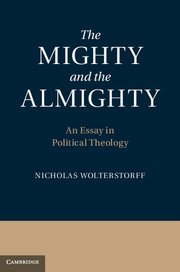
This is the second in a series of posts on Professor Nicholas Wolterstorff’s book,The Mighty and the Almighty The Mighty and the Almighty: An Essay in Political Theology. In the first post, I described what might be meant, and what Wolterstorff means, by “political theology,” and Wolterstorff’s project to arrive at a distinctly Christian political theology. Here I want to lay out the core thesis of that political theology.
That thesis can be summed up in the phrase, “dual authorities.” Christians, Wolterstorff writes, are subject to the dual authority of Christ and the civil power. And these dual authorities mediate one another.

These are deep waters and Wolterstorff explains and helps the reader by considering an ancient example–that of Polycarp, Bishop of Smyrna, who was martyred in 156 A.D.  Polycarp is sought out, arrested, and haled into a stadium filled with people where he is urged by the Roman proconsul to renounce Christ and swear by the genius of Caesar in order to save himself from execution. Polycarp refuses in these words: “For eighty and six years have I been his servant, and he has done me no wrong; how can I blaspheme my King, who has saved me?” Later in the exchange, Polycarp tells the proconsul: “[W]e [Christians] have been taught to render honour, as is meet, if it hurts us not, to princes and authorities appointed by God.”

Wolterstorff’s thesis depends on a close reading and interpretation of these statements. Unlike those who resist government’s coercive power as having no authority at all over them, “Polycarp’s resistance was different”:

He did not declare that obeying his own interior conscience had higher priority  for him than obeying the proconsul. He did not declare that loyalty to his group had higher priority for him than whatever loyalty he might feel toward Caesar, the proconsul, and the people in the stadium….[T]he explicit ground of his resistance was heteronomous. He had a sovereign distinct from Caesar, namely, Christ. The proconsul was demanding that he renounce that sovereign. That he would not do, for his sovereign had saved him. (13)

But Polycarp is not implying that the civil power is not his sovereign, or that Christ is his sovereign instead of the civil power. “No,” says Wolterstorff, “he was a citizen of Smyrna; and the proconsul had political jurisdiction over Smyrna. Polycarp was under dual authority. In his person, the authority of Christ and the authority of the emperor intersected. Given the command of Caesar’s proconsul to renounce Christ, these two authorities had now collided.” (14-15)

What makes the conflict even more complex and more difficult is the existence of other conflicting dualities beneath the surface. For one, Polycarp believed that the princes of the civil authority are appointed by God; yet now those self-same civil authorities demanded that he renounce God (that is, Christ). And for another, there was an institutional conflict at work: Polycarp was a bishop of the church, exercising Christ’s authority over the church. His exchange with the proconsul was not merely a personal conflict but represented a collision of institutional authorities. He was one person with dual membership in two authority structures that intersected in him. The key to Wolterstorff’s political theology is in understanding the nature of these dual authorities and the depth of their conflicts–dualities which affect everyone (political authority mediating divine authority and yet also being limited and judged by divine authority) and Christians in particular (being citizens of some state and under its authority, while that state is always under God’s authority; being members of the church and under the authority of Christ, who in turn is divine).

Finally, it is interesting to read Wolterstorff’s comments about the alien quality of all of this to American sensibilities, in which the language of religious liberty has the effect of effacing the problem of dual authority:

Some will find it strange to think of the church in terms of authority. They think of the church as a voluntary organization devoted to sponsoring religious activities. A group of us find ourselves interested in religion, in particular the Christian religion; so we get together and set up an organization for holding worship services and for engaging in a bit of social action. We put in place some organizational structure, call a minister, place ads in the local press, welcome neighbors. We are off and running.

Everything about religion in America conspires to make one think of the church along these lines. Christ as king and the church as an authority structure are nowhere in view. The local government may decide to clamp down on our group for one reason or another–it doesn’t like the architectural plans, doesn’t like the fact that wine is served to minors, doesn’t like the traffic jams. We may resist. But if we do, our resistance will be in the name of religious freedom. We will not declare that Christ is our king and that loyalty to our king requires that we not concede to the government’s demands. No Polycarps among us. (16-17)

My next post will concern an important objection to Wolterstorff’s account–the “two cities” objection whose most well-known exponent is St. Augustine.

Ramet (ed.), “Religion and Politics in Post-Socialist Central and Southeastern Europe”

This week, Palgrave Macmillan publishes Religion and Politics in Post-Socialist Central and Southeastern Europe, edited by Sabrina Ramet (Norwegian University of Science and Technology). The publisher’s description follows.Religion and Politics in Post-Socialist Central and Southeastern Europe - Edited By Sabrina P. Ramet

Since the crash of communism in Central and Southeastern Europe in 1989, almost everything in the region has changed – from politics to economics to popular culture to religion. There have been new challenges to confront and new dilemmas. This volume examines the political engagement of religious associations in the post-socialist countries of Central and Southeastern Europe, with a focus on disputes about property restitution, revelations about the collaboration of clergy with the communist-era secret police, intolerance, and controversies about the inclusion of religious instruction in the schools. Each of the countries in the region is analyzed with research grounded in on-site interviews, as well as extensive use of literature in local and Western languages.

Souaiaia, “Anatomy of Dissent in Islamic Societies”

In December, Palgrave Macmillan published Anatomy of Dissent in Islamic Societies by Ahmed Souaiaia (University of Iowa). The publisher’s description follows.Anatomy of Dissent in Islamic Societies - Ahmed E. Souaiaia

The ‘Arab Spring’ that began in 2011 has placed a spotlight on the transfer of political power in Islamic societies, reviving old questions about the place of political dissent and rebellion in Islamic civilization and raising new ones about the place of religion in modern Islamic societies.

In Anatomy of Dissent in Islamic Societies, Ahmed E. Souaiaia examines the complex historical evolution of Islamic civilization in an effort to trace the roots of the paradigms and principles of Islamic political and legal theories. This study is one of the first attempts at providing a fuller picture of the place of dissent and rebellion in Islamic civilization by interpreting Sunni and Shi`i records in the context of little-known Ibadi political and legal materials. As the oldest sect, Ibadiyyah provides a record of the ways sectarianism and dissent developed and impinged on Islamic society and thought.

Chagall and the Meaning of a Crucifixion

Readers in NYC should make sure to visit a current exhibition at the Jewish Museum, “Chagall: Love, War, and Exile,” before it closes on February 2. Besides being a lovely show, the exhibition illustrates well a point my colleague Marc DeGirolami and others have made in the context of public religious displays: religious images can have multiple meanings.

The exhibition focuses on Chagall’s work in the 1940s, which he spent, in exile, in the United States. Several canvases suggest the tender love he had for his wife, Bella. These paintings are quite touching, particularly the dreamlike portrayals of their wedding day. Chagall seems to have been genuinely broken up when Bella died suddenly in 1944, though he did shortly find a new love. He was a famous artist, after all.

The most interesting paintings at the exhibition, however, and the ones that have drawn most attention, are the religious images. Chagall famously used Jewish themes throughout his work. Although he wasn’t observant, he drew inspiration from his upbringing in a Hasidic family in Russia. Here, however, Chagall uses Christian imagery. As the notes to the exhibition explain:

The most prevalent image Chagall used during World War II was of Jesus and the Crucifixion. For Chagall, the Crucifixion was a symbol for all the victims of persecution, a metaphor for the horrors of war, and an appeal to conscience that equated the martyrdom of Jesus with the suffering of the Jewish people and the Holocaust. While other Jewish artists depicted the crucified Jesus, for Chagall it became a frequent theme.

Chagall didn’t paint the Crucifixion, in other words, to convey a Christian message about the atoning sacrifice of Christ, and no one seeing the paintings would draw that message. Rather, he used images of the Crucifixion for a political purpose. The Crucifixion “means” unjust suffering; we Jews in Europe are suffering now, at your hands, Chagall was saying. He was making an appeal for solidarity to the wider Christian world, especially artists in the wider Christian world.

The results disappointed him: “After two thousand years of ‘Christianity’ in the world—say whatever you like—but, with few exceptions, their hearts are silent… I see the artists in Christian nations sit still—who has heard them speak up? They are not worried about themselves, and our Jewish life doesn’t concern them.” But that doesn’t suggest the meaning of his paintings was incomprehensible. Whether or not they acted on Chagall’s appeal, most people who saw his paintings in the 1940s surely would have understood the message. So will most who see the paintings today.

Bottum, “An Anxious Age”

Next month, Random House will publish An Anxious Age by Joseph Bottum. The publisher’s description follows.9780385518819

We live in a profoundly spiritual age, but not in any good way. Huge swaths of American culture are driven by manic spiritual anxiety and relentless supernatural worry. Radicals and traditionalists, liberals and conservatives, together with politicians, artists, environmentalists, followers of food fads, and the chattering classes of television commentators: America is filled with people frantically seeking confirmation of their own essential goodness. We are a nation desperate to stand of the side of morality–to know that we are righteous and dwell in the light.
In An Anxious Age, Joseph Bottum offers an account of modern America, presented as a morality tale formed by a collision of spiritual disturbances. And the cause, he claims, is the  most significant and least noticed historical fact of the last fifty years: the collapse of the mainline Protestant churches that were the source of social consensus and cultural unity. Our dangerous spiritual anxieties, broken loose from the churches that once contained them, now madden everything in American life.

Updating The Protestant Ethic and the Sprit of Capitalism, Max Weber’s sociological classic, An Anxious Age undertakes two case studies of contemporary social classes adrift in a nation without the religious understandings that gave them meaning. Looking at the college-educated elite he calls “the Poster Children,” Bottum sees the post-Protestant heirs of the old mainline Protestant domination of culture: dutiful descendants who claim the high social position of their Christian ancestors even while they reject their ancestors’ Christianity. Turning to the Swallows of Capistrano, the Catholics formed by the pontificate of John Paul II, Bottum evaluates the early victories–and later defeats–of the attempt to substitute Catholicism for the dying mainline voice in public life.

Sweeping across American intellectual and cultural history, An Anxious Age traces the course of national religion and warns about the strange angels and even stranger demons with which we now wrestle. Insightful and contrarian, wise and unexpected, An Anxious Age ranks among the great modern accounts of American culture.