Around the Web This Week

Some interesting law & religion stories from around the web this week:

Pritchard, “Religion in Public”

0804785767This November, Stanford University Press will publish Religion in Public: Locke’s Political Theology by Elizabeth A. Pritchard (Bowdoin College). The publisher’s description follows.

John Locke’s theory of toleration is generally seen as advocating the privatization of religion. This interpretation has become conventional wisdom: secularization is widely understood as entailing the privatization of religion, and the separation of religion from power. This book turns that conventional wisdom on its head and argues that Locke secularizes religion, that is, makes it worldly, public, and political. In the name of diverse citizenship, Locke reconstructs religion as persuasion, speech, and fashion. He insists on a consensus that human rights are sacred insofar as humans are the creatures, and thus, the property of God. Drawing on a range of sources beyond Locke’s own writings, Pritchard portrays the secular not as religion’s separation from power, but rather as its affiliation with subtler, and sometimes insidious, forms of power. As a result, she captures the range of anxieties and conflicts attending religion’s secularization: denunciations of promiscuous bodies freed from patriarchal religious and political formations, correlations between secular religion and colonialist education and conversion efforts, and more recently, condemnations of the coercive and injurious force of unrestricted religious speech.

Horwitz on Overlapping Jurisdictions

Paul Horwitz (University of Alabama School of Law) has posted Rethinking the Law, Not Abandoning it: A Comment on ‘Overlapping Jurisdictions’. The abstract follows.

This short paper responds to a symposium article published by John Witte and Joel Nichols entitled “Who Governs the Family?: Marriage as a New Test Case of Overlapping Jurisdictions,” 4 Faulkner L. Rev. 321 (2013). Much of the response was motivated by a statement in an earlier draft of that paper suggesting that advocates of the use of shari’a in marriage cases “have given up on the state” and “want to become a law unto themselves.” I question that statement, and also take the occasion to discuss the legal status of anti-shari’a laws themselves.

My paper makes two basic points. First, although I am generally skeptical that equality is a sufficiently clean and clear principle to serve as the lodestar for all Religion Clause cases, I do believe there are cases where equality does a good deal of useful work. One such area is the legislative and judicial dispute over laws banning the judicial use of shari’a in interpreting marriage contracts. The Tenth Circuit’s decision in Awad v. Ziriax, in which it concluded that such a law violated the antidiscrimination principle offered in Larson v. Valente, shows that equality can be a powerful tool in such cases. It also sheds light on two points that have not been made much in law and religion scholarship: that Larson’s antidiscrimination principle can serve valuable information-forcing purposes, and that this principle can be profitably understood as a matter of political economy.

Second, I argue that although there are some grounds for Witte’s description of shari’a advocates as having given up on the state, that is a disturbing way to think of the issue, and not a necessary one. We need not think of religious arbitration panels and other mechanisms of religious law as an utter abandonment of “law” or “the state.” Rather, we can understand them as a challenge to what we mean by those terms. Religious arbitration of choice-of-law arrangements, and religious institutional autonomy arguments more generally, invite us to adopt a different view of what constitutes “the law” and, perhaps, a more skeptical view of the scope and dominance of “the state.”

Lecture: Jewish Law and Religious Lawyering (Oct. 16)

Fordham’s Russell Pearce will deliver a lecture on Jewish law and religious lawyering at Touro’s Jewish Law Institute on October 16. For information, please contact the Institute’s director, Professor Samuel J. Levine.

Norton, “On the Muslim Question”

Earlier this year, Princeton University Press published On the Muslim Question, by Annek9951 Norton (University of Pennsylvania). The publisher’s description follows.

In the post-9/11 West, there is no shortage of strident voices telling us that Islam is a threat to the security, values, way of life, and even existence of the United States and Europe. For better or worse, “the Muslim question” has become the great question of our time. It is a question bound up with others–about freedom of speech, terror, violence, human rights, women’s dress, and sexuality. Above all, it is tied to the possibility of democracy. In this fearless, original, and surprising book, Anne Norton demolishes the notion that there is a “clash of civilizations” between the West and Islam. What is really in question, she argues, is the West’s commitment to its own ideals: to democracy and the Enlightenment trinity of liberty, equality, and fraternity. In the most fundamental sense, the Muslim question is about the values not of Islamic, but of Western, civilization.

Moving between the United States and Europe, Norton provides a fresh perspective on iconic controversies, from the Danish cartoon of Muhammad to the murder of Theo van Gogh. She examines the arguments of a wide range of thinkers–from John Rawls to Slavoj Žižek. And she describes vivid everyday examples of ordinary Muslims and non-Muslims who have accepted each other and built a common life together. Ultimately, Norton provides a new vision of a richer and more diverse democratic life in the West, one that makes room for Muslims rather than scapegoating them for the West’s own anxieties.

“Jews, Christians, and the Roman Empire: The Poetics of Power in Late Antiquity” (Dohrmann and Reed, eds.)

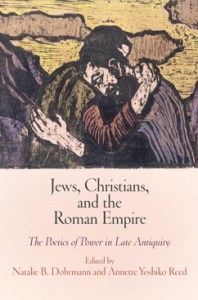
This month, University of Pennsylvania Press will publish Jews, Christians, and the 15169Roman Empire: The Poetics of Power in Late Antiquity, edited by Natalie B. Dohrmann (U. of Pennsylvania) and Annette Yoshiko Reed (U. of Pennsylvania). The publisher’s description follows.

In histories of ancient Jews and Judaism, the Roman Empire looms large. For all the attention to the Jewish Revolt and other conflicts, however, there has been less concern for situating Jews within Roman imperial contexts; just as Jews are frequently dismissed as atypical by scholars of Roman history, so Rome remains invisible in many studies of rabbinic and other Jewish sources written under Roman rule.

Jews, Christians, and the Roman Empire brings Jewish perspectives to bear on longstanding debates concerning Romanization, Christianization, and late antiquity. Focusing on the third to sixth centuries, it draws together specialists in Jewish and Christian history, law, literature, poetry, and art. Perspectives from rabbinic and patristic sources are juxtaposed with evidence from piyyutim, documentary papyri, and synagogue and church mosaics. Through these case studies, contributors highlight paradoxes, subtleties, and ironies of Romanness and imperial power.

Reflections from the City of God: On Excellence in the Two Cities

Excudent alii spirantia mollius aera,                                                                              (credo equidem), vivos ducent de marmore voltus;                                            orabunt causas melius, caelique meatus                                                              describent radio et surgentia sidera dicent:

tu regere imperio populous, Romane, memento                                                           (hae tibi erunt artes) pacique imponere morem,                                                       parcere subiectis et debellare superbos.

When I was a kid, these lines were an ending of sorts. We read them in 11th Publius Vergilius Marograde Latin, at year’s end, and they represented the culmination of the first half of the Aeneid. True, several of us continued on to read Books 7-12 in our senior year, but the second half is something of a long walk down the hill (and I always had a soft spot for Turnus and couldn’t get too excited about his defeat). It’s this section of Book VI (lines 847-853)–in which the ghost of father Anchises discloses to Aeneas what the special arts and excellences of the Roman are to be–that was the peak moment. It was satisfying to us not only as an explanation for all of the trouble that the hero of the story seemed to be taking and enduring but also as an inspiring affirmation of political virtue and the excellence of civic governance writ large: to impose the habit of peace, to spare (or, one might say, to tolerate) the subjugated, and to tame the proud!

It is really quite unnecessary to study “politics” as a discrete subject in high school, or even in college, since the study of abstract political ideologies is often simply a truncated version of the study of the political tradition and heritage of a particular society. And if you want to learn about the “political theory” of an empire that continued to think itself deeply committed to its republican past, you can find it all in Vergil. Other people, he says, might make pretty arts and crafts, but this is what you want from your politics.

These lines came back to me as I read some of the Preface of Book I of the AugustineCity of God, in which Augustine notes the obstacles that he faces in laying out the aim of the work.

For I am aware what ability is requisite to persuade the proud how great is the virtue of humility, which raises us, not by a quite human arrogance, but by a divine grace, above all earthly dignities that totter on this shifting scene. For the King and Founder of this city of which we speak, has in Scripture uttered to His people a dictum of the divine law in these words: “God resisteth the proud but giveth grace unto the humble.” But this, which is God’s prerogative, the inflated ambition of a proud spirit also affects, and dearly loves that this be numbered among its attributes, to “Show pity to the humbled soul,/ And crush the sons of pride.” And therefore, as the plan of this work we have undertaken requires, and as the occasion offers, we must speak also of the earthly city, which, though it be mistress of the nations, is itself ruled by its lust of rule.

Book I is, in fact, loaded with Vergil; Vergil’s poetry itself illustrates the excellence of the City of Man. Later in Book I, it is almost as if Augustine is speaking to the hundreds upon hundreds of generations of young Latin students to come: “There is Vergil, who is read by boys, in order that this great poet, this most famous and approved of all poets, may impregnate their virgin minds, and may not readily be forgotten by them,” after which he proceeds to engage in some close textual reading and interlocution of Vergil. All of this, of course, is meant to counter the claims of those who argued that the Romans got what was coming to them by abandoning the Roman gods and embracing Christ. And as for “parcere subiectis,” Augustine argues that, in fact, the Romans did no such thing. To the contrary: “[A]mong so many and great cities which they have stormed, taken, and overthrown for the extension of their dominion, let us be told what temples they were accustomed to exempt, so that whoever took refuge in them was free.” I.6. In this book, then, Augustine punctures the Vergilian rhetoric of the Augustan age extremely effectively–“[a]ll the spoiling, then, which Rome was exposed to in the recent calamity–all the slaughter, plundering, burning, and misery–was the result of the [Roman] custom of war.” I.7. What was novel, and what showed itself in the comparatively gentle behavior of the barbarians, was truly to spare the subjugated who (whether godly or not, whether deserving–by man’s lights–or not) sought sanctuary in the Christian “temples.”

As the eminent Augustine scholar R.A. Markus puts in his magisterial volume, Saeculum: History and Society in the Theology of St. Augustine:

In Augustine’s mature view the radical vice of Greek philosophy as of Roman political ideology was the belief in the possibility…of perfection through the polis or the civitas. ‘God resists the proud, but to the humble He giveth grace’: the scriptural sentence quoted at the opening of the City of God was to Augustine’s mind the most fundamental comment on classical pretensions to human self-determination, as expressed in Vergil’s line, quoted in dramatic juxtaposition, on the historic mission of Rome….Here is Augustine’s final answer to the illusion of a teleiosis through rational and human means; and it is the more poignant for being a repudiation of a heritage which, as we have seen, had some power over his mind in his youth. (84)

And not only over Augustine’s mind!! The political program, and the power, of Rome is beguiling and attractive indeed. It holds enduring appeal to young people–as it did for me and my friends in high school. There are, I suppose, several reasons that one reads Vergil rather than Augustine in high school. But one of them, perhaps the most important, is that the excellence of the City of Man is so easy and approachable (as texts millennia old go), while the excellence of the City of God is so distant and so difficult. The excellence of humility is so much harder to appreciate and embrace than the excellence of dominion–especially, it seems to me, for the young. The excellence of the City of God holds little of the immediate and prepossessing appeal of the splendors of Rome.

But perhaps a little Augustine in the relatively early educational years, as a counterpoint to Vergil, might cast politics in a mellower light for the rising generations.

Sixth Circuit Holds that “Secular, Profit-Seeking” Corporations are Not “Persons” under RFRA

In a terse and unsatisfying opinion, the United States Court of Appeals for the Sixth Circuit has held that “secular, profit-seeking” corporations have no standing to sue under the Religious Freedom Restoration Act. The plaintiffs, Roman Catholic owners of a closely held corporation that manufactures automotive and medical products, alleged that the HHS Contraception Mandate violated their religious free exercise under RFRA. After holding that the individual plaintiffs did not have standing, the court said this about the corporation’s standing:

Looking to RFRA’s relevant context, we find strong indications that Congress did not intend to include corporations primarily organized for secular, profit-seeking purposes as “persons” under RFRA. Again, Congress’s express purpose in enacting RFRA was to restore Free Exercise Clause claims of the sort articulated in Sherbert and Yoder, claims which were fundamentally personal . . . .

While the Supreme Court has recognized the rights of sole proprietors under the Free Exercise Clause during this period, it has never recognized similar rights on behalf of corporations pursuing secular ends for profit . . . .

Moreover, the Supreme Court has observed that the purpose of the Free Exercise Clause “is to secure religious liberty in the individual by prohibiting any invasions thereof by civil authority.” Sch. Dist. of Abington Twp., Pa. v. Schempp, 374 U.S. 203, 223 (1963) (emphasis added); see also Conestoga, 2013 WL 3845365, at *5 (“[W]e simply cannot understand how a for-profit, secular corporation–apart from its owners–can exercise religion.”).

Where to begin? The court recognizes that its emphasis on religious freedom that is “personal” or “individual” has, in fact, been totally irrelevant in many, many cases involving the Free Exercise Clause and RFRA in which the plaintiff corporations have prevailed. So why emphasize it? The distinction can do nothing by itself to justify the outcome, and the court seems to say as much.

“Personal” vs. “Group or Corporate” is doing no work here. Instead, there are two phrases that ground the decision: “secular” and “profit-seeking.” And, as I have said before, if courts are to deny religious freedom claims by corporations on these grounds–on the ground of a distinction between the secular and the religious, on the one hand, or of a distinction between profit-seeking and non-profit-seeking, on the other–then they will need to develop a theory of what “secular” means, and what “religious” means, and why the distinction matters in law. Or, they will need to make arguments about what precisely the difference is between “for profit” and “nonprofit” in this context and why it matters.

I should say straightaway that there may well be a discussion to be had, and arguments to be made, about the legal significance of the distinction between the “secular” and the “religious.” I recommend especially much of Steven D. Smith’s recent work on this issue, including this article. But there is not a single word in this decision about that distinction. Likewise, there is nothing about the conceptual distinction between for-profit and nonprofit in this specific context and its import (there is, at the end of the decision, a dubious interpretation of RFRA’s legislative history, but there is nothing of the sort of conceptual work that would be necessary to sustain a holding of this kind).

The Sixth Circuit joins the Third Circuit in reaching this result. Both courts are at odds with the Tenth Circuit. The case is Autocam Corp. v. Sebelius.

Library of Congress Releases “Constitution Annotated”

To celebrate Constitution Day yesterday, the Library of Congress released a new resource, Constitution Annotated, or, more formally, The Constitution of the United States of America: Analysis and Interpretation. Constitution Annotated contains legal analysis and interpretation of the US Constitution, including the Religion Clauses, based primarily on Supreme Court case law. It is updated through the end of the last Court term. Looks very helpful.

Glazer Institute Announces Fall 2013 Events

The Diane and Guilford Glazer Institute for Jewish Studies at Pepperdine has announced its events for Fall 2013, including talks on civil and Jewish law. A very impressive list indeed. Check it out here.