Elliott on Religion in Northern Ireland

Last month, Wiley Online Library posted Religion and Sectarianism in Ulster: Interpreting the Northern Ireland Troubles published in Religion Compass by Laurence Elliot.  The description follows.

The following article considers the various arguments and counter-arguments around the role of religion in causing and sustaining the conflict in Northern Ireland. It identifies the essential elements of the problem and assesses a number of the explanations given, emphasising the difficulty of providing a single answer to such a complex question. The correlation between religion and the divisions in Northern Ireland seems at first sight obvious, but, as a number of commentators have rightly observed, pinning down the relationship between someone’s religion and their attitudes is much more problematic. This essay therefore avoids the reductionism and ‘either/or’ formulations of so many scholars on both sides of the debate, instead emphasising that religion is ultimately one of a number of dimensions to Northern Irish identity, the politics of which sustains the social divisions and was the source of the political violence that ravaged the region.
“Must the Little Sisters of the Poor Implement the HHS Mandate?”

That’s the title of a very good post by my friend and Center for Law and Religion Forum former guest Kevin Walsh.  Kevin was involved in formulating comments on behalf of the Little Sisters of the Poor with respect to the Notice of Proposed Rulemaking as to the HHS Mandate.  Here are the succinct comments, which you should read in full, and here is a selection (footnotes omitted), which illustrates part of the difficulty faced by the Little Sisters, and perhaps by other self-insured eligible employers:

The fact that we have separately incorporated the homes in which we carry out our ministry to the elderly poor does not deprive our order’s religious exercise of its religious nature. Saint Jeanne Jugan, our foundress and the first Little Sister of the Poor, began her ministry by bringing an elderly and infirm woman into her own apartment and caring for her there. Since 1839, we have continued this tradition with our homes, which now operate in one of the most highly regulated segments of care providers. We have always done our best to comply with all government regulations that apply to our homes and with the highest standards of nonprofit financial stewardship. The Form 990 is an important tool for financial accountability in our religious charitable work, but it makes no sense to use the requirement to file it as a disqualifier for the religious employer exemption.

The Little Sisters of the Poor should receive a religious exemption based on what we believe and what we do rather than the corporate forms through which we carry out our ministry. The Notice of Proposed Rulemaking observes that a church should not lose its exemption simply because it “maintains a soup kitchen that provides free meals to low-income individuals.” We agree. The same should hold true for our religious order. We should not be deprived of an exemption because we maintain homes to provide shelter and loving care to the elderly poor . . . .

Our homes provide coverage for their employees through the Christian Brothers Employee Benefits Trust. The Trust is a self-funded church plan that provides health and welfare benefits to employees of Catholic employers nationwide. As a church plan, the Trust provides benefits consistent with Catholic teachings and doctrines. The Trustees of the Christian Brothers Employee Benefits Trust have contracted with Christian Brothers Services as a third-party administrator to administer and manage the Trust. Christian Brothers Services is a nonprofit Catholic ministry that operates in accordance with Catholic teachings and doctrines.

Although our homes qualify as “eligible organizations,” the proposed accommodation in the Notice of Proposed Rulemaking does not address the situation that they face under the HHS Mandate. The Notice identifies three alternative ways in which the third-party administrator of a self-insured plan might be made responsible for arranging the objectionable coverage. Each of these alternatives presupposes that the third-party administrator itself has no religious objection to arranging that coverage. But Christian Brothers Services, as another Catholic organization, shares our commitment to Catholic teaching and also objects to the HHS Mandate. Accordingly, the proposed accommodation does not offer us a path to compliance.

Poll: One-Third of Americans Would Make Christianity the Nation’s Official Religion

It’s hard to know what to make of these results, but a recent Huffington Post/YouGov survey reveals that roughly one-third of Americans would favor amending the Constitution to make Christianity the nation’s official religion. A similar percentage would favor making Christianity the official religion of their own state.

As Walter Russell Mead notes, there’s a lot of ambiguity here. What would it mean for “Christianity” to be the “official religion”? Given the very strong non-denominationalism in American religious life, I have to assume  respondents envisioned something like “Christianity-in-General,” or “Mere Christianity,” rather than any specific Christian communion. As to “official religion,” I doubt respondents had in mind a thoroughgoing establishment in which the state pays clergy salaries out of tax revenues. Most probably, respondents were thinking of mild endorsements of the sort traditional in American life. “In God We Trust,” for example.

One intriguing interpretation of the poll appears in the Huffington Post article itself. By calling for an official religion, respondents may simply be expressing frustration with what they see as an anti-religious theme in American public life. Saying one supports an “official religion” may be way to manifest one’s sense that America has gone too far in erasing its Christian heritage from public life:

The relatively high level of support for establishing Christianity as a state religion may be reflective of dissatisfaction with the current balance of religion and politics. Respondents to the poll were more likely to say that the U.S. has gone too far in keeping religion and government separate than they were to say religion and government are too mixed, by a 37-29 percent margin. Only 17 percent said that the country has struck a good balance in terms of the separation of church and state.

In other words, respondents don’t want a Church of America. They just want the Easter Bunny.

Vlas on Religious Freedom in Romania

Natalia Vlas (Babes-Bolyai University)  has posted The Law on Religious Freedom: An Expression of Romanian Democracy? . The abstract follows.

This paper aims to analyze the place of religion in the Romanian society and politics, by focusing specifically on the process of readjusting religious freedom in Romania after 1990. Although the regulation of religious life in accordance with international human rights principles was considered one of the cornerstones of the Romanian democracy, the replacement of the communist legal framework with a new one took more than 17 years and was accompanied by numerous tensions among the religious actors themselves, state institutions and civil society organizations. The analysis of the state of religious freedom two decades after the fall of the communism in Romania reveals ambivalent developments. Despite some undeniable signs of progress, there are still significant areas that require improvement. The most problematic aspects are the maintenance of the two-tier system and the financial dependence of the culte on the state.

The Top Five New Law & Religion Papers on SSRN

From SSRN’s list of most frequently downloaded law and religion papers posted in the last 60 days, here are the current top five:

1. God and the Profits: Is There Religious Liberty for Money-Makers? by Mark Rienzi (Catholic U. of America – Columbus School of Law) [239 downloads]

2. Suffer the Teenage Children: Child Sexual Abuse in Church Communities by Patrick Parkinson (U. of Sydney – Faculty of Law) [224 downloads]

3. Rethinking Religious Reasons in Public Justification  by Andrew F. March (Yale U.) [203 downloads]

4. Bankrupting the Faith by Pamela Foohey (U. of Illinois College of Law) [140 downloads]

5. And I Don’t Care What It Is: Religious Neutrality in American Law by Andrew Koppelman (Northwestern U. School of Law) [123 downloads]

Clark on Religions on Sovereigns

Elizabeth A. Clark (J. Reuben Clark Law School) has posted Religions as Sovereigns: Why Religion is “Special” The abstract follows.

Commentators increasingly challenge religion’s privileged legal status, arguing that it is not “special” or distinct from other associations or philosophical or conscientious claims. I propose that religion is “special” because it functions metaphorically as a legal sovereign, asserting supreme authority over a realm of human life. Under a religion-as-sovereign theory, religious freedom can be understood as at least partial deference to a religious sovereign in a system of shared or overlapping sovereignty. This Article suggests that federalism, which also involves shared sovereignty, can provide a useful heuristic device for examining religious freedom. Specifically, the Article examines a range of federalism theories and the values of (and concerns about) federalism that they identify and draws strong parallels with a range of theories of religious freedom, highlighting its similar values and potential weaknesses. This comparative endeavor highlights the powerful resonance of sovereignty talk in the religion and law field and suggests that sovereignty is part of the deep structure of our understanding of religious liberty.

Beale Reviews Coelho

This is far afield of law, but it’s Sunday and there will be time enough to return to law in the coming week.

On the recommendation of various relatives and sundry others, I recently listened to Paulo Coelho’s The Alchemist in the car.  It was recommended to me as representing an interesting new spiritual and mystical sensibility–an author who took the claims of religion seriously but explored them in novel ways.

I detested it.  I found it empty and pretentious, and pretentious about its emptiness.  It was truly one of the worst books I’ve listened to.  Coelho’s intolerably schmaltzy themes in the book are about pursuing one’s dreams (“Personal Legend”) and that nobody but you can help you to know and achieve your star.  Here is an absolutely splendid review by Victoria Beale that does justice to the novel, and remarks on similar themes in his other work, which it appears I won’t be reading.  From the review:

What is it in Coelho’s writing that has convinced so many millions of readers of his sagacity? In part, it is the universality of his central theme: A young person sets out on a spiritual quest, discovers that his elders are no wiser than he is, and ultimately realizes the power for change comes from within . . . . The worst aspect of Coelho (setting aside the fuzzy prose, which does a good job of concealing the greater flaws) is his absolute failure to genuinely, movingly, and convincingly, depict pain and suffering—the types of obstacles that positive thinking, however forceful, often cannot overcome . . . . This isn’t surprising. A realistic depiction of human difficulties would invalidate Coelho’s core teaching: every obstacle is surmountable and believing is all. The Alchemist lays out the grim future for those who don’t yearn sufficiently for their destiny: “Most people see the world as a threatening place and, because they do, the world turns out, indeed, to be a threatening place.’’ This is the alarming flipside of Coelho’s vapid optimism: Anyone in dire circumstances is suffering because they think it’s possible to suffer.

For a serious religious meditation by a Portuguese writer–a hard-core atheist with a knack for describing the human condition–may I humbly recommend the  novels of the late José Saramago, especially his excellent Blindness.

NYU to Host Conference on People v. Phillips (April 12-14)

Next weekend, the Center for Irish and Irish-American Studies at NYU will host a conference marking the bicentennial of People v. Phillips, an early freedom-of-religion case involving the priest-penitent privilege:

Religious Freedom in America, 1813 to 2013: Bicentennial Reflections on People v. Philips” is a weekend of events that marks the landmark 1813 case that is the earliest known constitutional test of freedom of religion and the priest-penitent evidentiary privilege in American law. A dynamic line-up of events will demonstrate how a trial for a petty jewelry theft escalated into an argument for religious freedom when the local priest was subpoenaed to testify what he had heard in confession.

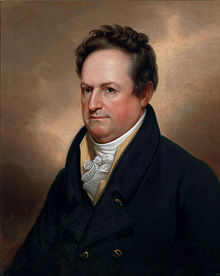
In People v. Philips, William Sampson — a banished political exile from Ireland and a Protestant — argued on behalf of the Trustees of St. Peter’s Roman Catholic Church on Barclay Street before the presiding judge, Mayor DeWitt Clinton [left]. William Sampson’s experience of religious-based intolerance in Ireland propelled him to persuade the court that America should not look to British common law for legal precedent when dealing with Catholics, then a small but growing minority in New York City.

William Sampson’s own published account of the case, The Catholic Question in America, will be presented in a staged reading adapted by Steve DiUbaldo of New York University’s Tisch School of the Arts on Friday evening, 12 April. A full-day symposium follows on Saturday, 13 April, where scholars from a wide variety of disciplines — especially law, religion, history, and politics — will comment on Sampson’s 1813 record of the trial and consider it in relation to their own understanding of contemporary issues. On Sunday morning 14 April, Green-Wood Cemetery in Brooklyn, the final resting place of lawyer William Sampson and DeWitt Clinton, will mark the 200th anniversary of the case with an encore reading of The Catholic Question and a wreath-laying ceremony.

Details are here.

The Becket Fund’s Cert Petition in the Wisconsin High School Graduation Case

Last summer, the Seventh Circuit ruled, en banc, that a Wisconsin public high school could not hold its graduation ceremonies in a rented Evangelical church sanctuary. To do so, the court ruled, posed too great a risk of government coercion, proselytism, and endorsement of religion. Three judges–Easterbrook, Posner, and Ripple–filed blistering dissents, the sort that often result in Supreme Court review.

The Becket Fund has filed a cert petition on behalf of the high school; Stanford Law Professor Michael McConnell appears on the petition as counsel of record. You can read the petition here. The Supreme Court is expected to announce whether it will hear the case, Doe v. Elmbrook School District, later this month. The case would give the Court an opportunity to clarify (or discard) its much maligned endorsement test. For my reflections on the issues the case raises, please click here.

Around the Web This Week

Some interesting law & religion stories from around the web this week: