From Crux’s John Allen, here is an interesting and provocative article on today’s scheduled meeting between Russian president Vladimir Putin and Pope Francis. Surprisingly, Allen writes, on some issues, the two men have “forged an improbably strong partnership.”
One of those issues is the persecution of Mideast Christians. While Western nations have temporized, refusing even to acknowledge the sectarian dimension of the crisis–ISIS’s actions have nothing to do with religion, apparently–Putin has made himself the champion of the region’s Christians:
“As regards the Middle East and its Christians, their situation is dire,” Putin said in April. “The international community is not doing enough … this is the motherland of Christians. Christians have lived there from time immemorial, for thousands of years.”
In some corners of the Middle East, such as the Syrian region of Qualamun, Russia actually has floated the idea of granting citizenship to pockets of Orthodox Christians, effectively offering them a security blanket.
Now, talk is cheap. And Putin’s motivations are not wholly humanitarian. By offering itself as the protector of Mideast Christians, most of whom are Orthodox, Russia can exert influence in the region. (France has traditionally put itself forward in the same role, although France tends to focus on Catholics). Speaking out for Christian minorities also increases Putin’s credibility as the representative of traditional Christianity, which no doubt wins him admirers in the developing world, where Christianity is expanding, often in conflict with a rising Islam. And, of course, championing the cause of Orthodox Christians increases his political appeal in Russia itself.
Still, whatever his motives, Putin has focused on the suffering of Christians as Christians, and that is something many leaders in the West are apparently reluctant to do. It is also a stance, Allen writes, that appeals to Pope Francis:
Since Francis’ election in March 2013, meanwhile, no social or political issue has engaged the pontiff like the plight of persecuted Christians, especially in the Middle East.
In March, he demanded that the world stop trying to “hide” the reality of anti-Christian violence, and he’s also argued that the shared suffering of Orthodox, Catholics, and Protestants alike is the basis for a contemporary “ecumenism of blood.”
Allen notes that the conflict in Ukraine will pose obstacles for any real partnership between Russia and the Vatican. Ukrainian Catholics believe that Pope Francis has taken too soft a line in that particular crisis. Francis has described the conflict as an unfortunate disagreement between Christians, while Ukrainian Catholics tend to see it as the result of Russian provocation, which they wish Francis would denounce. In particular, Ukrainian Catholics resent what they see as bullying and duplicity on the part of the Russian Orthodox Church, particularly the Moscow Patriarchate.
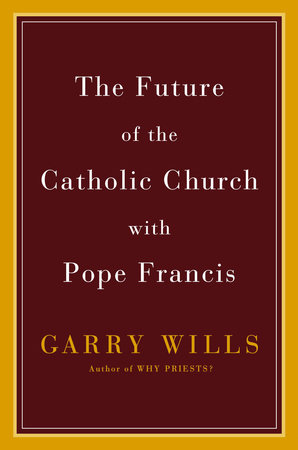
Pope Francis, the first Jesuit pope and the first from the Americas, offers a challenge to his church. Can he bring about significant change? Should he?
Garry Wills, the Pulitzer Prize-winning historian, argues provocatively that, in fact, the history of the church throughout is a history of change. In this brilliant and incisive study, Wills describes the deep and serious changes that have taken place in the church or are in the process of occurring. These include the change from Latin, the growth and withering of the ecclesiastical monarchy, the abandonment of biblical literalism, the assertion and nonassertion of infallibility, and the erosion of church patriarchy. In such developments we see the living church adapting itself to the new historical circumstances.
As Wills contends, it is only by examining the history of the church that we can understand Pope Francis’s and the church’s challenges.
On Wednesday, April 29, 2015, from 6:30–8:30 p.m., Fordham Law School’s Institute on Religion, Law, and Lawyer’s Work will host a panel discussion on “Pope Francis and the Vocation of the Lawyer.” CLR Advisory Board member Judge Richard Sullivan will be among the panelists:
Pope Francis has spoken about the obligation of those whose work involves the law, administration of justice, and the setting of public policy.
He recently mentioned, at a meeting with Filipino authorities, “…the challenge of building on solid foundations a modern society—a society respectful of authentic human values, protective of our God-given human dignity and rights, and ready to confront new and complex political and ethical questions.”
And on a letter to the participants of the 19th International Conference of the International Association of Penal Law, he wrote: “… the Church recommends a justice that is humanizing, genuinely reconciling,… that leads the offenders, though an educational way and through inspiring penance, to complete their rehabilitation and reintegration into the community.”
This panel will explore how Pope Francis and the Catholic Social Teachings of the Church impact the practice of law and the lives of lawyers.
Pope Francis Greets Armenian Apostolic Patriarch Karekin II on Sunday (NYT)
Last Sunday in Rome, Pope Francis celebrated a Mass in St. Peter’s Basilica to commemorate the 100th anniversary of the Armenian Genocide, an ethnic cleansing campaign that took place at the end of the Ottoman Empire. In the course of a two-hour liturgy in the Armenian rite, and in the presence of the Armenian Catholic patriarch, patriarchs of the Armenian Apostolic Church, the president of the Republic of Armenia, and many Armenian pilgrims from around the world, Pope Francis made what should have been an entirely uncontroversial statement. The Armenian Genocide, he said, quoting his predecessor Pope St. John Paul II, “‘is generally referred to as the first genocide of the twentieth century.’”
The essential facts are well known. Armenian Christians made up a significant percentage of the population in the Ottoman Empire’s eastern provinces. For a few decades, there had been unrest. In religious and political reforms known as the Tanzimat, the Ottomans had formally granted equal status to Christians and Muslims. Equality for Christians caused a backlash among Turkish Muslims, though, and oppression of Armenians and other Christians continued, particularly in the countryside. Armenian paramilitary groups began to resist. When World War I began, the Young Turk government worried that these groups would side with Christian Russians. So it decided to solve the “Armenian Question” once and for all by deporting the entire Armenian population from Anatolia to Syria, through the Syrian desert. Deportation through a desert, without adequate protection or supplies, is obviously a recipe for mass extermination. And that is what happened. Historians estimate that 1.5 million Armenian Christians perished, under horrible conditions, in the death marches and slaughters. The enormities are well documented.
Nonetheless, the Turkish side refuses to acknowledge what happened as genocide, denying that there was any plan to eliminate Armenians from Anatolia, while also arguing, inconsistently, that the Armenians were a potentially disloyal population and that the Ottomans had a right to do what they did. Besides, they say, many Turkish Muslims also suffered and died in World War I—surely true, but a non-sequitur. Because of Turkey’s sensitivities on the subject, and because of geopolitical realities, many Western governments, including our own, dance around the issue. When running for office, President Obama promised that he would officially recognize the Genocide, a promise he immediately broke as president. So Pope Francis’s forthright statement—even if he was, in fact, only quoting a predecessor, who was in turn referring to a general consensus—was remarkable, and praiseworthy. (The words on paper don’t capture the tone of the pope’s remarks. Watch this video of the event from Rome Reports. Francis is not simply reading from a text. He obviously means every word of it).
In response, Turkey has condemned the pope’s remarks as religious hatemongering and recalled its ambassador from the Vatican. The repercussions will no doubt continue. Yesterday, Turkey’s minister for European affairs suggested the pope had been brainwashed by the Armenian community in Argentina. Today, Turkish President Recip Erdogan reacted in rather personal terms. According to the English-language Turkish Daily News, Erdogan–who actually has gone farther than many Turkish leaders in acknowledging the suffering of the Armenians in 1915–said the pope’s remarks were characteristic of a “politician” rather than a religious leader. “I want to warn the pope to not repeat this mistake and condemn him,” Erdogan said.
In his remarks, Francis correctly linked the Armenian Genocide to the persecution of Mideast Christians generally—100 years ago, and today. Religion was not the only factor in the Genocide, of course, but it had a major role. Armenians who converted to Islam were often spared; some of their descendants still live in Turkey today. Many Armenians died as Christian martyrs; indeed, the Armenian Apostolic Church will canonize these victims of the Genocide at a ceremony in Armenia this month. Moreover, as the pope told the crowd at St. Peter’s, the Genocide struck not only the “Armenian people, the first Christian nation”—here the pope is referring to the fact that Armenia was the first state to adopt Christianity as its religion, in 301 A.D.—but also “Catholic and Orthodox Syrians, Assyrians, Chaldeans and Greeks.” In all these communions, “bishops and priests, religious, women and men, the elderly and even defenseless children and the infirm were murdered.”
In addition, as everyone knows, the persecution of Christians in the Middle East continues today. The pope referred to these new martyrs as well: “Sadly, today too we hear the muffled and forgotten cry of so many of our defenseless brothers and sisters who, on account of their faith in Christ or their ethnic origin, are publicly and ruthlessly put to death – decapitated, crucified, burned alive – or forced to leave their homeland.” Many Christian communities in Syria and Lebanon took in the refugees of 1915, saving their lives, giving them a place to raise their children and preserve their faith. Now those communities themselves are the victims of ethnic and religious cleansing. To whom shall they go?
In an insightful column, Walter Russell Mead argues that Pope Francis’s remarks show that he has decided to raise the rhetorical stakes in the crisis facing Christians in the Mideast. Up till now, the Vatican has taken a “‘softly, softly’” approach to the conflict, so as not to endanger the lives of vulnerable Christians still there. Outside intervention often makes things worse for Mideast Christians, after all. But how much worse can things get? Mideast Christians face extinction.
Today’s Turks are not responsible for what their ancestors did 100 years ago. God willing, Turks and Armenians will one day be able to reconcile in a way that honors justice. Acknowledging the truth about what happened to the Armenians is a start. Meanwhile, drawing attention to the Armenian Genocide may be a way to mobilize the world to save suffering Christians now—before it is too late.
On a plane home from the Philippines yesterday, Pope Francis clarified remarks he made last week, on a plane to the Philippines, about the Charlie Hebdo massacre. (These papal plane trips are really good copy. The Vatican press corps must fight over passes). In last week’s remarks, while condemning the Paris murders, the Pope also cautioned against disparaging people’s religion in a way that leads, quite naturally, to a violent response. In a widely quoted remark, the Pope said that even a friend could expect a punch in the nose if he “says a swear word against my mother.” That, the Pope said, is “normal.”
I was struck by the different reactions people I know had to the Pope’s remarks. Some Eastern Christians, who have more reason than most to resent Islamist brutality, told me the Pope was correct. The Paris massacre was horrible, but the magazine should have shown more respect for religious belief, Muslim and Christian. Most of my American friends, by contrast, thought the Pope was wrong. And many in the Western media, on both the left and right, quickly denounced his remarks. Was Pope Francis advocating censorship? Was he signaling a tacit alliance with Muslims to fight the Enlightenment and insulate religion from criticism?
Yesterday, the Pope explained his meaning. According to CBS News:
Pope Francis said he wasn’t justifying violence when he said a friend who had cursed his mother could “expect a punch” in return. Rather, he says he was only expressing a very human response to a provocation, and that greater prudence would have avoided such offense.… Francis said: “In theory we can say a violent reaction to an offense or provocation isn’t a good thing … In theory we can say that we have the freedom to express ourselves. But we are human. And there is prudence, which is a virtue of human coexistence.”
In other words, the Pope was not excusing the Paris murders or saying that religions can’t be criticized. He was making the rather sensible observation that people react badly when you insult their religion and that wisdom, not to mention civility, counsels a certain restraint. You have the legal right to say whatever you want, but why say whatever you want?
The example the Pope gave is suggestive. Most people have a special respect for their mothers. Other people’s mothers are not beyond criticism, of course, but there are limits to what you can say about them. This explains why the worst schoolyard curse–it used to be, anyway; based on what I hear on the sidewalks of New York, it isn’t any longer–involves someone else’s mother.
In most of the world, people view religion the same way, as a matter deserving special respect. It’s the so-called WEIRD societies–Western, Educated, Industrial, Rich and Democratic–that fail to do so. In WEIRD societies, individual rights, including the right to express oneself, have priority. (At least when it comes to insulting religion; other subjects, significantly, are off-limits). Autonomy, not divinity, is the key value; insults to religion have less moral valence than restrictions on liberty. These are generalizations, but social science research supports them and they seem intuitively correct. In fact, according to psychologist Jonathan Haidt, whose book on the subject, The Righteous Mind, is well worth the read, America is the WEIRDest society in the world, and America’s educated upper-middle class, the sort of people who make up our editorial pages, is the WEIRDest group in America. It’s no surprise, therefore, that the Western media would find the Pope’s remarks incomprehensible.
The murders at Charlie Hebdo were not justified, and we oughtn’t surrender our values to placate Islamists. But it’s worth remembering that much of the world, not only Islamists, sees things rather differently from us.
Not long after his election, the new Pope explained why he had taken the name “Francis”: “Ah, how I would like a church,” he said, “that is poor and is for the poor.” It was refreshing: the Pope was going to change the basic terms of the conversation between the Church and the world. Instead of waging a grinding “culture war” against a secular West, the Church would instead speak to the most urgent concerns of the global East and South. The first Pope to come from beyond Europe and the Mediterranean basin promised to be the champion of those who lived in the parts of the earth where hunger, injustice and persecution abounded. Places like the Philippines, Mexico, and Nigeria had already become the true center of gravity of a global Church, displacing Quebec, Chicago, Milan and Vienna. The new Pope would speak for the populations of the emerging world – for their suffering, their desperation, their resilience, their energy, their sense of hope. The “North/South” polarity would supplant the “Left/Right” one. The Church would make the pivot to poverty. In making that turn, it would address the West too – but by awakening it from the deadly self-absorption of the affluent.
So when one learns that the Synod of Catholic cardinals and bishops summoned by the same Pope has returned the conversation to the culture wars of the West – though with unmistakable overtones of capitulation on many of the bishops’ part — it is, to say no more, a disappointment. Try as it may, the Church under Francis seems to be unable to resist scratching the sores of Western sexuality. The consuming obsessions of the West, now in the terminal phases of the sexual and cultural revolutions that have swept over it for more than half a century, are dominating the Church’s agenda once again. At the Pope’s insistence, the bishops did a reset, plunging the Church into renewed debate over divorce and homosexuality and cutting short the conversation that the Pope had earlier invited over famine, persecution and want. With Islamist terrorist groups like Boko Haram recently murdering 2500 Catholics in one Nigerian diocese alone, and with Christian children being crucified or cut in half by ISIS, you might think that the world’s bishops would have more pressing things on their mind than the compatibility of same-sex unions with Church teaching. You would, of course, be wrong.
Indeed, even considering “family” issues alone, the non-Western Church was short-changed: how much attention was given to the question of inter-faith marriages, despite its being a major concern for the Church in India? In the Philippines, many marriages break up because poverty forces a spouse or parent to migrate overseas in search of employment, leaving home, spouse and children behind. Philippine Cardinal Luis Tagle noted this problem, saying that poverty “goes right at the heart of the family” in his country ; but how much attention did this issue get?
What is more, the organizers of the Synod openly expressed their indifference to – if not contempt for – the opinions of the leaders of the non-Western Church. They spoke as if the opposition of the African bishops to their “modernizing” program could stem only from irrational hatred and prejudice. What the Africans needed, they seemed to be saying, was a good, stiff dose of Richard Posner’s writings. In the controversy over the initial draft of the Synod’s statement, Cardinal Walter Kasper, an octogenarian German theologian and a favorite of the Pope’s, infamously said:
Africa is totally different from the West. Also Asian and Muslim countries, they’re very different, especially about gays. You can’t speak about this with Africans and people of Muslim countries. It’s not possible. It’s a taboo. For us, we say we ought not to discriminate, we don’t want to discriminate in certain respects.
Kasper later denied having made those revealing remarks – a denial that was then proven to be false. In any case, the remarks hardly seemed out of character for the Cardinal. In an interview with the German magazine Focus published under the heading “Third World Land,” Kasper was reported to have said, “When you land at Heathrow you think at times you have landed in a Third World country.” The German Cardinal obviously notices different things when he is at the airport from what Cardinal Tagle does. The Philippine prelate spoke of his anguish in watching Filipino mothers at airports forced to part from their children because their poverty is so desperate that they must leave their families and search for work abroad.
Not Just Cardinal Kasper
Even if Cardinal Kasper’s statement were merely condescension on the part of the passenger with the first-class cabin towards the passengers in steerage, it would be bad enough. But Kasper and those like him simply did not seem to understand the position. Perhaps the Africans and Asians are not just squinting narrowly at the issue of homosexuality, but rather looking at the state of Western culture as a whole? And perhaps they do not like what they see? Perhaps the cultural exports of the secular West – its current practices regarding marriage, abortion, childbirth, the family, the relations between the sexes – are no more wanted in Africa and Asia than the West’s toxic wastes and sewage effluents? (New York Cardinal Dolan’s wonderful defense of the “prophetic” African Church effectively made these points. )
But the problem with the Synod went far beyond the tactlessness and incomprehension of elderly European churchmen. Apparently at the Pope’s insistence, the Synod’s final report included three controversial articles that had received the approval of a Synod majority, but not the supermajority required for consensus. The final report will now go to the Church throughout the world for discussion and debate before the Synod reconvenes. You can be sure that the media coverage of the debate in this intervening period will focus overwhelmingly on the articles that the Pope reinstated. Cui bono? In their effort to get the conversation back on the familiar tracks of the Western culture wars, the Pope and his bishops are doing serious harm to millions of faithful Catholics trying to live out the Gospel in hostile and often dangerous conditions in the emerging world.
My former student, Andrew Ratelle, makes the point forcefully:
By upholding the nuclear family, the Church made what was perhaps the most important social investment in history. People in the poorer, more pagan regions of the world where polygamy, polyandry, arranged and child marriages were common, now had a place to look for support when it came to building a life that was most beneficial for themselves and their children. By weakening this support, or at the very least dispersing it to include more “diverse” arrangements, these bishops have weakened the very shield from which the nuclear family has received so much protection. Even in our own country, where “diverse” familial arrangements have almost become synonymous with urban poverty and crime (at least for those who have no gilded safety net to fall into), where should families look to now, since the Church has seen fit to dilute the medicine they have thrived on for so long?
Church leaders in the developing world understand this perfectly well. South African Cardinal Wilfrid Napier, for instance, wondered how he could deny communion to an African man living in polygamy in accordance with local culture and tradition, if he had to administer the sacrament to a divorced man married to his second wife? “Successive” polygamy, Napier pointed out, is hardly distinguishable from “simultaneous” polygamy.
Pope Francis was right (at first): it really is time to change the conversation. The global Church is not the parochial Western Church; the Church of the poor and the marginal is not the affluent, greying Church of Western Europe and North America. The Church should not be shadowing the West’s cultural trajectory all the way downwards. The future of the Church lies elsewhere. Ex oriente, lux.
In an airborne press conference on the way back from Korea yesterday, Pope Francis addressed the ongoing humanitarian crisis in Iraq. In response to a question about the American bombing of ISIS targets, the Holy Father made three important points. One, unfortunately, was not helpful.
First, the Pope said, under Just War theory, it is “licit” for third parties to intervene in order to “stop” the “unjust aggression” by ISIS. Pope Francis emphasized that he did not endorse bombing, specifically, but action to stop ISIS generally. Second, the decision how best to deal with ISIS must be made by nations acting together in consultation, at the United Nations. Consultation is necessary, he said, in order to prevent any one nation–implicitly, the United States–from succumbing to the temptation to become an occupying force.
There isn’t very much danger of the US seeking to occupy Iraq at this stage, frankly. If anything, Americans in 2014 are disposed to avoid the region altogether. But the Pope’s statements are consistent with Just War theory and entirely appropriate. And perhaps Pope Francis feels justified in offering an oblique criticism of the US, which ignored his predecessor’s plea to get UN approval for the 2003 Iraq invasion, and reaped the consequences.
The Pope seems to have gone a little astray, though, in his third point. Responding to a question about religious minorities, including Catholics, he said this:
Secondly, you mentioned the minorities. Thanks for that word because they talk to me about the Christians, the poor Christians. It’s true, they suffer. The martyrs, there are many martyrs. But here there are men and women, religious minorities, not all of them Christian, and they are all equal before God.
Pope Francis is right that minorities other than Christians are suffering in Iraq. And Christians would not object to the idea that God loves all people equally, Christians and non-Christians. But the implication of the Pope’s statement– at least in the way his remarks have been translated and transcribed–is that the suffering of Christians gets disproportionate attention, and that it’s necessary to widen the focus to make sure other groups are not forgotten.
With great respect, this misstates the situation. The danger is not that the outside world pays too much attention to Christian suffering, but too little. The media routinely downplays that suffering, notwithstanding the fact that Christians–as Pope Francis himself recently stated–suffer the greatest share of religious persecution in the world today. As for the great powers, they typically look the other way. The United States, for example, did absolutely nothing to help the 100,000 Christian refugees displaced by ISIS in recent weeks, but sent in helicopters to distribute relief to 40,000 Yazidis.
As I say, the transcript may not fairly reflect the sense of Pope Francis’s remarks. Transcripts do not capture inflections. But many in the media will no doubt seize on the remarks to justify their comparative inattention to Christian suffering. That would be most unfortunate. Although non-Christians are surely suffering in Iraq, and although it’s entirely appropriate to remember and help them, there is nothing wrong with stressing the suffering of Christians, especially when one is Pope. Unless people speak out, continually, there is a grave danger that Iraq’s Christians will simply be forgotten.
I took a shot at translating Pope Francis’s remarks on religious freedom, which he addressed to the participants at our conference on international religious freedom. I have tried to be faithful to the text, sacrificing a bit of readability. I have done this in part because some partial translations I’ve seen are not true enough to the original, even if the resulting translation here still leaves some open spaces in meaning (which, at any rate, should not be filled by the translator). Here is the original in Italian. I’ve also got a few comments at the end of the translation.
I welcome you on the occasion of your international conference, dear brothers and sisters. I thank Professor Giuseppe Dalla Torre for his courteous words.
Recently the debate about religious freedom has become very intense, asking questions of both governments and religious denominations. The Catholic Church, in this respect, refers to the Declaration Dignitatis Humanae, one of the most important documents of the Ecumenical Council Vatican II.
In effect, every human being is a “seeker” of truth about his own origins and his own destiny. In his mind and in his heart arise questions and thoughts that cannot be repressed or suffocated, inasmuch as they emerge from the deeps and are by nature connected with the intimate essence of the person. These are religious questions and they demand religious freedom to manifest themselves fully. These questions seek to shed light on the authentic meaning of existence, on the ties that connect it to the cosmos and to history, and they mean to pierce the darkness by which the human condition would be surrounded if such questions were not asked or if they remained answerless. The Psalmist says: “When I see your heavens, work of your fingers/ the moon and the stars that you have fixed, / what then is man that you would remember him, / a son of man that you would care for him?” Psalms 8: 3-4.
Reason recognizes in religious freedom a fundamental right of man that reflects his highest dignity, that of the capacity to seek the truth and to adhere to it, and recognizes in that right an indispensable condition in order to deploy his own potentialities. Religious freedom is not only the freedom of a thought or of a private sect. It is freedom to live according to ethical principles consequent to discovered truth, whether privately or publicly. This is a great challenge in the globalized world, where weak thought—which is like a disease—lowers the general ethical level, and in the name of a false notion of tolerance ends by persecuting those who defend the truth about man and that truth’s ethical consequences.
Legal regimes, national or international, are called to recognize, guarantee, and protect religious freedom, which is a right that inheres intrinsically in the nature of man, in his dignity as a free being, and is also an indicator of a healthy democracy and one of the principal fonts of the legitimacy of the state.
Religious freedom, implemented in constitutions and in laws and translated into coherent behaviors, favors the development of relationships of mutual respect among the different faiths and their healthful collaboration with the state and political society, without confusion of roles and without antagonisms. In place of the global conflict of values, coming from a nucleus of universally shared values, a global collaboration in view of the common good becomes possible.
By the light of the acquisitions of reason, confirmed and perfected by revelation, and of the civil progress of peoples, it is incomprehensible and worrisome that, even today, in the world there remain discriminations and restrictions of rights for the sole reason of belonging to and professing publicly a certain faith. It is unacceptable that true and actual persecutions exist for reasons of religious membership! And wars too! This wounds reason, attacks peace, and humiliates the dignity of man.
It is a motive of great pain for me to observe that Christians in the world suffer the largest number of such discriminations. Persecution against Christians today is even more powerful than in the first centuries of the Church, and there are more Christian martyrs than in that era. This is happening more than 1700 years after the edict of Constantine, which granted freedom to Christians to profess their faith publicly.
I hope profoundly that your conference illustrates with depth and scientific rigor the reasons that today oblige the legal order to respect and defend religious freedom. I thank you for this contribution. I ask you to pray for me. From my heart I wish you the best and I ask God to bless you. Thank you.
Some brief thoughts:
1. A note on the fourth paragraph with Patrick Brennan’s good questions in mind. According to my translation, the Pope did not say that “every person has a right to seek the freedom to live according to ethical principles, both privately and publicly, consequent to the truth one has found.” The full paragraph fragment in Italian is:
La ragione riconosce nella libertà religiosa un diritto fondamentale dell’uomo che riflette la sua più alta dignità, quella di poter cercare la verità e di aderirvi, e riconosce in essa una condizione indispensabile per poter dispiegare tutta la propria potenzialità. La libertà religiosa non è solo quella di un pensiero o di un culto privato. E’ libertà di vivere secondo i principi etici conseguenti alla verità trovata, sia privatamente che pubblicamente.
The phrase in question, as well as the entire paragraph fragment, is more faithfully translated as “discovered truth” rather than “the truth that one has found” ; “discovered truth” refers back to the same truth that is being sought for in the previous section of this paragraph.
2. Note the reference to the “global clash of values” in paragraph six–a specific comment on our conference–and the Pope’s statement that such a clash can be overcome. That struck me as relevant to the discussion that Tom Berg and I have been having here, here, and here.
3. Nevertheless, in spite of his optimism about the prospects for religious freedom, the Pope expresses great distress about the plight of Christians in the world today, as can be seen in the paragraphs toward the close of the speech.
Pope Francis opened our conference in Rome last week with a statement on religious liberty and the persecution of Christians. He reflected on the place of religious liberty in Catholic thought and decried religious discrimination across the world, particularly against Christians.
Pope Francis Greets Conference Participants (News.va)
The Pope’s remarks came at a special audience at the Vatican for participants in the conference, “International Religious Freedom and the Global Clash of Values,” which the Center for Law and Religion co-sponsored with the St. John’s Center for International and Comparative Law and the Department of Law at the Libera Università Maria SS. Assunta. Referring to the Second Vatican Council’s declaration, Dignitatis humanae, the Pope argued that people require religious freedom in order to be fully human:
“Every human is a ‘seeker’ of truth on his origins and destiny,” the Pope said. “In his mind and in his ‘heart,’ questions and thoughts arise that cannot be repressed or stifled, since they emerge from the depths of the person and are a part of the intimate essence of the person. They are religious questions, and religious freedom is necessary for them to manifest themselves fully.”
He called religious freedom “a fundamental right of man.” It is “not simply freedom of thought or private worship,” but “the freedom to live according to ethical principles, both privately and publicly, consequent to the truth one has found.”
“Legal systems, at both national and international level, are therefore required to recognize, guarantee and protect religious freedom, which is a right intrinsically inherent in human nature.”
Religious freedom is also “an indicator of a healthy democracy” and “one of the main sources of the legitimacy of the state,” the Pope continued.
Nowadays, international and domestic law protect religious freedom. Notwithstanding this protection, however, religious discrimination continues. In fact, Pope Francis noted, 1700 years after the Edict of Milan, Christians worldwide suffer disproportionate discrimination and persecution. “The persecution of Christians today is even more virulent than in the first centuries of the Church,” he said, “and there are more Christian martyrs today than in that era.”
We’ll have a fuller discussion of the Pope’s statement when the Vatican releases an official English translation. Meanwhile, here’s a video report on the audience in English.
In the Boston Globe, the always worthwhile John Allen analyzes today’s meeting between President Obama and Pope Francis. Although the two men will agree on issues like economic inequality, Allen says, they will likely differ on others, including, notably, Mideast policy.
Pope Francis often highlights the crisis Mideast Christians face; President Obama, not so much. “Few on the Catholic side are inclined to see the Obama administration as a great defender of those Christians at risk,” Allen writes, “while standing up against violent anti-Christian persecution is emerging as a cornerstone of Francis’ social and political agenda”:
On Egypt, Obama took a “pox on both your houses” stance last summer with regard to the Muslim Brotherhood and the army after a military council declared controversial President Mohamed Morsi deposed. The Vatican was more favorable to the military intervention, inclined to see it less as a coup and more as a reflection of popular will.
In Syria, the Obama administration has made the removal of President Bashar al-Assad a precondition for any negotiated end to that country’s civil war, while the Vatican is more skeptical about regime change, in part out of concern that whatever follows Assad might actually be worse.
Underlying these contrasts is that the Vatican’s reading of the Middle East is heavily conditioned by the perceptions of the Christian minorities in these countries, who generally see either a powerful military or strong-arm rulers as a buffer between themselves and Islamic radicalism. They often point to Iraq, where a once-thriving Christian community has been gutted in the chaos that followed the collapse of Saddam Hussein.

 challenge to his church. Can he bring about significant change? Should he?


