Around the Web

Here are some important law-and-religion news stories from around the web:

  • In Gaddy v. Corporation of the President of the Church of Jesus Christ of Latter-Day Saints, the 10th Circuit heard oral arguments in a class action lawsuit accusing the LDS Church of fraudulently misrepresenting its founding and the use of tithing funds. A Utah federal court had previously dismissed the case, which was brought by former members claiming the Church’s leaders did not sincerely believe in the foundational narrative.
  • In Catholic Benefits Association v. Burrows, a federal district court in North Dakota blocked the Equal Employment Opportunity Commission from enforcing rules that would compel a Catholic organization to accommodate employee’s abortions and infertility treatments in violation of the organization’s religious teachings. The court ruled that such mandates would infringe on religious freedom.
  • In In re Calvary Chapel Iowa, an Iowa Administrative Law Judge ruled that the state’s Religious Freedom Restoration Act shields churches from taxpayer lawsuits challenging their property tax exemptions. The court held that such lawsuits impose a substantial burden on religious exercise, and that tax enforcement is better handled by the state, not individuals, to avoid retaliatory actions against religious organizations.
  • Jewish students filed a lawsuit against Haverford College alleging the college violated Title VI of the Civil Rights Act by failing to enforce its nondiscrimination policy and protect Jewish students from harassment over their pro-Israel views. The complaint also includes a breach of contract claim, accusing the college of fostering a hostile environment where Jewish students feel unsafe expressing support for Israel.
  • Ukraine signed a new law, No. 3894-IX, effective August 24, banning the Russian Orthodox Church (ROC) for justifying and supporting Russia’s invasion, and introducing legal procedures to dissolve Ukrainian religious organizations connected to the ROC. The law specifically targets the Ukrainian Orthodox Church (UOC) by prohibiting affiliations with any Russian religious groups involved in supporting the war.

Around the Web

Here are some important law-and-religion news stories from around the web:

  • A federal district court in Colorado granted a preliminary injunction against the Town of Castle Rock, preventing the Town from enforcing zoning regulations that interfere with a church’s use of an RV and a trailer on church property for the purpose of providing temporary shelter to homeless individuals and small families. The court reasoned that the church was likely to succeed in its RLUIPA claim against Castle Rock, as the church satisfied its burden in pleading that Castle Rock’s zoning restrictions place a “substantial burden” upon the church’s religious obligation to provide for the needy on church property.
  • In Shlomo Hyman v. Rosenbaum Yeshiva of North Jersey, the New Jersey Supreme Court affirmed the dismissal of a defamation claim brought against an Orthodox Jewish school by a Judaic Studies teacher. The court held that the ministerial exception applied because the teacher conceded that his role constituted that of a minister in the yeshiva.
  • In Indiana, a man was sentenced to 24 months in prison and two years of supervised release for willfully transmitting, in interstate commerce, threats to injure other people and for choosing his victims because of their religion. For roughly five months, the defendant left eight voicemails using antisemitic slurs in threats to kill or assault Jews.
  • Representatives of over 39 countries and international organizations published the Global Guidelines for Countering Antisemitism, a set of legally nonbinding policies aimed at monitoring and combatting antisemitism in a way that can be adapted to a wide variety of national, regional, and cultural contexts. The guidelines include, but are not limited to, calls for political leaders to denounce antisemitism wherever it arises, calls for leaders to consider appointing national coordinators, special envoys, or designated officials to proactively address antisemitism, and emphasis on a need to enforce hate crime and anti-discrimination laws.
  • In Jewish Community Council of Montreal v. Canada (Attorney General), a Canadian Federal Court granted an interlocutory injunction against the Canadian Food Inspection Agency, preventing the Agency from enforcing animal slaughter guidelines that require slaughterhouses to go through a series of measures, including applying the three indicators of unconsciousness when slaughtering a food animal. The court reasoned that the applicants were likely to succeed in their claim that the guidelines infringed their right to freedom of religion under subsection 2(a) of the Canadian Charter of Rights and Freedoms.
  • In India, representatives from the United Christian Forum (UCF), a human rights group based in New Delhi, recently met with Kiren Rijiju, Indian Minister for Minority Affairs, in an attempt to discuss recent increases in faith-motivated attacks against Christians, largely attributable to mobs who seek to make India a purely Hindu nation. According to UCF National President Michael Williams, the meeting yielded few promises, prompting UCF to state that the national government is doing little to curb police and mob brutality against Christians.

On the Autonomy of Religious Communities

Marc has written before about the rise of what he calls the “Australian School” in law and religion, a group of scholars, many fairly young, which “offers justifications for religious freedom rooted in theological considerations.” Marc identifies Alex Deagon (Queensland University of Technology) as a member of this school. Earlier this year, Bloombsury published Deagon’s latest work, A Principled Framework for the Autonomy of Religious Communities: Reconciling Freedom and Discrimination, which takes a comparative perspective and argues for “a peaceful coexistence of difference which supports both religious freedom and equality.” Here’s the description from the publisher’s website:

This book engages in a theological critique of the legal frameworks and theoretical approaches of Australia, the US and England to create a peaceful coexistence of difference which supports both religious freedom and equality.

It develops a new framework for reconciling religious freedom and discrimination in Western liberal democracies and presents a unique approach to practically supporting both religious freedom and equality as fundamentally important objectives which promote more compassionate and cohesive communities.

The book applies the idea of peaceful coexistence of difference by assuming the dignity and goodwill of different people and perspectives, and proceeds upon shared virtues such as love which are affirmed by all.

Around the Web

Here are some important law-and-religion news stories from around the web:

  • A petition for certiorari was filed with the Supreme Court in Faith Bible Chapel International v. Tucker. The Tenth Circuit denied an en banc review of a panel decision that held that interlocutory appeals from the denial of a ministerial exception defense are not permitted. In the case, a former high school teacher and administrator/chaplain contends that he was fired for opposing alleged racial discrimination by a Christian school. 
  • In Belya v. Kapral, the Second Circuit denied en banc review of a three-judge panel decision which held that the collateral order doctrine does not allow the appeal of an interlocutory order rejecting a church autonomy defense. The defense was raised in an action in which the plaintiff contended that he was defamed when the defendants publicly accused him of forging a series of letters regarding his appointment as Bishop of Miami in the Russian Orthodox Church Outside Russia. 
  • The Second Circuit heard oral arguments in New Yorkers For Religious Liberty, Inc. v. The City of New York. At issue are First and Fourteenth Amendment challenges to New York City’s public employee COVID vaccine mandate by employees with religious objections to the vaccines. 
  • The Fifth Circuit heard oral arguments in U.S. Navy SEALs 1-26 v. Biden. In the case, a Texas federal district court issued preliminary injunctions barring the U.S. Navy from imposing its COVID-19 vaccine mandate on Navy service members who sought religious exemptions from the requirement. 
  • In Lubavitch of Old Westbury, Inc. v. Incorporated Village of Old Westbury, New York, a New York federal magistrate judge recommended that the district court dismiss on various procedural and jurisdictional grounds a number of claims in a long-running suit by an Orthodox Jewish Chabad organization, which has been unable to obtain permission to use its property for religious education, worship, and related activities. The Second Amended Complaint in the case asserted seventeen causes of action under the First, Fourth, Fifth, and Fourteenth Amendments. It also asserted causes of action under RLUIPA and the state Constitution. 
  • In Collins v. City University of New York, a New York federal district court rejected a student’s claims that his free exercise, equal protection, and procedural due process rights were violated when he was denied a religious exemption from City University’s COVID vaccine mandate. In rejecting the student’s free exercise claim, the court said that the Vaccination Policy is neutral, generally applicable, and easily passes rational basis review. 

Weinberger on Church Autonomy: A Matter of Jurisdiction?

Our friend Lael Weinberger, who has just finished an Olin-Searle-Smith Fellowship at Harvard Law School and begun a clerkship with Justice Neil Gorsuch, has posted a new draft, Is Church Autonomy Jurisdictional?, on SSRN. The draft, prepared for a symposium last spring at Loyola University Chicago Law School, carefully analyzes the use of the word “jurisdictional” in discussions of church autonomy and shows that the term conveys a number of different meanings, only some of which are apposite. Very much worth reading! Here’s the abstract:

The First Amendment’s religion clauses create what courts have called church autonomy doctrine, protecting the internal self-governance of religious institutions. But courts are divided as to whether this doctrine is simply an affirmative defense for religious institutions or a jurisdictional limitation on courts’ ability to adjudicate. Scholars meanwhile have long debated whether church autonomy is jurisdictional at a higher level of abstraction, speaking of jurisdiction as a concept of authority rather than a technical term for civil procedure. This paper engages this multilevel debate with an argument for unbundling. First, it urges unbundling conceptual jurisdiction from judicial jurisdiction. Jurisdiction in the conceptual sense can be a helpful a way of talking about institutional authority relevant to church autonomy. But church autonomy is not properly jurisdictional for purposes of civil procedure. Second, this paper proposes unbundling the array of procedural issues that could be resolved under the label of jurisdiction. This paper argues that it is a mistake to try to use the term jurisdiction to solve the interesting problems. It is better to disaggregate the issues that sometimes come under the label of jurisdiction and instead consider them one at a time. The paper concludes by looking to another quasi-jurisdictional body of law—sovereign immunity—for clues as to how to handle issues such as interlocutory appeals, waiver, and forfeiture in the church autonomy space.

Kirkham (ed.), “State Responses to Minority Religions”

Last month, Ashgate published State Responses to Minority Religions edited by David M. Kirkham (Brigham Young University).  The publisher’s description follows.   State Responses to Minority Religions

The response of states to demands for free exercise of religion or belief varies greatly across the world. In some places, religions come as close as imaginable to autonomous existences with little interference from government. In other cases religion finds itself grinding out a meagre living, if at all, under the jealously watchful eye of the state.

This book provides a legal and normative overview of the variety of responses to minority religions available to states. Exploring case studies ranging from Islamic regions such as Indonesia, Pakistan, and the wider Middle East, to Western Europe, Eastern Europe, China, Russia, Canada, and the Baltics, contributors include international scholars and experts in law, sociology, religious studies, and political science. This book offers invaluable perspectives on how minority religions are currently being received, reviewed, challenged, or ignored in different parts of the world.

Can a Church Refuse to Sell Property Because of a Buyer’s Religion?

Here’s a bleg for you law and religion fans. Rod Dreher had an interesting post last week about the continuing division in the Episcopal Church over doctrinal issues. Several parishes, and even a few dioceses, if I’m not mistaken, have sought to leave the Episcopal Church because of the church’s liberal stand on issues like homosexuality. These parishes typically affiliate with Anglican bishops who remain committed to traditional doctrine.

Often, the departing congregations wish to maintain control of church property. Because of the way the relevant deeds and other legal documents are written, though, and because of the church autonomy principle, the congregations typically lose. Rod reports that the Episcopal Church has spent about $26 million litigating all the cases–an astounding figure, when you think about it.

All this is straightforward, legally speaking. But Rod’s post raises an issue I hadn’t thought about. When a departing parish in Binghamton, New York, sought to purchase its church building for $150,000, the Episcopal Church refused to sell. Apparently, the Church’s presiding bishop, Katharine Jefferts Schori, has adopted a policy of refusing to sell church property to any group that intends to affiliate with an Anglican bishop. The Episcopal Church has sold off property to Baptists, Methodists, Jews, and Muslims, but not Anglicans. In the Binghamton case, the Church eventually sold the property to a mosque which paid only $50,000 for it–one-third what the departing congregation had offered to pay.

So, here’s the question. Is it legal for a church to refuse to sell church property solely because of the buyer’s religion? You’d think there would be an easy answer, but I haven’t been able to find one. The federal civil rights laws prohibit religious discrimination in residential sales, but that wouldn’t apply to church buildings. Some state civil rights laws apply to commercial property, but there are exemptions for religious groups–and anyway, these cases don’t involve commercial property, either. In the federal employment anti-discrimination laws, a specific exception exists for religious bodies that discriminate on the basis of religion, and a couple of years ago, in the Hosanna-Tabor case, the Supreme Court held that the Constitution allows religious bodies to discriminate with respect to the employment of ministers. Would there be an analogous carve-out from non-discrimination principles for churches that do not wish to sell their sanctuaries to religious rivals? Any ideas?
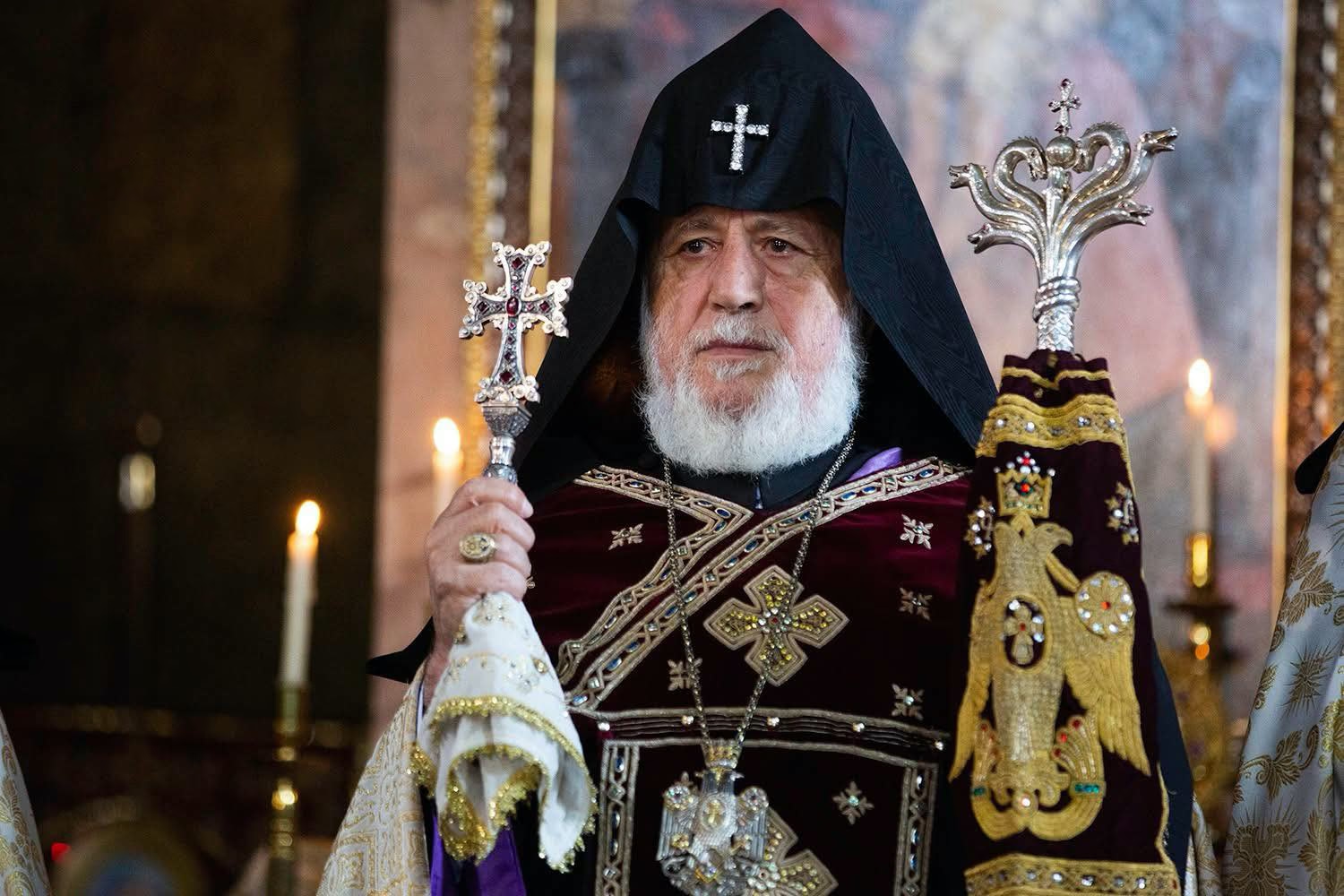
Religious Division and Identity – Richard III and the Rest of Us – Part IV

I’ve been writing about theological and historical perspectives on religious identity, continuity, and division.  See here and here and here.  But what about the law? The problem of competing claims to what I’ve called the “religious DNA” of a faith tradition typically comes up during battles over church property arising out of divisions and schisms of one sort or another, within congregations or between congregations and larger church bodies.  (I’m not going to talk here about the “personnel” issues that have given risen to the “ministerial exception” doctrine

These sorts of conflicts arise frequently in a country such as ours where religious life and ecclesiastical identities have often been in flux, and have always raised fascinating and difficult questions.  An important recent example has been the effort to adjudicate the property of several Episcopal parish churches in Virginia whose congregations voted to break away from the Diocese of Virginia, and affiliate with the new “Anglican Church in North America” in reaction to the national Episcopal Church’s policies regarding homosexuality.  Nobody, of course, disputes the right of a group of persons to worship as they please and affiliate with whatever religious group they please.  The real question, put bluntly, is who gets to keep the church building, the bank accounts, the chalices and crosses and books and all the other material stuff of religious life.  This past April, the Virginia Supreme Court ruled largely in favor of the Diocese and the national Episcopal Church and against the breakaway congregations.

The issues raised by these and similar cases are much too involved and messy for one blog post.  But here are a few thoughts, connecting the legal questions to the other perspectives I’ve written about in this little series of posts.

Read more

Robinson on Religious Institutions

Zoe Robinson (DePaul) has posted a new piece, What is a Religious Institution?, on SSRN. The abstract follows:

Change in the First Amendment landscape tends towards the incremental, but the Supreme Court’s opinion two terms ago in Hosanna-Tabor v. EEOC — holding that religious institutions enjoy a range of First Amendment protections that do not extend to other individuals or organizations — is better understood as a jurisprudential earthquake. The suddenness and scale of the shift helps to explain the turmoil that has ensued in the lower courts and law journals. And yet, it could be that the biggest aftershock has yet to be felt. The Court left open the most important functional question that exists in scenarios where there will be constitutional winners and losers: what, or who, is a ‘religious institution’ for First Amendment purposes?

The lower federal courts have begun to grapple with the question, but no satisfactory approach exists. Drawing on the historical sources and values animating Hosanna-Tabor and its Religion Clause predecessors, this Article provides a workable framework for distinguishing between those institutions that fall within the scope of the religious institutions category and those that do not. The framework proposed here proceeds from a purposive analysis that turns on which institutions will most often and most effectively use the newly identified and exclusive protections to benefit society as a whole. To this end, the framework favors institutions that have as their purpose (1) protection of individual conscience; (2) protection of group rights; and (3) provision of desirable societal structures.

Nichols (ed.), “Marriage and Divorce in a Multicultural Context: Multi-Tiered Marriage and the Boundaries of Civil Law and Religion”

Today, Cambridge University Press publishes Marriage and Divorce in a51hSPzHqugL__BO2,204,203,200_PIsitb-sticker-arrow-click,TopRight,35,-76_AA300_SH20_OU01_ Multicultural Context: Multi-Tiered Marriage and the Boundaries of Civil Law and Religion, edited by Joel A. Nichols (University of St. Thomas, Minnesota). The publisher’s description follows.

American family law makes two key assumptions: first, that the civil state possesses sole authority over marriage and divorce; and second, that the civil law may contain only one regulatory regime for such matters. These assumptions run counter to the multicultural and religiously plural nature of our society. They are also wrong. This book elaborates how those assumptions are descriptively incorrect, and it begins an important conversation about whether more pluralism in family law is normatively desirable. For example, may couples rely upon religious tribunals (Jewish, Muslim, or otherwise) to decide family law disputes? May couples opt into stricter divorce rules, either through premarital contracts or “covenant marriages?” How should the state respond when couples purport to do these things? Intentionally interdisciplinary and international in scope, this volume contains contributions from fourteen leading scholars. The authors address the provocative question of whether the state must consider sharing its jurisdictional authority with other groups in family law.