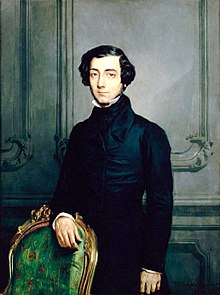
Tocqueville on Pantheism: Part I

We have seen that Tocqueville believes that the dominant American faith, Ralph Waldo EmersonProtestantism, will tend to decompose. The process of dissolution will occur in two phases. In the first, Protestantism (or more accurately, Calvinism) will tend to become a form of natural religion, such as he believed he had encountered in Unitarianism. This movement will take place chiefly among American élites; working class American Protestants, he believes, will be increasingly drawn to Catholicism. In the second phase, Unitarianism or natural religion will itself tend to become what he calls “pantheism.” These movements are traced out, albeit in very summary and schematic form, in Vol. II, Pt. I, chh. 6-7 of Democracy in America, dealing, respectively, with Catholicism and pantheism. In a powerful and illuminating study, Peter Lawlor has described these as two of the “least studied and strangest chapters” of Democracy in America. See Peter Augustine Lawlor, Tocqueville on Pantheism, Materialism, and Catholicism, 30 Perspectives on Political Science 218 (2001).

Tocqueville’s notions may seem very wayward and idiosyncratic to us. After Walt Whitmanall, contemporary America is neither predominantly Catholic nor predominantly pantheistic. Nonetheless, when examined more closely, Tocqueville’s analysis is full of interest and even, remarkably, of current applicability.

The “decline” of Protestantism

Since the 1960s, there has been vigorous and ongoing debate over whether American Protestantism – or at any rate “mainstream” Protestantism – is dead or dying. See, e.g., Stanley Hauerwas, The end of American Protestantism (July 2, 2013), available at http://www.abc.net.au/religion/articles/2013/07/02/3794561.htm. Equally, the question whether American Catholicism has become, or is becoming, a form of Protestantism also provokes current controversy. (Tocqueville himself had noted the tendency of American Catholicism to be less dogmatic and less ritualized than French Catholicism.) Neither of these interesting issues can detain us here. What is more relevant to our purpose is why Tocqueville should have thought that Protestantism would decline, and whether the evidence from the period in which he wrote might have supported the prediction that it would turn into something radically different from traditional Christianity.

Bossuet

Tocqueville could certainly have derived his thesis from reading the work of the great eighteenth century French Catholic theologian, historian and apologist, Jacques-Bénigne Bossuet, the Bishop of Meaux and the tutor of Louis XIV’s eldest child, the Dauphin of France. Probably the greatest work by the prolific Bossuet was his History of the Variations of the Protestant Churches (1688; English trans. 1836). Bossuet’s History is a massively learned account of what the author sees as the steady fragmentation of the main branches of Protestantism into different and discordant sects. We know that Tocqueville had studied this work. In his letter of November 15, 1835 to Gustave Beaumont, he says that after finishing reading Machiavelli’s History of Florence, I turned to Bossuet’s Variations. Finding the “distance” between Machiavelli and Bossuet “great,” he writes that “I had never looked at [the Variations] so closely, and I cannot tell you how much I admired its content, and even more perhaps, its form. It is truly a magnificent and powerful arrangement.” Selected Letters 112. In thinking that Protestantism was bound to disintegrate, Tocqueville was very possibly adopting, if quietly, the polemical case that Bossuet had made for that proposition.

Tocqueville seems to have drawn on Bossuet in the places in Democracy in America in which he connects the growth of democracy with Divine Providence. For instance, in Vol. I, Pt. ii, ch. 17 of Democracy, entitled “A Few Sources of Poetry in Democratic Nations,” he writes that in egalitarian ages, as “each man . . . begins to perceive humanity itself, God reveals himself more and more to the human mind in his full and complete majesty . . . Observing the human race as a single entity, men find it easy to imagine that the same plan rules its destiny and they are inclined to perceive, in the actions of any individual, the trace of that universal and consistent design by which God guides our race.” Bevan trans. 563-64. Likewise, in his Introduction to Part I, Tocqueville speaks of the “gradual unfurling of equality in social conditions” as “a providential fact which reflects its principal characteristics: it is universal, it is lasting and it constantly eludes human interference; its development is served equally by every event and every human being.” Id. at 15. In such passages, Tocqueville is echoing another of Bossuet’s works, the Discourse on Universal History (1681), which he had also read. (For a fuller treatment of providentialism in Democracy, which downplays the influence of Bossuet, see David A. Selby, Tocqueville’s politics of providence: Pascal, Jansenism and the author’s introduction to Democracy in America, 33 The Tocqueville Review 167 (2012)).

Rousseau

It is also possible that Tocqueville formulated his thesis about Protestantism on the basis of reading Rousseau. After the publication of The Vicar of Savoy (on which see posting Tocqueville on Protestantism and Natural Religion: Part II), Rousseau was compelled to defend his views against the Protestant authorities of his native city of Geneva, who accused him of undermining the Reformed religion. Rousseau defended himself in a series of lengthy pieces called Letters Written from the Mountain (1764). In the second of these Letters, Rousseau identifies what he considers to be the “two fundamental points of the Reform,” and contends that his writings fully comply with both. Collected Writings of Rousseau, vol. 9 at 154. These two core principles are “to acknowledge the Bible as the rule of one’s belief, and not to admit any other interpreter of the Bible than oneself.” Id. To this he adds: “Combined, these two points form the principle on which the Reformed Christians separated from the Roman Church, and they could not do any less without falling into contradiction; for what interpretive authority could they have reserved to themselves, after having rejected that of the body of the Church?” Id.

To make the Bible the sole rule for deciding questions of faith and practice appears to be adopting a common standard of truth that transcends any individual opinion; but to take the principle of private judgment to mean that each believer is the final judge for himself or herself of the Bible’s meaning is to abandon the idea of a common authority.

Read more

Tocqueville on Unitarianism

In the last two postings in this series, we considered Tocqueville’s thinking onWilliam Ellery Channing natural religion, especially in light of the views on that subject of two of his masters, Montesquieu and Rousseau. Like those two earlier thinkers, Tocqueville is interested in natural religion, not only for theological reasons, but also, and perhaps more importantly, for political ones. All three thinkers shared the view that religion is necessary or useful to government. And since Christianity was (and is) historically the dominant religion in the West, all three recognized that if any religion were to serve that purpose in Western societies, it would necessarily be Christianity. But Rousseau, at least, thought that Christianity, especially in the form of Roman Catholicism, was also potentially highly disruptive to society.Alexis de Tocqueville Rousseau, therefore, seems to have advocated “natural religion” – which he regarded as a purified form of Christianity – as an alternative to the traditional forms of that religion. Natural religion, as Rousseau conceived it, would offer the State the essential benefits of traditional Christianity: it would, e.g., function to integrate and bind the citizens together in a cohesive social union, and it would fashion their characters and inculcate virtuous habits in civically desirable ways. At the same time, Rousseau thought that natural religion would not have the destructive tendencies of traditional, revealed Christianity, among them that of teaching us to love our fellow humans as much as our fellow citizens. Rousseau may have thought that his natural religion was a particularly apt form of belief for democratic states, because its starting points were simple, common ideas that were accessible to people of ordinary intelligence and because its dogmatic teachings were few, undemanding, and generally accepted.

Tocqueville was far more uncertain that mere natural religion will suffice to serve the needs of a democracy. Thus, his position is different from that of Rousseau. True, as we saw in Tocqueville on Protestantism and Natural Religion: Part I, Tocqueville may be saying, in the chapter of Democracy in America entitled “How Religious Belief Sometimes Diverts the Thoughts of Americans Toward Spiritual Pleasures,” that democratic statesmen will do well enough for democracy if they succeed in maintaining in the general population a bare belief in the soul’s survival of the body’s death. But surely Tocqueville realized that that is an unstable position – a kind of half-way house between traditional, dogmatic Christianity and outright unbelief. Belief in the immortality of the soul at least has the sanction of long tradition and seems to answer to a deep human need; belief that the soul dies with the body is encouraged by the testimony of the senses and has the warrant of materialist philosophers going back to Lucretius. But what credible reason is there to think that the soul has a shadowy existence for a period after the body’s death, only to flicker out indefinitely later? And even if one could find a reason to credit such a belief, how effective would it be in motivating the kind of attitudes and conduct necessary for a vital democracy?

Thus, I am reluctant to think that Tocqueville’s considered view is that natural religion alone provides truly satisfactory and durable support for democracy. The better interpretation, as I shall try below to show, is that he thinks that democracy requires – or, at least, is better served by – a more traditional, revealed religion.

But if that interpretation is right, then Tocqueville would have had cause to question the long-term health and stability of American democracy. For, as we saw at the conclusion of the last post, he believes that Protestantism in America will tend to collapse into mere natural religion. See his Letter to de Chabrol (October 26, 1831). If natural religion is at best a weak and undependable safeguard for democracy, then the future of democracy, in a Protestant society like America, must be clouded.

The June 29, 1831 Letter to Kergolay

Tocqueville gives expression to these thoughts in a long and fascinating letter of June 29, 1831 to his intimate friend Louis de Kergolay. See Selected Letters 45 et seq. Plainly Tocqueville is extemporizing in this letter: it was written in two stages, and Tocqueville tells Kergolay at the start of the second stage that he writes “without knowing just what I am going to say to you.” Nonetheless the tumultuous flood of ideas in this letter reveals much about Tocqueville’s deeper thinking.

Read more

Tocqueville on Protestantism and Natural Religion: Part II

Rousseau: “The Savoyard Vicar”

In my last post, I introduced the subject of Tocqueville’s views on natural religion. As we shall see, Tocqueville believed that Protestantism had an inherent tendency to collapse into natural religion, and indeed that its transmutation into something very distinct from traditional Christianity might not cease there. Because of Tocqueville’s insistence on the importance of religion to American democracy, the transformation or decline of American Protestantism would be, from his perspective, a momentous development.

One of the main sources of Tocqueville’s understanding of natural religion, I argued last time, was likely to have been Montesquieu. We reviewed Montesquieu’s thought on that subject in his epistolary novel, The Persian Letters. A second likely influence on Tocqueville’s understanding of natural religion is Rousseau’s Profession of Faith of a Savoyard Vicar (1783), which forms a section of Rousseau’s novel, Emile.

Although Tocqueville is silent on the matter, I believe that the Savoyard Vicar exercised a lasting and extensive influence on Tocqueville’s thinking, and I would even conjecture that reading this very work precipitated the shattering crisis of belief that Tocqueville underwent in his father’s library in Metz when he was sixteen.

The Savoyard Vicar is a complex and many-layered work, and I cannot pretend to do anything like full justice to it here. Its complexity stems, in part, from the ambiguity of Rousseau’s intentions in writing it. Although Rousseau’s critics, then and later, found nothing, or almost nothing, of Christian doctrine or sentiment in it, Rousseau himself contended vehemently that the work to provide a more secure foundation for revealed religion, above all Protestantism, that would make it more attractive to his contemporaries. See Robert Derathe, “Jean-Jacques Rousseau et le Christianisme,” in 53 Revue de Métaphysique et de Morale, 375, 381-85, 410-14 (1948). (As noted in my last post, Rousseau’s hostility towards Roman Catholicism was unremitting.) Furthermore, the work can be read both to extend the Enlightenment’s scathing critique of Christianity and at the same time to point towards a post-Enlightenment return to Christianity. See Arthur M. Melzer, “The Origin of the Counter-Enlightenment: Rousseau and the New Religion of Sincerity,” 90 American Political Science Review 344 (1996).

The Savoyard Vicar consists chiefly in a lengthy discourse delivered by a Catholic priest (the Vicar) to a young man identified in the story as Rousseau himself in his twenties. The discourse is divided into two parts of unequal length, marked by a short intervention by the young Rousseau. In the first and longer discourse, the Vicar discusses natural religion; the second and shorter speech concerns revealed religion. Rousseau later explained that the “more important” first part was “intended to combat modern materialism, to establish the existence of God and natural religion” and “contains what is truly essential to Religion,” while the second part “raises doubts and difficulties about revelation in general” and is designed to make believers “more circumspect.” J.-J. Rousseau, Letter to Christophe Beaumont, Archbishop of Paris (1763), in The Collected Writings of Rousseau, vol. 9 at 75 (Christopher Kelly and Eve Grace eds. 2001). In the break between the two parts, the young Rousseau exclaims that during the Vicar’s speech, “I imagined myself attending to the divine Orpheus singing his hymns and teaching mankind the worship of the g Read more

Tocqueville on Protestantism and Natural Religion: Part I

To this point, we have seen that Tocqueville believes that religion is necessary to the well-being of society, and especially to market democracies. Since the religious sentiment is natural to human beings, religion should flourish when it does not lend itself to exploitation by the State. But the natural tendency toward religious belief is weakened or even overcome by a competing passion for wealth. Because American democracy celebrates and encourages the pursuit of wealth, our democracy exerts a ceaseless, grinding pressure that gradually wears down our religion. Thus, American democracy has a built-in disposition to destroy a necessary condition of its own existence. To guard against that, Tocqueville urges American leaders and opinion-makers to surround religion with their protection – without, however, enmeshing it in the State. If they are wise, they will understand that our religion is “the most valuable bequest from aristocratic times.” Democracy in America at 633 (Bevan trans.). “It is vital that all those who are involved in the future of democratic societies unite together and . . . diffuse throughout these societies the taste for the infinite, the appreciation of greatness, and the love of spiritual pleasures.” Id. at 632.

But what, exactly, are the doctrines of the “religion” that Tocqueville considers necessary for the proper functioning of American democracy? Granted, America in the period of his visit was overwhelmingly a Protestant Christian nation, and would surely remain so for the foreseeable future. But Tocqueville does not contend that American democracy depended on the vitality of Protestantism. Instead, in an important chapter entitled “How Religious Belief Sometimes Diverts the Thoughts of Americans Toward Spiritual Pleasures,” he argues that “[t]he belief in a spiritual and immortal principle united for a time with matter is . . . indispensable to man’s greatness.” Id. at 633. That is, he appears at first to argue that a prevalent belief in one religious doctrine — the immortality of the human soul — is the irreducible minimum required for a healthy democracy. He does not, however, mention here any other doctrine that is characteristic of Christianity, Protestant or other, even the existence of God.

Furthermore, when read closely, Tocqueville does not even insist on the belief in immortality, as Christianity has traditionally taught it. Rather, he indicates that the belief which he considers necessary need not extend to “the idea of rewards and punishments” after bodily death, nor even that the “divine principle” that survives death be understood as personal: it would suffice if most citizens believe that that the soul was “absorbed in God or transformed to bring life to some other creature.” Id. Thus, he says that it is better for citizens to believe in transmigration, “believing that their souls will pass into the body of a pig,” than for them to think that “their soul is nothing at all.” Id. Finally, he concludes with an observation that seems intended for his more perceptive readers: “It is doubtful whether Socrates and his school had very definite opinions upon what was to happen in the afterlife.” Id. Instead, “Platonic philosophy” simply teaches the “one belief” that “the soul has nothing in common with the body and would survive it.” Id. The prevalence of that “one belief,” which does not even amount to the idea of personal immortality, is the indispensable prerequisite for a vital democracy.

Tocqueville thus does not teach that Christianity, or any other form of revealed religion, is absolutely indispensable for democracy. Indeed, he does not even say that democracy cannot function well unless belief in natural religion in its entirety is widespread. Rather, at least in this place, he reduces the indispensable minimum to something even less demanding than natural religion as that was generally understood – i.e., to the “one belief” that he associates with Platonic philosophy. All he contends for, in other words, is an extremely thin belief that amounts to little more than the rejection of philosophical materialism, i.e., of the metaphysical position that he associates with the dominance of the drive for physical pleasure and wealth. Nonetheless, some religious, or at least metaphysical, belief must be widely held in order to ensure against political calamity.

In order to understand his thinking fully, we need to start with the idea of “natural religion.” What did Tocqueville think constituted natural religion, and from what sources did he acquire that idea? We will see that a large and important body of French thought underlies the brief and enigmatic remarks cited above from Democracy.

The doctrines of natural religion

In his marvelous account of the origins of Unitarianism in America, Conrad Wright distilled the essence of “natural religion” down to three essentials: “the existence of God, the obligations of piety and benevolence, and a future state of rewards and punishments.” Conrad Wright, The Beginnings of Unitarianism in America 140 (1955). The chief points of natural religion were understood to be discoverable by Read more

Tocqueville on materialism

In my last posting, I discussed Tocqueville’s view that religious belief in “natural” to human beings, but that religion loses its hold when it is instrumentalized to serve a political purpose. On that view, it would seem to follow that religion should be secure in a nation like the United States, where the government seeks to avoid any entanglement with religion. However, Tocqueville also thinks that American democracy has a tendency to corrode religious belief, so that our democratic environment is not as hospitable to religion as it might have seemed. The primary reason why American democracy is predisposed to unbelief, Tocqueville seems to say, is that it gives rise to “materialism.” In this posting, I shall probe that thought.

The religious sentiment is not, for Tocqueville, the only or even the dominant passion within the human heart. “What most sharply stirs the human heart is not the quiet possession of a precious object but the as yet unsatisfied desire of owning it and the constant fear of losing it.” Democracy in America at 616 (Bevan trans.). In an aristocratic society, where the opportunities for gaining wealth are limited, neither the rich, who already enjoy material prosperity, nor the poor, who have no hope of attaining it, are driven by this passion. In that type of society, “the mind of the poor man is cast forward to the next world; his imagination is cramped by the wretchedness of real life, yet it escapes to seek for joys beyond.” Id. at 617. But in more open and egalitarian societies, where the poor have the chance of becoming wealthy and the rich have more cause to fear the loss of their fortunes, both rich and poor will be “constantly engaged in the pursuit or the preservation of these precious, imperfect, and fugitive delights.” Id. Hence both the hedonism and the restlessness of American society; hence also the threat that American affluence poses for American religion. “Religion is often powerless to restrain man in the face of the countless temptations offered by wealth and cannot moderate his eagerness to become rich, which everything around him helps to stimulate.” Id. at 340.

Tocqueville is both impressed and dismayed by the Americans’ unrelenting drive for wealth. “The passions which stir Americans most deeply are commercial not political ones or more accurately they transfer into politics the methods of business. . . . One must go to America to understand the power of material prosperity over political actions and even those opinions which ought to be governed by reason alone.” Id. at 333. The American pursuit of wealth is “feverish;” it leaves them “ceaselessly tormented.” Id. at 623. Yet their enjoyment of their acquisitions is shadowed by a “secret anxiety.” Id. at 624. They cannot rest content. “In the United States, a man will carefully construct a home in which to spend his old age and sell it before the roof is on; he will plant a garden and will rent it out just as he was about to enjoy its fruit; he will clear a field and leave others to reap the harvest.” Id. at 623. Thus we find “unusual melancholy” and “distaste for life” “in the midst of plenty.” Id. at 625-26. “The man who has set his heart exclusively on the search for the good things of this world is always in a hurry for he has only a limited time to find, grasp, and enjoy them.” Id. at 624. The thought of his mortality “floods his mind with agitation, fear and regret; it holds his soul in a sort of ceaseless nervousness.” Id. Yet if Americans could finally “be[] satisfied with their physical possessions alone,” that would bring them ruin rather than repose: “they would gradually lose the skill of producing them and would end up enjoying them without discernment or improvement like the animals.” Id. at 636.

Read more

Tocqueville on the naturalness of religious belief

In considering the relationship between Christianity and modern democracy, Tocqueville was bound to offer some explanation of the fact that democracy in America was hospitable to that faith while democracy in France was hostile to it. Such an explanation could of course also help explain why, in America, the Reformation and the Enlightenment were and have remained allies while, in much of Europe, the Enlightenment and the Counter-Reformation were, until recent times, vehemently opposed. And it could also shed light on the persisting phenomenon that Americans even now are typically more “religious” than Europeans.

One might have thought that the difference between French and American had something to do with the origins of the two democracies: American democracy took hold in an overwhelmingly Protestant environment, while French democracy arose in opposition to the Catholic Church. Indeed, Tocqueville himself observed that the early Puritan settlers of America brought with them “a form of Christianity which I can only describe as democratic and republican,” and that the circumstances of America’s founding were thus “exceptionally favorable to the establishment of a democracy and a republic in governing public affairs.” Democracy in America at 336 (Bevan trans.). To understand America fully, Tocqueville suggests, we must keep its Puritan origins in mind: “[i]t is religion which has given birth to Anglo-American societies: one must never lose sight of that.” Id. at 496.

In fact, however, Tocqueville’s explanation of the (sometimes amicable, sometimes antagonistic) relationship between Christianity and democracy followed another course. The crucial distinction, he argues, is not between Protestant and Catholic forms of Christianity, but between religion in its “natural” state and religion as a “political” institution. When a political régime permits religion to remain in its “natural” condition, and religion for its part does not seek a “political” role, religion will flourish and, moreover, the régime may find itself stronger for that fact. On the other hand, if a régime seeks to instrumentalize religion or if religion seeks political power, religion will inevitably suffer and any benefits to the régime from its alliance with religion will be fleeting.

Although Tocqueville says that “[a]longside every religion lies some political opinion which is linked to it by affinity,” id. at 336, and acknowledges that “Catholicism resembles absolute monarchy,” id. at 337, he nonetheless insists that neither Protestantism nor Catholicism is especially fitted to or congruent with any specific type of political régime. “[I]n the United States there is no single religious doctrine which is hostile to democratic and republican institutions.” Id. at 338. If anything, Tocqueville believes that Catholicism, despite its apparent affinity for monarchy, would be a better form of Christianity from the standpoint of democracy than Protestantism. Catholicism leads men towards equality, while Protestantism leads them towards independence, id. at 337; and the former condition is more favorable to democracy. Thus, although Catholics retain “a firm loyalty” to their form of worship and are “full of fervent zeal” for their beliefs, they are “the most republican and democratic class in the United States” id., at once “the most obedient believers and the most independent citizens,” id. at 338.

Such, in brief, is Tocqueville’s main line of argument. But as we shall discover, many qualifications to it are needed and some significant problems for it arise. Let us begin by considering his analysis of the situation in pre-Revolutionary France.

Two Trends in French Enlightenment Thought

The French Revolution, Tocqueville thought, saw two great passions at work: political and religious. Of these, the anti-religious passion was “the first to be kindled and the last to be extinguished.” Alexis de Tocqueville, The Ançien Régime and the Revolution 21 (original ed. 1856; Bevan trans. 2008). The Revolution’s hatred of religion was largely the handiwork of eighteenth century French Enlightenment philosophy which, he says, “is correctly considered as one of the main causes of the Revolution” and which was “profoundly anti-religious.” Id.

Read more

Tocqueville on Religion and the Limits of the Political Imagination

In my last post, I argued that despite the existence of important areas of agreement, Tocqueville rejected (what he took to be) Machiavellianism because he found that it left the ruler “capable of doing anything.” For Tocqueville, it appeared, there were certain inviolable moral limits to political action. Without such limits, Tocqueville feared, a society’s liberty would be lost. The question thus arises: how did Tocqueville think that such limits were to be defined and enforced?

The most obvious answer would seem to be: through religion. Indeed, by restraining political leaders and democratic peoples from pursuing certain courses of action, Tocqueville argues, religion performs one of its greatest services for human society. This is especially so in a democracy, for whose vitality religious beliefs are “more necessary” than they are in other systems. Democracy in America at 632 (Bevan trans.).

Tocqueville’s thinking on this point seems to have deepened in the five years that separated the publication of Part I of Democracy (1835) and Part II (1840). In a passage in Part I, he suggested that religion and morality usually regulated political action effectively in America, even when a democratic majority supported such action. He wrote (id. at 465; emphasis added):

Republicans in the United States value customs, respect beliefs, recognize rights. They hold the view that a nation must be moral, religious, and moderate in proportion as it is free. What is called a republic in the United States is the quiet rule of the majority, which is the communal source of power once it has had the time to acknowledge and confirm its existence. But the majority is not all-powerful. Above it, in the world of moral issues, lie humanity, justice, and reason; in the world of politics lie rights acquired. The majority acknowledges both these limits. . . .

If the majority should ever fail to observe such moral and political limits, Tocqueville says, “it is because, like any individual, it has its passions and . . . it can act badly even though it knows what is good.” Id. The American people, in other words, may, in episodic fits of “passion,” suffer from weakness of will; but “know[ing] what is good,” it will eventually correct itself.

In Part II of Democracy (published in 1840), Tocqueville offered a more penetrating analysis. Here he argues that the strength and pervasiveness of Christianity in America ensure that the American people and their leaders will observe certain defined moral limits. Christianity operates to set bounds to the moral imagination, so that certain courses of action become literally Read more

Tocqueville and Machiavellianism

Alexis de Tocqueville

In my last post, I discussed Tocqueville’s personal religious opinions. Here I extend that discussion by considering his relationship to Machiavellianism.

Few theorists have emphasized the usefulness of religious belief for government and society as strongly as Tocqueville. Yet, if the interpretation of his private views that I sketched out in my previous post is correct, it would seem unlikely that Tocqueville was an advocate of a purely “civil religion.” To be more precise: Tocqueville did not advocate the “Machiavellian” position that the “magistrate” ought to inculcate religion in the “populace” because of its social utility, even while disbelieving it himself.

There are at least three ways by which Tocqueville reached this conclusion: through logic, through personal observation and through the study of history.

The Illogic of the Utilitarian Case for Religion

First, it would have been especially difficult to have advocated this “Machiavellian” policy for America. In the United States, the sovereign “People,” which Tocqueville described as acting “in the American political world like God over the universe,” see Democracy in America at 71 (Bevan trans.), was itself at once magistrate and populace. Hence, to have any chance of being effective, the policy would have required collective self-deception on a mass scale. (Note, however, that one of Tocqueville’s subtlest and most profound interpreters seems to think that this was indeed Tocqueville’s view. See Pierre Manent, Tocqueville and the Nature of Democracy 92 (John Waggoner trans. 1996)).

Furthermore, if the American public generally accepted religion solely for its utilitarian consequences, then its faith would be unable to produce the desired effects: religion can only serve social utility if the public generally believes it to be true. Just as a placebo will do good only if the patient believes that it is a medicine and not a placebo, so religious belief will promote public welfare only Read more

Tocqueville’s Faith

To begin with, I would like to express my gratitude to Marc DeGirolami and Mark Movsesian for inviting me to write this month for the Center for Law and Religion Forum.

What I propose to do over the course of the month is to post a series of short essays dealing with the great French nineteenth century thinker Alexis de Tocqueville.  Specifically, I shall aim to discuss a set of questions arising from his work that concern the relationships between Church and State in the United States and France.  These are well-studied subjects, to be sure. But I hope to have some new things to say.   Moreover, although my primary interest here will be historical and exegetical, I will also consider the application of Tocqueville’s ideas to contemporary matters.

I need hardly stress that Tocqueville remains a thinker of lasting influence and importance.  He plays a prominent role, e.g., in the Harvard historian Niall Ferguson’s recent book, The Great Degeneration:  How Institutions Decay and Economies Die (2013).  Other significant works on contemporary society and culture bear the impress of Tocqueville’s thought, including Robert Putnam’s Bowling Alone:  The Collapse and Revival of American Community (2001) and Habits of the Heart:  Individualism and Commitment in American Life (original edition 1985) by Robert N. Bellah (whose death Mark Movsesian noted in this forum this week) and Bellah’s associates.   (Indeed, the title of the last of these books encapsulates a phrase of Tocqueville’s.)   But however valuable Tocqueville remains as a student of culture and society, his thinking pivots on religion and its varied relationships to political regimes.  He was, he wrote, “convinced . . . that man’s true grandeur lies only in the harmony of the liberal sentiment and religious sentiment, both working simultaneously to animate and restrain souls,” and he noted that he had worked “for thirty years . . . to bring about this harmony.”  (Letter to Claude-François de Corcelle, September 17, 1853, in Alexis de Tocqueville, Selected Letters on Politics and Society 295 (Roger Boesche (ed.) 1985)).   The power, depth and complexity of Tocqueville’s analyses of the relationships between the “liberal” and the “religious” sentiments repay close and repeated study.

Tocqueville was the intellectual heir to both the Enlightenment and Christianity.  In a sense, his entire work can be understood as a dialogue between these two traditions in his mind.  In a letter of October 10, 1836 to his life-long friend Count Louis de Kergolay, he writes that he is passing part of each day reading “three men, Pascal, Montesquieu and Rousseau.”   The choice of these three writers is revealing:  Tocqueville’s interest in Pascal reflects the Christian (and Jansenist) side of his mind; Rousseau and Montesquieu speak for the Enlightenment side.  No less revealing is the fact that Tocqueville does not name any figures from the radical French Enlightenment, such as Diderot or D’Holbach.  He appears to have had little acquaintance with or interest in their ideas.  Rather, he turns to Montesquieu, the leading figure in the moderate Enlightenment, and Rousseau who, though a revolutionary figure, can be considered to represent the counter-Enlightenment.  (For the distinction between “radical” and moderate” Enlightenments, see Jonathan Israel, A Revolution of the Mind:  Radical Enlightenment and the Origins of Modern Democracy (2011)).

Tocqueville’s Deconversion

Before turning to the particular questions that will concern us in later posts, it will be useful to consider Tocqueville’s personal religious beliefs.  These rarely appear in his published works.  But we can infer them from his manner of living and from his extensive Read more