
Not to Mention Universities and the News Media

Here’s an odd story, from The Independent:

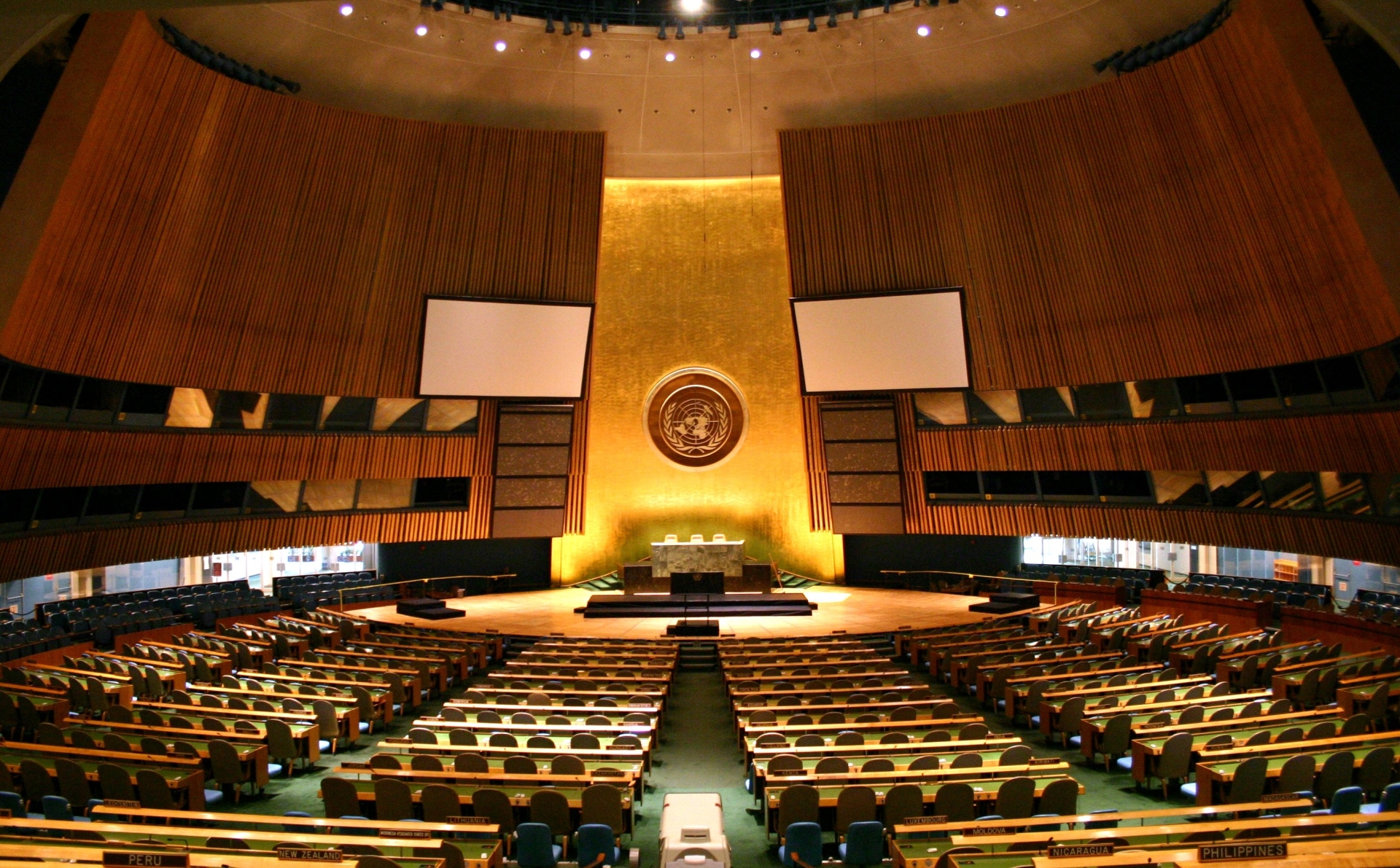
Christianity dominates the United Nations and a more inclusive system must be introduced at the world peace-making organisation, according to a new study.

The report Religious NGOs and The United Nations found that Christian NGOs are overrepresented at the UN in comparison to other religious groups.

Overall, more than 70 per cent of religious NGOs at the UN are Christian, where the Vatican enjoys a special observer status, as a state and religion, according to research undertaken by Professor Jeremy Carrette from the University of Kent’s Department of Religious Studies.

The study questions claims by the Christian right that cults are running the UN given the scale of Christian NGOs, and calls for greater awareness, transparency and equality, while putting a strong emphasis on religious tolerance.

See, we told you the secularization theory was wrong. Just so you know, according to the article, religious NGOs make up only 7.3% of the total number of NGOs at the UN. So it’s hard to see how Christian NGOs, which amount to even a smaller percentage, could really “dominate” the organization. And the UN doesn’t appear to promote particularly Christian worldviews in its programs. Anyway, maybe there’s more to the study than the Independent suggests. You can follow the links in the article to read more.

Sperry, “Religion in America”

Next month, Cambridge University Press will re-publish Religion in America by Willard Sperry. This book was originally published in 1945. The publisher’s description follows.

First published in 1945, this book was originally intended as ‘an implied conversation’ between the American Willard Sperry and his British audience in order to convey ‘some idea of the present state of religion in America’. Sperry examines the separation of Church and State as enshrined in the Constitution and its consequences, as well as providing a general survey of religious groups in America and ‘American theology’. This book will be of value to anyone with an interest in the role of religion in American life.

Bosco, “Securing the Sacred: Religion, National Security, and the Western State”

Next month, the University of Michigan Press will publish Securing the Sacred: Religion, National Security, and the Western State by Robert Bosco (Centre College). The publisher’s description follows.

Since the terrorist attacks of September 11, 2001, Western nations have increasingly recognized religion as a consideration in domestic and foreign policy. In this empirical comparison of the securitization of Islam in Britain, France, and the United States, Robert M. Bosco argues that religion is a category of phenomena defined by the discourses and politics of both religious and state elites.

Despite significant theoretical distinctions between securitization on the domestic and the international levels, he finds that the outcome of addressing religion within the context of security hinges upon partnerships. Whereas states may harness the power of international allies, they cannot often find analogous domestic allies; therefore, states that attempt to securitize religion at home are more vulnerable to counterattack and more likely to abandon their efforts. This book makes a significant contribution to the fields of political theory, international relations, Islamic studies, and security/military studies.

Helping Mideast Christians

Last week, Robert George and Katrina Lantos Swett, the chair and vice-chair, respectively, of the US Commission on International Religious Freedom, published an important op-ed on the persecution of Mideast Christians. This topic receives far too little attention, for reasons I’ve explained, and George and Swett deserve praise for writing about it.

The situation is truly dire. For example, George and Swett discuss the plight of Egypt’s Copts, who celebrate Christmas today, as well as Christians in Iraq:

In Egypt, persecution against Coptic Christians, the region’s largest non-Muslim religious minority, numbering 8 million, has reached critical proportions. While Hosni Mubarak’s military-backed regime failed to punish attacks against Copts and other religious minorities, Mohammed Morsi’s election to the presidency in 2012 was followed by rhetoric leading to more violence before and since his ouster this July. Since mid-August, following a military crackdown on Morsi’s Muslim Brotherhood supporters, Brotherhood sympathizers have assaulted more than 200 Christian religious structures, homes, and businesses.

In Iraq, violence against Christians rose after Saddam Hussein’s fall. Christians have endured increasing levels of rape, torture, and murder, driving many away. On Christmas Day, at least 37 people died in bombings in Christian areas, including a car bombing outside of a church. Meanwhile, Prime Minister Nouri al-Maliki’s government has failed repeatedly to bring perpetrators to justice. Once home to about one million Christians, Iraq has half that number today.

The situation in Iraq, in particular, should embarrass the United States. America toppled Saddam Hussein and occupied Iraq for almost a decade. The result for Christians and some other religious minorities has been disaster. And security continues to deteriorate. Just last week, Fallujah fell to militants linked to Al Qaeda.

But I digress. At the end of their op-ed, George and Swett suggest some things that the US can do to help persecuted Mideast Christians now:

First, the United States must press governments to bring to justice those who assault religious minorities – not only Christians but Shi’a Muslims in Egypt, Iraq, and Saudi Arabia, Sunni Muslims and Baha’is in Iran, and Shi’a and Ahmadis in Pakistan.

Second, Washington must urge these governments to cease punishing the innocent. In countries like Egypt and Pakistan, Christians and others face not only violence from extremists who rarely are imprisoned for their misdeeds, but prison at the hands of these same governments, thanks to blasphemy laws which violate freedom of expression as well as religion.

Third, the United States must firmly support religious freedom as an antidote to religious extremism in these countries. By supporting a robust marketplace of beliefs and ideas, religious freedom enables more tolerant beliefs to compete in the struggle for hearts and minds.

Here I’d like to suggest a couple of friendly amendments. First, it’s not clear whether George and Swett are suggesting public action by the US. Public pressure could do more harm than good, in my view. Given the pathologies of the Mideast, overt advocacy on the part of religious minorities could expose them to a backlash. Christians are already seen, unfairly, as intruders and Western agents. Moreover, popular opinion in America would not support serious interventions on behalf of Mideast Christians. Public statements of support, without the will to back them up with concrete actions, would only raise expectations unfairly. This sort of thing has occurred to Mideast Christians many times in the past.

So pressure by the US should be private. Even private pressure could backfire, of course, especially if regional governments decide to make Christians scapegoats. But private pressure is less likely than public admonishment to cause greater problems for already vulnerable people.

Second, in addition to trying to improve the status of Christians in the region, the US and other Western countries should fast-track asylum applications from Copts and other Mideast Christians, to provide a haven for those who wish to leave the region. This is a very imperfect solution, of course, as it would accelerate the depopulation of ancient Christian communities in the Middle East. But leaving these Christians to their fate isn’t a good option, either.
Stepan & Taylor (eds.), “Boundaries of Toleration”

Next month, Columbia University Press will publish Boundaries of Toleration, edited by Alfred Stepan (Columbia University) and Charles Taylor (McGill University). The publisher’s description follows.

How can people of diverse religious, ethnic, and linguistic allegiances and identities live together without committing violence, inflicting suffering, or oppressing each other? In this volume, contributors explore the limits of toleration and suggest we think beyond them to mutual respect. Salman Rushdie reflects on the once tolerant Sufi-Hindu culture of Kashmir. Ira Katznelson follows with an intellectual history of toleration as a layered institution in the West. Charles Taylor advances a new approach to secularism in our multicultural world, and Akeel Bilgrami responds by offering context and caution to that approach. Nadia Urbinati explores why Cicero’s humanist ideal of Concord was not used in response to religious discord. The volume concludes with a refutation of the claim that toleration was invented in the West. Rajeev Bhargava writes on Asoka’s India, and Karen Barkey explores toleration within the Ottoman and Habsburg Empires. Sudipta Kaviraj examines accommodations and conflicts in India, and Alfred Stepan highlights contributions to toleration and multiple democratic secularisms in such Muslim-majority countries as Indonesia and Senegal.

Iqtidar, “Secularizing Islamists?: Jama’at-e-Islami and Jama’at-ud-Da’wa in Urban Pakistan”

Next month, the University of Chicago Press will publish Secularizing Islamists?: Jama’at-e-Islami and Jama’at-ud-Da’wa in Urban Pakistan by Humeira Iqtidar (Kings College London). The publisher’s description follows.Secularizing Islamists?

Secularizing Islamists? provides an in-depth analysis of two Islamist parties in Pakistan, the highly influential Jama‘at-e-Islami and the more militant Jama‘at-ud-Da‘wa, widely blamed for the November 2008 terrorist attack in Mumbai, India. Basing her findings on thirteen months of ethnographic work with the two parties in Lahore, Humeira Iqtidar proposes that these Islamists are involuntarily facilitating secularization within Muslim societies, even as they vehemently oppose secularism.

 This book offers a fine-grained account of the workings of both parties that challenges received ideas about the relationship between the ideology of secularism and the processes of secularization. Iqtidar particularly illuminates the impact of women on Pakistani Islamism, while arguing that these Islamist groups are inadvertently supporting secularization by forcing a critical engagement with the place of religion in public and private life. She highlights the role that competition among Islamists and the focus on the state as the center of their activity plays in assisting secularization. The result is a significant contribution to our understanding of emerging trends in Muslim politics.

The Top Five New Law & Religion Papers on SSRN

From SSRN’s list of most frequently downloaded law and religion papers posted in the last 60 days, here are the current top five. This week, Michal Gilad remains at #1, Wilson Ray Huhn moves up to #2 and replaces Patrick McKinley Brennan; Richard Scharagger and Micah Schwartzman remain at #3; Frederick Mark Gedicks and Pasquale Annicchino move up to #4; and Asifa Quraishi-Landes and Najeeba Syeed Miller return to the list at #5.

1.In God’s Shadow: Unveiling the Hidden World of Domestic Violence Victims in Religious Communities by Michal Gilad (University of Pennsylvania Law School) [985 downloads]

2.Slaves to Contradictions: 13 Myths that Sustained Slavery by Wilson Ray Huhn (University of Akron- School of Law) [161 downloads]

3.Some Realism about Corporate Rights by Richard Schragger and Micah Schwartzman (University of Virginia School of Law, University of Virginia School of Law) [159 downloads]

4. Cross, Crucifix, Culture: An Approach to the Constitutional Meaning of Religious Symbols by Frederick Mark Gedicks and Pasquale Annicchino (Brigham Young University – J. Reuben Clark Law School, European University Institute – Robert Schuman Centre for Advanced Studies (RSCAS)) [143 downloads]

5.No Altars: A Survey of Islamic Family Law in United States) by Asifa Quraishi-Landes and Najeeba Syeed Miller (University of Wisconsin-Madison-Law School, Unaffiliated Authors-Independent) [135 downloads]

An-Na’im, “What is an American Muslim?”

Next month, Oxford University Press will publish What is an American Muslim? by Abdullahi Ahmed An-Na’im (Emory University School of Law).  The What is an American Muslim?publisher’s description follows.

Since 2001, there has been a tremendous backlash against the very idea that it is possible to be both American and Muslim-the controversy over the so-called “Ground Zero Mosque” and the attempts to ban shari’a law are examples. Even within the Muslim community many leaders urge believers to integrate more fully into the mainstream of American life. Is it possible to be both fully American and devoutly Muslim?

An American citizen born and raised in the Sudan, an internationally recognized scholar of Islam, and a human rights activist, Abdullahi Ahmed An-Na’im brings a unique perspective to this crucial question. By demanding that Muslims assimilate, he argues, allies and critics alike assume that American Muslims are a monolithic bloc, a permanent minority set apart from that which is truly “American.” An-Na’im wholeheartedly rejects this notion and urges Muslims to embrace their faith without fear. Islam, he argues, is one of many dimensions of identity-Muslims are also members of different ethnic groups, political parties, and social circles, not to mention husbands and wives, fathers and mothers, baseball fans and movie buffs. In short, Muslims share a vast array of identities with other Americans, but the most important identity they all share is as citizens.

Muslims, An-Na’im argues, must embrace the full range of rights and responsibilities that come with American citizenship, and participate fully in civic life, while at the same time asserting their right to define their faith for themselves. They must view themselves, simply, as American citizens who happen to be Muslims. What is an American Muslim? is a bold and provocative take on the future of Islam in America.

Leverett & Leverett, “Going to Tehran: Why American Must Accept the Islamic Republic of Iran”

This month, Macmillan will publish, Going to Tehran: Why America Must Accept the Islamic Republic of Iran by Flynt Leverett and Hilary Mann Leverett.  The Going to Tehranpublisher’s description follows.

Less than a decade after Washington endorsed a fraudulent case for invading Iraq, similarly misinformed and politically motivated claims are pushing America toward war with Iran. Challenging the daily clamor of U.S. saber rattling, Flynt and Hillary Mann Leverett argue that America should renounce thirty years of failed strategy and engage with Iran—just as Nixon revolutionized U.S. foreign policy by going to Beijing and realigning relations with China.

In Going to Tehran, former analysts in both the Bush and Clinton administrations, the Leveretts offer a uniquely informed account of Iran as it actually is today, not as many have caricatured it or wished it to be. They show that Iran’s political order is not on the verge of collapse, that most Iranians still support the Islamic Republic, and that Iran’s regional influence makes it critical to progress in the Middle East. Drawing on years of research and access to high-level officials, the Leveretts’ indispensable work makes it clear that America must “go to Tehran” if it is to avert strategic catastrophe.

Contraception Mandate “Accommodation”: The State of Play

Both because of the fast pace of the developments (lots of action before the new year) and because of the holidays, I am behind on reporting the state of play with respect to the contraception mandate litigation concerning non-profit entities that have not been exempted by the government. Such entities, as I noted here, have received the government’s so-called “accommodation,” which requires that they certify to the government their religious objections to the mandate. There are special rules for “accommodated” self-insured non-profits who self-certify, which details are discussed in full here. Note finally that these suits are distinct from the question of for-profit challenges to the contraception mandate, which the Supreme Court will take up shortly in the Hobby Lobby and Conestoga Wood litigation.

The Becket Fund reports that the tally now stands at 19-1 in favor of the challengers and against the government. Here’s a breakdown which elaborates a little bit on the present procedural posture of the cases (of course with the caveat that the situation is fluid and that I may well have missed additional cases or changes to the cases I list).

I. Number of cases in which an injunction has been issued at the district court level, or where denial of an injunction at the district court level has been overturned by an appellate court (Court of Appeals or United States Supreme Court), barring enforcement of the contraception mandate against “accommodated” entities: 19.

1. E.D.N.Y. (RC Archdiocese v. Sebelius)

2. W.D. Pa. (Zubik v. Sebelius)

3. W.D. Pa. (Persico v. Sebelius)

4. W.D. Pa. (Geneva College v. Sebelius)

5. D.D.C. (as to Thomas Aquinas College in Roman Catholic Archbishop of Washington v. Sebelius)

6. N.D. Indiana (Diocese of Fort Wayne v. Sebelius)

7. N.D. Indiana (Grace Schools v. Sebelius)

8. S.D. Texas (East Texas Baptist University v. Sebelius)

9. W.D. Oklahoma (Southern Nazarene University v. Sebelius)

10. W.D. Oklahoma (Reaching Souls International, Inc. v. Sebelius)

11. E.D. Mich. (Legatus v. Sebelius)

12. E.D. Mich. (Ave Maria Foundation v. Sebelius)

13. E.D. Missouri (CNS Int’l Ministries v. Dept. of HHS)

14. E.D. Tex. (Catholic Diocese of Beaumont v. Sebelius)

15. N.D. Tex. (Catholic Diocese of Fort Worth v. Sebelius)

In an additional three lawsuits, district courts had ruled against the religious claimants. But circuit court decisions have reversed those findings and granted emergency motions for injunctions pending appeal (which requires a finding of likelihood of success on the merits as well). Those are:

16. D.C. Circuit (Priests for Life v. US Department of Health and Human Services)

17. Sixth Circuit (Catholic Diocese of Nashville v. Sebelius)

18. Sixth Circuit (Michigan Catholic Conference v. Sebelius)

Finally, in one law suit, both the district court and the Tenth Circuit had denied injunctive relief. But Justice Sotomayor granted emergency injunctive relief on December 31, 2013. The government has now filed its brief and the religious claimant (the Little Sisters of the Poor) has filed its reply:

19. United States Supreme Court (Little Sisters of the Poor Home for the Aged v. Sebelius)

II. Number of cases in which an injunction has been denied at both the federal district and circuit court levels: 1.

1. N.D. Indiana and Seventh Circuit (University of Notre Dame v. Sebelius)