American Theocracy, cont.

More evidence that worries about creeping “theocracy” in America are misguided: According to a poll released this week by the Center for Applied Research in the Apostolate at Georgetown University, only 16% of American Catholics are aware that during the 2008 election cycle, the U.S. Conference of Catholic Bishops issued a document explaining Catholic teaching on political issues. The report, “Forming Consciences for Faithful Citizenship,” was not a new idea; the bishops issue such a report every presidential election cycle. Even more striking: 71% of American Catholics said the report would not have made a difference to them even if they had known about it.  Three-quarters who read the report said it had no influence on their vote.

Statistics like these don’t explain why American Catholics apparently tuned out the bishops’ report.  Maybe the report wasn’t sufficiently publicized. Maybe the report was vague. Maybe American Catholics know what the Church teaches about political questions and don’t think they need a refresher. Maybe – and this surely worries the Bishops Conference – the vast majority of American Catholics simply do not believe they have to form their consciences according to Church teaching. One implication is clear. If “theocracy” means that believers blindly vote the way their churches tell them – or even seriously consider their churches’ positions on political questions – theocracy doesn’t seem a real issue in America today. — MLM

Conkle on the Foundations of Religious Liberty

Daniel L. Conkle (Indiana University Maurer School of Law) posted Religious Truth, Pluralism, and Secularization: The Shaking Foundations of American Religious Liberty. The abstract follows. – JKH

In this Essay, I recount John Locke’s 1689 Letter Concerning Toleration and explain how religious liberty continues to rest on Lockean and related justifications. These various justifications depend in part on religious-moral reasoning (both Christian and non-Christian) and in part on political-pragmatic considerations. I then discuss recent and ongoing developments in the American religious landscape, including a radical increase in religious diversity, the modernization of traditional faiths, the individualization or “spiritualization” of religion, and the increasing secularization of individual belief structures. I suggest that these developments, over time, may seriously threaten the underlying religious-moral and political-pragmatic foundations of religious liberty and therefore America’s commitment to religious liberty as a fundamental value. If I am correct, the long-term future of American religious liberty may be in peril.

Zagorin’s “How the Idea of Religious Toleration Came to the West”

When the separationist position was ascendant in religion clause law, one would frequently see two sorts of reasons given for it: separation from religion and separation for religion.  The former was oriented toward protecting the state; the latter toward protecting religion.  And even today, when separationism is no longer the Court’s favored position in either free exercise or establishment cases, one continues to see the idea that government and religion need to be shielded from one another for their mutual benefit.

The history of these ideas is discussed in How the Idea of Religious Toleration Came to the West (PUP 2003), by the late Perez Zagorin, a first-rate European intellectual historian.  In explaining the origins of the idea of religious toleration, Zagorin’s study emphasizes the second component of the separationist stance.  And for those who are interested in a readable point of entry into these important issues, I think you will enjoy Zagorin’s accessible but deeply cultivated approach.  The publisher’s description follows.  — MOD

Religious intolerance, so terrible and deadly in its recent manifestations, is nothing new. In fact, until after the eighteenth century, Christianity was perhaps the most intolerant of all the great world religions. How Christian Europe and the West went from this extreme to their present universal belief in religious toleration is the momentous story fully told for the first time in this timely and important book by a leading historian of early modern Europe.

Perez Zagorin takes readers to a time when both the Catholic Church and the main new Protestant denominations embraced a policy of endorsing religious persecution, coercing unity, and, with the state’s help, mercilessly crushing dissent and heresy. This position had its roots in certain intellectual and religious traditions, which Zagorin traces before showing how out of the same traditions came the beginnings of pluralism in the West. Here we see how sixteenth- and seventeenth-century thinkers–writing from religious, theological, and philosophical perspectives–contributed far more than did political expediency or the growth of religious skepticism to advance the cause of toleration. Reading these thinkers–from Erasmus and Sir Thomas More to John Milton and John Locke, among others–Zagorin brings to light a common, if unexpected, thread: concern for the spiritual welfare of religion itself weighed more in the defense of toleration than did any secular or pragmatic arguments. His book–which ranges from England through the Netherlands, the post-1685 Huguenot Diaspora, and the American Colonies–also exposes a close connection between toleration and religious freedom.

Haupt on Nonestablishment in Europe

Claudia E. Haupt (George Washington University Law School) has posted Transnational Nonestablishment. The abstract follows. –YAH

Over the past decade, significant changes have occurred in the religious freedom jurisprudence of the European Court of Human Rights. The most recent indicators of change are the conflicting opinions displayed in the 2009 Chamber decision finding the mandatory posting of crucifixes in public school classrooms in Italy impermissible, and its subsequent reversal by the Grand Chamber in 2011. Taking a broader perspective, this Article argues that an emerging trend toward a transnational nonestablishment principle seems to be developing in contemporary Europe. This Article first places the emerging principle into a larger multi-level religious policy framework, one of several such frameworks that also include the Post-Reformation model as well as the U.S. Establishment Clause model. After surveying the development of nonestablishment principles in the United States, under the European Convention, in the law of the European Union and in individual countries, this Article then traces the contours of nonestablishment. In doing so, this Article illustrates that several useful comparisons can be made between the evolving understanding of nonestablishment in the United States and current developments in Europe. Some of these comparative insights – particularly in the public school context – may prove helpful in anticipating the likely future effects of an emerging transnational nonestablishment principle. Read more

Sisk and Heise on Religious Liberty Claims Brought by Muslims in the Federal Courts

Gregory C. Sisk (University of St. Thomas School of Law) and Michael Heise (Cornell Law School) have posted Muslims and Religious Liberty in the Era of 9/11: Empirical Evidence from the Federal Courts. The abstract follows. –YAH

In our continuing empirical study of religious liberty decisions, we find that Muslims asserting free exercise or accommodation claims were at a distinct and substantial disadvantage in the lower federal courts for the period of 1996-2005. Holding other variables constant, the predicted likelihood for success for non-Muslim claimants in religious free exercise or accommodation claims was approximately 38 percent, while the predicted probability for success for Muslim claimants fell to approximately 22 percent (with the disparity being slightly higher among court of appeals judges). In sum, Muslim claimants had only about half the chance to achieve accommodation that was enjoyed by claimants from other religious communities.

Drawing on insights from legal studies, political science, and cognitive psychology, we discuss alternative explanations for this result, including (1) a cultural antipathy to Muslims as a minority religion outside the modern American religious triumvirate of Protestants, Catholics, and Jews; (2) growing secularism in certain sectors of society and opposition to groups with traditional religious values; (3) the possibility that claims made by Muslims are weaker and deserve to be rejected on the merits; and (4) the perception that followers of Islam pose a security danger to the United States, especially in an era of terrorist anxiety. Presenting a new threat to religious liberty, the persistent uneasiness of many Americans about our Muslim neighbors appears to have filtered into the attitudes of even such well-educated and independent elites as federal judges.

Conference: Religion and Bankruptcy

The American Bankruptcy Institute Law ReviewCenter for Bankruptcy Studies and Center for Law and Religion at St. John’s School of Law are hosting a conference, “Religion and Bankruptcy,” at the Law School’s  Queens campus on Friday, September 16. The conference keynote will be given by Geoffrey Miller (NYU). A description follows; the full schedule is here. — MLM

From the time of its creation and throughout its evolution, bankruptcy law has affected and been affected by religion. Important aspects of current bankruptcy law, such as the discharge of debt and the exemption of personal property, originated in religious traditions before making their way into secular law. At the same time, religious individuals and institutions are themselves often parties in bankruptcy cases, and a number of Bankruptcy Code provisions specifically address religious matters. This symposium will bring together leading bankruptcy experts and thinkers who will examine both sides of this relationship.

Lecture: Rakove on Free Exercise at Boston College

Those who are in the Boston/Chestnut Hill area on September 15 may want to check out this lecture (open to the public) by world famous constitutional historian Jack Rakove, “Beyond Belief: The Radical Significance of the Free Exercise of Religion,” at Boston College’s Clough Center for the Study of Constitutional Democracy (headed up by Ken Kersch, whose own writing on the history of 20th century legal conservatism is superb).  — MOD

Büchler, “Islamic Law in Europe?”

Legal pluralism is much discussed these days, particularly with respect to religious law. Andrea Büchler (University of Zurich) addresses the subject in the newly-released Islamic Law in Europe? Legal Pluralism and Its Limits in European Family Laws (Ashgate 2011), a monograph on the relationship of European legal systems and Islamic law, particularly Islamic family law. A description follows.  – MLM

Cultural and religious identity and family law are inter-related in a number of ways and raise various complex issues. European legal systems have taken various approaches to meeting these challenges. This book examines this complexity and indicates areas in which conflicts may arise by analysing examples from legislation and court decisions in Germany, Switzerland, France, England and Spain. It includes questions of private international law, comments on the various degrees of consideration accorded to cultural identity within substantive family law, and remarks on models of legal pluralism and the dangers that go along with them. It concludes with an evaluation of approaches which are process-based rather than institution-based.

Mautner’s “Law & the Culture of Israel”

I want to flag Law & the Culture of Israel (OUP 2011), by Menachem Mautner (Faculty of Law, Tel Aviv University) as a very worthwhile looking contribution dealing with the question of how law, religion, and cultural have interacted and affected one another in Israel.  The publisher’s description follows.  — MOD

Menachem Mautner offers a compelling account of Israeli law as a site for the struggle over the shaping of Israeli culture. On the one hand, a secular, liberal group wishes to associate Israel with Western culture and to link Israeli law to Anglo-American liberalism. On the other hand, a religious group wishes to associate Israeli culture with traditional Jewish culture, and to found Israeli law on traditional Jewish law. The struggle between secular and religious Jews has been part of the life of the Jewish people in the past 300 years. It resurged in the 1970s with the rise of religious fundamentalism and the decline of the political and cultural hegemony of the Labor movement. The secular group reacted by shifting much of its political action to the Supreme Court which since the establishment of the state has been the state organ most identified with entrenching liberal values in the country’s political culture. In a short span of time in the early 1980s the Court effected extensive changes in its jurisprudence, most strikingly adoption of sweeping judicial activism which is widely regarded as the most far-reaching in the world. The Court’s activism provided the secular group with the means for intervening in decisions of the state branches over which the group had lost control. With Arabs being a fifth of the country’s population, an additional divide in Israel is that between Jews and Arabs. Drawing on notions of multiculturalism, political liberalism and republicanism, the book offers fresh insights as to how to manage Israel’s divisive situation.

Breton: Paul’s Subversive Message

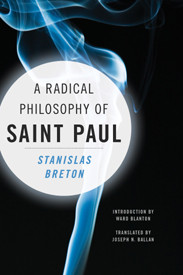
This month, Columbia University Press issues a new English translation of Stanislas Breton’s A Radical Philosophy of Saint Paul (Joseph N. Ballan, trans.).   Breton (1912–2005), French philosopher and theologian, explored Paul’s work—among other contexts—within that of the Roman Empire, in whose territory Paul traveled, under whose threatening gaze he evangelized, and whose apparatus of state religion and oppression would eventually imprison and murder him.  The work explores the Pauline message from a variety of unconventional perspectives, including its subversion of the Roman State.  (For further reflection on Paul as a theologian of resistance in an atmosphere of political oppression and state-imperio deification, I recommend the work of Dr. Brigitte Kahl, Professor of New Testament at Union Theological Seminary.)  Here is Columbia University Press’s description of this new translation:

Stanislas Breton’s A Radical Philosophy of Saint Paul, which focuses on the political implications of the apostle’s writings, was an instrumental text in Continental philosophy’s contemporary “turn to religion.” Reading Paul’s work against modern thought and history, Breton helped launch a reassessment of Marxism, introduce secular interpretations of biblical and theological traditions, develop “radical negativity” as a critical category, and rework modern political ideas through a theoretical lens.

Newly translated and critically situated, this edition takes a fresh approach to Breton’s classic work, reacquainting readers with the remarkable ways in which an ancient apostle can reset our understanding of the political. Breton begins with Paul’s biography and the texts of his conversion, which challenge common conceptions of identity. He broaches the question of allegory and divine predestination, introduces the idea of subjectivity as an effect of power, and confronts Paul’s critique of Law, which leads to an exploration of the logics and limits of agency and power. Breton develops these and other insights in relation to Paul’s subversive reflections on the crucified messiah, which challenge meaning and reason and upend our current world order. Neither a coherent theologian nor a stable humanist, Breton’s Paul becomes a fascinating figure of excess and madness, experiencing a kind of being that transcends philosophy, secularity, and religion.

— DRS, CLR Fellow