Gold, “Provincial Hinduism”

This January, Oxford University Press will release “Provincial Hinduism: Religion and Community in Gwalior City” by Daniel Gold (Cornell University).  The publisher’s description follows:

Provincial HinduismProvincial Hinduism explores intersecting religious worlds in an ordinary Indian city that remains close to its traditional roots, while bearing witness to the impact of globalization. Daniel Gold looks at modern religious life in the central Indian city of Gwalior, drawing attention to the often complex religious sensibilities behind ordinary Hindu practice. Gold describes temples of different types, their legendary histories, and the people who patronize them. He also explores the attraction of Sufi shrines for many Gwalior Hindus. Delicate issues of socioreligious identity are highlighted through an examination of neighbors living together in a locality mixed in religion, caste, and class. Pursuing issues of community and identity, Gold turns to Gwalior’s Maharashtrians and Sindhis, groups with roots in other parts of the subcontinent that have settled in the city for generations. These groups function as internal diasporas, organizing in different ways and making distinctive contributions to local religious life. The book concludes with a focus on new religious institutions invoking nineteenth-century innovators: three religious service organizations inspired by the great Swami Vivekenanda, and two contemporary guru-centered groups tracing lineages to Radhasoami Maharaj of Agra.

Gold offers the first book-length study to analyze religious life in an ordinary, midsized Indian city, and in so doing has created an invaluable resource for scholars of contemporary Indian religion, culture, and society.

Lassander, “Post-Materialist Religion: Pagan Identities and Value Change in Modern Europe”

In October, Bloomsbury Publishing released “Post-Materialist Religion: Pagan Identities and Value Change in Modern Europe” by Mika T. Lassander (Abo Akademi University, Finland). The publisher’s description follows:

Post-Materialist Religion discusses the transformations of the individual’s worldview in contemporary modern societies, and the role general societal value change plays in these. In doing so, Mika Lassander brings into conversation sociological theories of secularisation and social-psychological theories of interpersonal relations, the development of morality, and the nature of basic human values. The long-term decline of traditional religiosity in Europe and the emerging ethos that can be described as post-secular have brought religion and values back into popular discussion. One important theme in these discussions is about the links between religion and values, with the most common assumption being that religions are the source of individuals’ values. This book argues for the opposite view, suggesting that religions, or people’s worldviews in general, reflect the individual’s priorities.

Mika Lassander argues that the transformation of the individual’s worldview is a direct consequence of the social and economical changes in European societies since the Second World War. He suggests that the decline of traditional religiosity is not an indication of linear secularisation or of forgetting traditions, but an indication of the loss of relevance of some aspects of the traditional institutional religions. Furthermore, he argues that this is not an indication of the loss of ethical value base, but, rather, a change in the value base and consequently the transformation of the legitimating framework of this value base.


Rosati, “The Making of a Postsecular Society”

In January, Ashgate Publishing will release “The Making of a Postsecular Society: A Durkheimian Approach to Memory, Pluralism and Religion in Turkey” by Massimo Rosati (University of Rome ‘Tor Vergata’). The publisher’s description follows:

Drawing on the thought of Durkheim, this volume focuses on societal changes at the symbolic level to develop a new conceptualisation of the emergence of postsecular societies. Neo-Durkheimian categories are applied to the case of Turkey, which in recent years has shifted from a strong Republican and Kemalist view of secularism to a more Anglo-Saxon perspective. Turkish society thus constitutes an interesting case that blurs modernist distinctions between the secular and the religious and which could be described as ‘postsecular’.

Presenting three symbolic case studies – the enduring image of the founder of the Republic Atatürk, the contested site of Ayasofia, and the remembering and commemoration of the murdered journalist Hrant Dink – The Making of a Postsecular Society analyses the cultural relationship that the modern Republic has always had with Europe, considering the possible implications of the Turkish model of secularism for a specifically European self-understanding of modernity.

Based on a rigorous construction of theoretical categories and on a close scrutiny of the common challenges confronting Europe and its Turkish neighbour long considered ‘other’ with regard to the accommodation of religious difference, this book sheds light on the possibilities for Europe to find new ways of arranging the relationship between the secular and the religious. As such, it will appeal to scholars of social theory, the sociology of religion, secularisation and religious difference, and social change.

Özyürek, “Being German, Becoming Muslim”

This December, Princeton University Press will release “Being German, Becoming Muslim: Race, Religion, and Conversion in the New Europe” by Esra Özyürek (London School of Economics).  The publisher’s description follows:

Being German Becoming MuslimEvery year more and more Europeans, including Germans, are embracing Islam. It is estimated that there are now up to one hundred thousand German converts—a number similar to that in France and the United Kingdom. What stands out about recent conversions is that they take place at a time when Islam is increasingly seen as contrary to European values. Being German, Becoming Muslim explores how Germans come to Islam within this antagonistic climate, how they manage to balance their love for Islam with their society’s fear of it, how they relate to immigrant Muslims, and how they shape debates about race, religion, and belonging in today’s Europe.

Esra Özyürek looks at how mainstream society marginalizes converts and questions their national loyalties. In turn, converts try to disassociate themselves from migrants of Muslim-majority countries and promote a denationalized Islam untainted by Turkish or Arab traditions. Some German Muslims believe that once cleansed of these accretions, the Islam that surfaces fits in well with German values and lifestyle. Others even argue that being a German Muslim is wholly compatible with the older values of the German Enlightenment.

Being German, Becoming Muslim provides a fresh window into the connections and tensions stemming from a growing religious phenomenon in Germany and beyond.

Cimino & Smith, “Atheist Awakening”

This October, Oxford University Press will release “Atheist Awakening: Secular Activism and Community in America” by Richard Cimino (University of Richmond) and Christopher Smith.  The publisher’s description follows:

Atheist AwakeningSurveys over the last twenty years have seen an ever-growing number of Americans disclaim religious affiliations and instead check the “none” box. In the first sociological exploration of organized secularism in America, Richard Cimino and Christopher Smith show how one segment of these “nones” have created a new, cohesive atheist identity through activism and the creation of communities.

According to Cimino and Smith, the new upsurge of atheists is a reaction to the revival of religious fervor in American politics since 1980. Feeling overlooked and underrepresented in the public sphere, atheists have employed a wide variety of strategies-some evangelical, some based on identity politics-to defend and assert themselves against their ideological opponents. These strategies include building and maintaining communities, despite the absence of the kinds of shared rituals, texts, and laws that help to sustain organized religions.

Drawing on in-depth interviews with self-identified atheist, secularist, and humanist leaders and activists, as well as extensive observations and analysis of secular gatherings and media, Cimino and Smith illustrate how atheists organize and align themselves toward common goals, and how media-particularly web-based media-have proven invaluable in connecting atheists to one another and in creating a powerful virtual community. Cimino and Smith suggest that secularists rely not only on the Internet for community-building, but on their own new forms of ritual.

This groundbreaking study will be essential reading for anyone seeking to understand the growing atheist movement in America.

“Transformations of Religion and the Public Sphere: Postsecular Publics” (Braidotti et al. eds.)

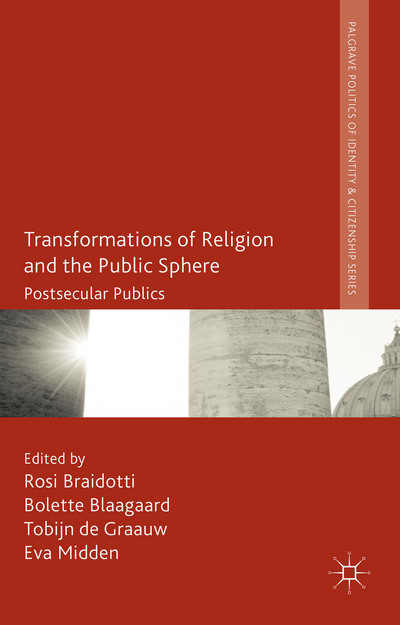
Next month, Palgrave Macmillan will release “Transformations of Religion and the Public Sphere: Postsecular Publics”  edited by Rosi Braidotti (Utrecht University), Bolette Blaagaard (Aalborg University), Tobijn de Graauw (Utrecht University), and Eva Midden (Utrecht University). The publisher’s description follows:

Transformations of Religion and the Public Sphere: Postsecular Publics contributes a counter-discourse to the myth of secularism. This myth is a strongly-held belief, predominantly advocated in the westernised world, that progress and modernity is intimately linked to secular politics and social relations. This book develops a range of critiques of this myth through discussions on the current political, social, and technological conditions in which we find ourselves. It explores the political implications of the myth, as well as exploring postcolonial relations, liberal-secularism and religious sentiments, and the mediated public sphere, with an in-depth focus on the Dutch case. Transformations of Religion and the Public Sphere: Postsecular Publics takes issue with the secular condition and accepted beliefs of its liberal emancipatory foundations.

“The Oxford Handbook of American Islam” (Haddad & Smith, eds.)

Next month, Oxford University Press releases “The Oxford Handbook of American Islam”  edited by Yvonne Y. Haddad (Georgetown University) and Jane I. Smith (Harvard Divinity School, retired). The publisher’s description follows:

Islam has been part of the increasingly complex American religious scene for  well over a century, and was brought into more dramatic focus by the attacks of September 11, 2001. American Islam is practiced by a unique blend of immigrants and American-born Muslims. The immigrants have come from all corners of the world; they include rich and poor, well-educated and illiterate, those from upper and lower classes as well as economic and political refugees. The community’s diversity has been enhanced by the conversion of African Americans, Latina/os, and others, making it the most heterogeneous Muslim community in the world.

With an up-to-the-minute analysis by thirty of the top scholars in the field, this handbook covers the growth of Islam in America from the earliest Muslims to set foot on American soil to the current wave of Islamophobia. Topics covered include the development of African American Islam; pre- and post-WWII immigrants; Sunni, Shi`ite, sectarian and Sufi movements in America; the role and status of women, marriage, and family; and the Americanization of Islamic culture.

Throughout these chapters the contributors explore the meaning of religious identity in the context of race, ethnicity, gender, and politics, both within the American Islamic community and in relation to international Islam.


“Choreographies of Shared Sacred Sites: Religion, Politics, and Conflict Resolution” (Barkan & Barkey, eds.)

Next month, Columbia University Press will release “Choreographies of Shared Sacred Sites: Religion, Politics, and Conflict Resolution” edited by Elazar Barkan (Columbia University) and Karen Barkey (Columbia University). The publisher’s description follows:

This anthology explores the dynamics of shared religious sites in Turkey, the Balkans, Palestine/Israel, Cyprus, and Algeria, indicating where local and national stakeholders maneuver between competition and cooperation, coexistence and conflict. Contributors probe the notion of coexistence and the logic that underlies centuries of “sharing,” exploring when and why sharing gets interrupted—or not—by conflict, and the policy consequences.

These essays map the choreographies of shared sacred spaces within the framework of state-society relations, juxtaposing a site’s political and religious features and exploring whether sharing or contestation is primarily religious or politically motivated. While religion and politics are intertwined phenomena, the contributors to this volume understand the category of “religion” and the “political” as devices meant to distinguish between the theological and confessional aspects of religion and the political goals of groups. Their comparative approach better represents the transition in some cases of sites into places of hatred and violence while in other instances they remain noncontroversial. The essays clearly delineate the religious and political factors that contribute to the context and causality of conflict at these sites and draw on history and anthropology to shed light on the often rapid switch from relative tolerance to distress to peace and calm.

“The Oxford Handbook of European Islam” (Cesari, ed.)

This December, Oxford University Press will release “The Oxford Handbook of European Islam” edited by Jocelyn Cesari (Center for European Studies).  The publisher’s description follows:

OXford Handbook of European IslamFor centuries, Muslim countries and Europe have engaged one another through theological dialogues, diplomatic missions, political rivalries, and power struggles. In the last thirty years, due in large part to globalization and migration from Islamic countries to the West, what was previously an engagement across national and cultural boundaries has increasingly become an internalized encounter within Europe itself. Questions of the Hijab in schools, freedom of expression in the wake of the Danish Cartoon crisis, and the role of Shari’a have come to the forefront of contemporary European discourse.

The Oxford Handbook of European Islam is the first collection to present a comprehensive approach to the multiple and changing ways Islam has been studied across European countries. Parts one to three address the state of knowledge of Islam and Muslims within a selection of European countries, while presenting a critical view of the most up-to-date data specific to each country. These chapters analyze the immigration cycles and policies related to the presence of Muslims, tackling issues such as discrimination, post-colonial identity, adaptation, and assimilation. The thematic chapters, in parts four and five, examine secularism, radicalization, Shari’a, Hijab, and Islamophobia with the goal of synthesizing different national discussion into a more comparative theoretical framework. The Handbook attempts to balance cutting edge assessment with the knowledge that the content itself will eventually be superseded by events. Featuring eighteen newly-commissioned essays by noted scholars in the field, this volume will provide an excellent resource for students and scholars interested in European Studies, immigration, Islamic studies, and the sociology of religion.

“The Sociology of Shari’a: Case Studies from around the World” (Possamai & Richardson et al., eds.)

In December, Springer Publishing will release “The Sociology of Shari’a: Case Studies from around the World” edited by Adam Possamai (University of Western Sydney), James T. Richardson (University of Nevada), and Bryan S. Turner (City University of New York). The publisher’s description follows:

This edited volume offers a collection of papers that presents a comparative analysis of the development of Shari’a in countries with Muslim minorities, such as America, Australia, China, Germany,  Italy, Singapore, South Africa and the Philippines, as well as countries with Muslim majorities, such as Malaysia, Bangladesh, Turkey, and Tunisia.

The Sociology of Shari’a provides a global analysis of these important legal transformations and  examines the topic from a sociological perspective.

In addition, the third part of the book includes case studies that explore some ground-breaking applications of theoretical perspectives such as those from Chambliss and Eisenstein.