Falk, “The German Jews in America: A Minority within a Minority”

german jewsThis April, University Press of America will publish, The German Jews in America: A Minority within a Minority  by Gerhard Falk (Buffalo State College). The publisher’s description follows.

This book describes the assimilation and acculturation of a small minority who immigrated to the United States in the nineteenth century and again in the twentieth century. Gerhard Falk focuses on refugees who fled from Nazi tyranny in the 1930s, immigrated to America, and succeeded despite immense obstacles. This book includes a review of the most prominent academics that made major contributions to science, medicine, art, and literature in America. The German Jews in America demonstrates that America is still the land of opportunity for everyone who makes an effort, no matter what their religion, ethnicity, or race.  In addition, this book is a key to understanding immigration and the role of community in providing the support needed in becoming an American.

Hinojosa, “Latino Mennonites”

Next month, Johns Hopkins University Press will publish Latino Mennonites: Civil Rights, Faith & Evangelical Culture by Felipe Hinojosa (Texas A&M University). The publisher’s description follows.book cover

Felipe Hinojosa’s parents first encountered Mennonite families as migrant workers in the tomato fields of northwestern Ohio. What started as mutual admiration quickly evolved into a relationship that strengthened over the years and eventually led to his parents founding a Mennonite Church in South Texas. Throughout his upbringing as a Mexican American evangélico, Hinojosa was faced with questions not only about his own religion but also about broader issues of Latino evangelicalism, identity, and civil rights politics.

Latino Mennonites offers the first historical analysis of the changing relationship between religion and ethnicity among Latino Mennonites. Drawing heavily on primary sources in Spanish, such as newspapers and oral history interviews, Hinojosa traces the rise of the Latino presence within the Mennonite Church from the origins of Mennonite missions in Latino communities in Chicago, South Texas, Puerto Rico, and New York City, to the conflicted relationship between the Mennonite Church and the California farmworker movements, and finally to the rise of Latino evangelical politics. He also analyzes how the politics of the Chicano, Puerto Rican, and black freedom struggles of the 1960s and 1970s civil rights movements captured the imagination of Mennonite leaders who belonged to a church known more for rural and peaceful agrarian life than for social protest.

Whether in terms of religious faith and identity, race, immigrant rights, or sexuality, the politics of belonging has historically presented both challenges and possibilities for Latino evangelicals in the religious landscapes of twentieth-century America. In Latino Mennonites, Hinojosa has interwoven church history with social history to explore dimensions of identity in Latino Mennonite communities and to create a new way of thinking about the history of American evangelicalism.

Garrioch, “The Huguenots of Paris and the Coming of Religious Freedom, 1685-1789”

Next month, Cambridge University Press will publish The Huguenots of Paris and the Coming of Religious Freedom, 1685-1789 by David Garrioch (Monash University). The publisher’s description follows.

How did the Huguenots of Paris survive, and even prosper, in the eighteenth century when the majority Catholic population was notorious for its hostility to Protestantism? Why, by the end of the Old Regime, did public opinion overwhelmingly favour giving Huguenots greater rights? This study of the growth of religious toleration in Paris traces the specific history of the Huguenots after Louis XIV revoked the Edict of Nantes in 1685. David Garrioch identifies the roots of this transformation of attitudes towards the minority Huguenot population in their own methods of resistance to persecution and pragmatic government responses to it, as well as in the particular environment of Paris. Above all, this book identifies the extraordinary shift in Catholic religious culture that took place over the century as a significant cause of change, set against the backdrop of cultural and intellectual transformation that we call the Enlightenment.

Jansen, “Secularism, Assimilation, and the Crisis of Multiculturalism”

9789089645968-yolande-jansen-secularism-assimilation-and-the-crisis-of-multiculturalism-178Next month, Amsterdam University Press will publish Secularism, Assimilation, and the Crisis of Multiculturalism: French Modernist Legacies by Yolande Jansen (Amsterdam Centre for Globalization Studies). The publisher’s description follows.

This remarkable study develops a theoretical critique of contemporary discourses on secularism and assimilation, arguing that the perspective of assimilating distinct religious minorities by incorporating them into a secular and supposedly neutral public sphere may be self-subverting. To flesh out this insight, Jansen draws on the paradoxes of assimilation as experienced by the French Jews in the late 19th century through a contextualised reading of Proust’s In Search of Lost Time. She proposes a dynamic, critical multiculturalism as an alternative to discourses focusing on secularism, assimilation and integration.

Discussion on Banning “Islamophobia” (Jan. 17)

The Hudson Institute in Washington will host a discussion, “The Organization of Islamic Cooperation: Free Speech Implications of a Proposed Ban on ‘Islamophobia,'” on January 17:

“Islamophobia” is a widely used yet vague and controversial term referring to anti-Muslim bigotry. In recent years, identifying, monitoring, reporting on, and working to ban Islamophobia worldwide has been a major focus of the Organization of Islamic Cooperation (OIC).

The OIC is an international body of 56 member states that is based in Saudi Arabia and active within the United Nations. While the United States has formally recognized its work in the past – US ambassadors have observed its sessions and former Secretary of State Hillary Clinton co-chaired some of its meetings – American awareness of the organization remains scant.

 In 2007, the OIC began issuing regular “observatory” reports on Islamophobia, and since 2009 has published monthly bulletins that cite primarily Western examples of Islamophobia.

Is Islamophobia a serious problem, or is the term itself an ideological cudgel designed to incite fear and criminalize dissent?  Dr. Mark Durie will discuss these and other basic questions related to the OIC’s efforts to ban Islamophobia.

Details are here.

Cohen, “Becoming Ottomans: Sephardi Jews and Imperial Citizenship in the Modern Era”

This month, Oxford published Becoming Ottomans: Sephardi Jews and Imperial 9780199340408Citizenship in the Modern Era, by Julia Phillips Cohen (Vanderbilt University). The publisher’s description follows.

The Ottoman-Jewish story has long been told as a romance between Jews and the empire. The prevailing view is that Ottoman Jews were protected and privileged by imperial policies and in return offered their unflagging devotion to the imperial government over many centuries. In this book, Julia Phillips Cohen offers a corrective, arguing that Jewish leaders who promoted this vision were doing so in response to a series of reforms enacted by the nineteenth-century Ottoman state: the new equality they gained came with a new set of expectations. Ottoman subjects were suddenly to become imperial citizens, to consider their neighbors as brothers and their empire as a homeland.

Becoming Ottomans is the first book to tell the story of Jewish political integration into a modern Islamic empire. It begins with the process set in motion by the imperial state reforms known as the Tanzimat, which spanned the years 1839-1876 and legally emancipated the non-Muslims of the empire. Four decades later the situation was difficult to recognize. By the close of the nineteenth century, Ottoman Muslims and Jews alike regularly referred to Jews as a model community, or millet-as a group whose leaders and members knew how to serve their state and were deeply engaged in Ottoman politics. The struggles of different Jewish individuals and groups to define the public face of their communities is underscored in their responses to a series of important historical events.

Charting the dramatic reversal of Jews in the empire over a half-century, Becoming Ottomans offers new perspectives for understanding Jewish encounters with modernity and citizenship in a centralizing, modernizing Islamic state in an imperial, multi-faith landscape.

Fredette, “Constructing Muslims in France: Discourse, Public Identity, and the Politics of Citizenship”

Next month, Temple University will publish 2272_regConstructing Muslims in France: Discourse, Public Identity, and the Politics of Citizenship, by Jennifer Fredette (San Diego State University). The publisher’s description follows.

The standing of French Muslims is undercut by a predominant and persistent elite public discourse that frames Muslims as failed and incomplete French citizens. This situation fosters the very separations, exclusions, and hierarchies it claims to deplore as Muslims face discrimination in education, housing, and employment.

In Constructing Muslims in France, Jennifer Fredette provides a deft empirical analysis to show the political diversity and complicated identity politics of this relatively new population. She examines the public identity of French Muslims and evaluates images in popular media to show how stereotyped notions of racial and religious differences pervade French public discourse. While rights may be a sine qua non for fighting legal and political inequality, Fredette shows that additional tools such as media access are needed to combat social inequality, particularly when it comes in the form of unfavorable discursive frames and public disrespect.

Presenting the conflicting views of French national identity, Fredette shows how Muslims strive to gain recognition of their diverse views and backgrounds and find full equality as French citizens.

Prince Charles Draws Attention to Persecution of Mideast Christians

Photo from the BBC

This year has been a dreadful one for Mideast Christians. In Egypt, Islamists frustrated at the fall of the Morsi government have singled out Copts for vengeance. By some accounts, Copts are suffering the worst persecution they have experienced in 700 years. In Syria, Islamist rebels are targeting Christians, whom they accuse of siding with the Assad regime.  In Iraq, Islamist gangs demand exorbitant protection money from the few Christians who remain–unless the Christians agree to convert to Islam. Across the region, Christians are being kidnapped, driven from their homes, killed. Their churches are being burned, their schools bombed. Christianity faces an existential threat in the place where it was born.

Mostly, the persecution of Mideast Christians has failed to attract attention in the West–although the media seems to be catching on. Mideast Christians lack strong lobbies in Western capitals, and the Western human rights community has a hard time seeing any Christians as victims rather than oppressors. So praise goes to Britain’s Prince Charles, who last week met with representatives of Mideast Christians in London to draw attention to the ongoing persecution:

“It seems to me that we cannot ignore the fact that Christians in the Middle East are, increasingly, being deliberately targeted by fundamentalist Islamist militants,” he said. Noting Christianity’s roots in the region, the Prince observed that today the Middle East and North Africa have the lowest concentration of Christians in the world—just 4 percent—and that this has “dropped dramatically over the last century and is falling still further.” He said that the effect of this was that “we all lose something immensely and irreplaceably precious when such a rich tradition dating back 2,000 years begins to disappear.”

The BBC’s report of the Prince’s meeting is here.

Anscombe, “State, Faith, and Nation in Ottoman and Post-Ottoman Lands”

Next month, Cambridge will publish State, Faith, and Nation in Ottoman and9781107615236 Post-Ottoman Lands, by Frederick F. Anscombe (University of London). The publisher’s description follows.

Current standard narratives of Ottoman, Balkan, and Middle East history overemphasize the role of nationalism in the transformation of the region. Challenging these accounts, this book argues that religious affiliation was in fact the most influential shaper of communal identity in the Ottoman era, that religion molded the relationship between state and society, and that it continues to do so today in lands once occupied by the Ottomans. The book examines the major transformations of the past 250 years to illustrate this argument, traversing the nineteenth century, the early decades of post-Ottoman independence, and the recent past. In this way, the book affords unusual insights not only into the historical patterns of political development but also into the forces shaping contemporary crises, from the dissolution of Yugoslavia to the rise of political Islam.

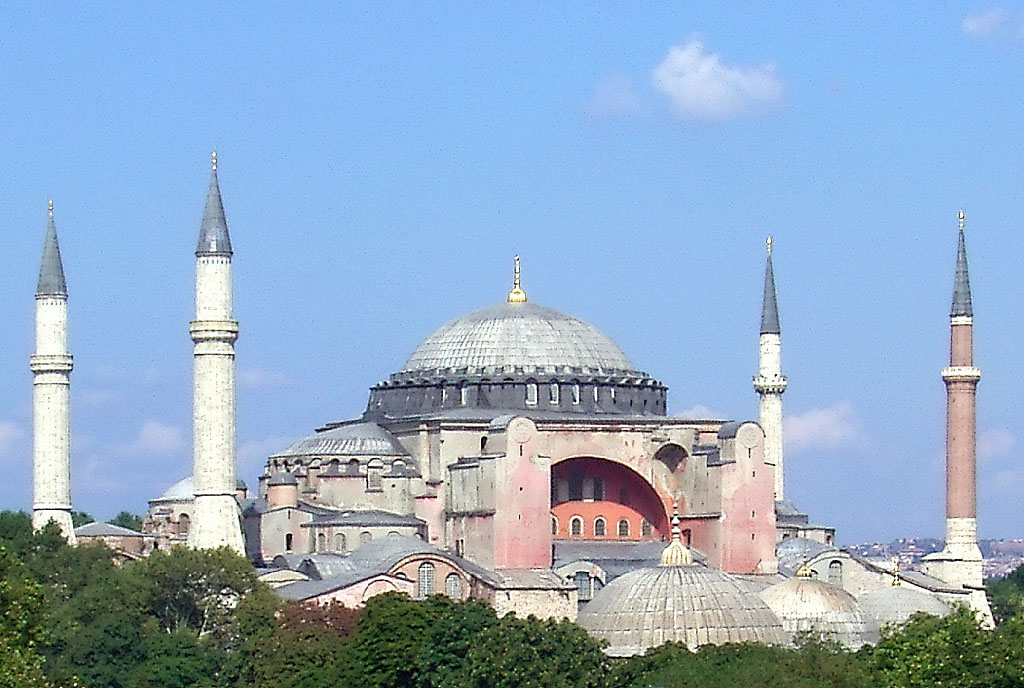
Will the Hagia Sophia Again Become a Mosque?

When I heard the rumors this fall, I have to confess, I dismissed them. And maybe it is only political posturing. But leading Turkish officials are actually talking about converting the famed Hagia Sophia in Istanbul back into a mosque.

The Hagia Sophia, or Church of the Holy Wisdom, was built by the Emperor Justinian in the sixth century. (“Solomon,” the emperor cried when he saw the completed church, “I have surpassed thee!”). For 1000 years, it was the largest Christian cathedral in the world and the emblem of Byzantium. After the empire fell in 1453, the Ottomans converted the church into a mosque. About 500 years after that, the secular Kemalist government made it a museum. And so it has remained.

Now, however, a nationalist party has introduced legislation to reconvert the building to a Muslim place of worship. The idea has support at very high levels. In October, the imam at the neighboring Sultan Ahmet Mosque–a government official–called for Hagia Sophia to reopen as a mosque. Last month, at a public event in Istanbul, Turkey’s Deputy Prime Minister, Bulent Arinc, referred approvingly to two other churches-turned-mosques-turned-museums-turned-mosques-again, one in Trabzon and one in Iznik (once known as Nicea). And he made this comment about the Hagia Sophia itself: “We currently stand next to the Hagia Sophia Mosque. We are looking at a sad Hagia Sophia but hopefully we will see it smiling again soon.”

Arinc’s implication is unmistakable. According to the Religion News Service, Turkey’s ruling party, the Islamist AKP, is trying to shore up its base ahead of March provincial elections. It’s smart politics. AKP rank-and-file see Kemalism as a huge historical mistake and wish to return to the pan-Islamism of the Ottoman Empire. Converting Byzantine and other historical Christian monuments from museums into mosques is a way of rejecting secularism and returning to Turkish roots. The Hagia Sophia is the greatest symbol of all. That’s why, in the words of one observer, “Supporting the reopening of Hagia Sophia has become the litmus test of the true believer.”

When it comes to appropriating the temples of the vanquished, no great religion is innocent. Historically, Christians often built churches on the ruins of pagan shrines. One of my favorite sites in Rome, the Basilica of San Clemente, sits atop a Mithraic temple, the ruins of which are still visible. After the Reconquista, Rod Dreher writes, Christians converted the great mosque of Cordoba into a cathedral. The point of such conduct is obvious. The victor wishes literally to squash the altars of the vanquished, to humiliate and demoralize followers of the old way. Our god is greater than yours.

But this sort of thing doesn’t happen anymore in the civilized world. As Dreher writes, converting the Hagia Sophia into a mosque now, after it has been a museum for decades, would be “a stunning act of cultural aggression” against Christians in Turkey, particularly the handful of Greeks who somehow have managed to hang on there. It would put the lie to claims of pluralism. And it would underline, as few other acts could, what Samuel Huntington famously called “the clash of civilizations.”