“Yearbook of Islamic and Middle Eastern Law” (Lau & Cotran, eds.)

In February, Brill Publishing will release “Yearbook of Islamic and Middle Eastern Law, Volume 17” edited by Martin Lau (University of London) and Hon. Eugene Cotran. The publisher’s description follows:

Practitioners and academics dealing with the Middle East can turn to the Yearbook of Islamic and Middle Eastern Law for an instant source of information on the developments over an entire year in the region. The Yearbook covers Islamic and non-Islamic legal subjects, including the laws themselves, of some twenty Arab and other Islamic countries.

Sattam, “Sharia and the Concept of Benefit”

This February, I.B. Tauris Publishing will release “Sharia and the Concept of Benefit: The Use and Function of Maslaha in Islamic Jurisprudence” by Abdul Aziz bin Sattam (Imam Muhammad bin Saud Islamic University).  The publisher’s description follows:

The idea of maslaha has a rich history in classical legal thought and literature. Conventionally translated into English as ‘general benefit’ or ‘general interest’, it has been the subject, over many centuries, of intense argument in Muslim legal manuals about how the concept should be constructed and how it might be interpreted. Some celebrated scholars have even elevated its status to an independent legal source; while other prominent jurists have spoken of the special strictures which need to be applied to maslaha when considering it within the overall framework of Islamic law. In this thorough and original treatment of the concept, Abdul Aziz bin Sattam offers the first sustained examination of one of the most important tenets of Sharia. Seeking to illuminate not only the intricacies of its application, but also the wider history which has shaped it, the author examines its foundations, theoretical underpinnings and the key debates in both classical and contemporary texts. His book will be a vital resource for all those with an interest in Islamic law, whether of the medieval or modern periods.

Foreign Policy Magazine on Iraqi Christians

From Foreign Policy,  a moving essay on how Iraqi Christians are observing this Christmas season. Last month, the author, Christian Caryl, visited Erbil, in Iraqi Kurdistan, where Chaldean-rite Catholics, refugees from ISIS’s summer campaign, live in tents in a church courtyard:

I guess you could argue that this is all old news. A lot has happened since late November, and there are plenty of other stories to cover. By and large, the international media have moved on. But the refugees are still there, huddled together on the grounds of the church, or in other sites scattered around Kurdish-controlled territory (which has offered them a warm welcome despite its own lack of resources). The world may have forgotten these people, but they’re still struggling to come to terms with the catastrophe. The accounts repeat and overlap: “I hid our money in the house, thinking we’d be back in a few days. But now we realize that we’ll probably never be able to go back.” “They knew our cellphone number, so a few days later, they called us up and said they’d hunt us down and kill us.” “They took him away, and we’ve never heard from him again.”

Sadly, the tragedy of the Christians of Iraq — who span a whole range of doctrines and ethnic groups — is being replicated in many other places. Sectarian tensions are deepening around the world, and Christians are often the victims. Syria’s mostly Orthodox Christians are caught in the middle of the civil war between the government of Bashar al-Assad and its Islamist opponents. Egypt’s Copts are still attending charred churches, burned inanti-Christian pogroms and battling persistent anti-Christian sentiment. And now churches are even being targeted for attack by Hindu nationalists in India.

Caryl also answers the inevitable criticism that it is wrong to focus on the plight of Christians. (Do human rights advocates ever require explanations for defending other persecuted minorities? Just asking).

And yes, before you put coal in my stocking, I do understand that Christians aren’t the only ones in the world suffering from bigotry and violence. Just this past week, many Yezidis, another important religious minority in northern Iraq, finally got thrown a lifeline when Kurdish forces broke through an IS siege to open up a corridor to Mount Sinjar, where many Yezidis had been trapped. And yes, it’s absolutely true that many Muslims, Buddhists, and Hindus are victims of persecution and terror. I think everyone in the world should be happy to see that stop. Faith should never be an excuse for violence.

What’s important to keep in mind in the case of Middle Eastern Christians is that the communities under attack embody unique cultural traditions that now stand on the verge of irreparable damage or even extinction. (Some of Iraq’s Christians still speak Aramaic, the language of Christ.) Small wonder that a group of Christian and Muslim leaders recently meeting in Cairo issued a statement calling for tolerance pleading with Christians to remain in the Middle East. They understand that the loss of each one of these ancient communities of faith is a loss for all of us — and a victory for the forces of intolerance at a time when the world can least afford it.

Read the whole thing.

“Islam and the European Empires” (Motadel, ed.)

Last month, Oxford University Press released “Islam and the European Empires” edited by David Motadel (University of Cambridge).  The publisher’s description follows:

Islam and the European EmpiresAt the height of the imperial age, European powers ruled over most parts of the Islamic world. The British, French, Russian, and Dutch empires each governed more Muslims than any independent Muslim state. European officials believed Islam to be of great political significance, and were quite cautious when it came to matters of the religious life of their Muslim subjects. In the colonies, they regularly employed Islamic religious leaders and institutions to bolster imperial rule. At the same time, the European presence in Muslim lands was confronted by religious resistance movements and Islamic insurgency. Across the globe, from the West African savanna to the shores of Southeast Asia, Muslim rebels called for holy war against non-Muslim intruders.

Islam and the European Empires presents the first comparative account of the engagement of all major European empires with Islam. Bringing together fifteen of the world’s leading scholars in the field, the volume explores a wide array of themes, ranging from the accommodation of Islam under imperial rule to Islamic anti-colonial resistance. A truly global history of empire, the volume makes a major contribution not only to our knowledge of the intersection of Islam and imperialism, but also more generally to our understanding of religion and power in the modern world.

Gordis, “Menachem Begin”

Earlier this year, Schocken Books released “Menachem Begin: The Battle for bweginIsrael’s Soul,” by Daniel Gordis (Shalem College – Jerusalem). The publisher’s description follows:

Reviled as a fascist by his great rival Ben-Gurion, venerated by Israel’s underclass, the first Israeli to win the Nobel Peace Prize, a proud Jew but not a conventionally religious one, Menachem Begin was both complex and controversial. Born in Poland in 1913, Begin was a youthful admirer of the Revisionist Zionist Ze’ev Jabotinsky and soon became a leader within Jabotinsky’s Betar movement. A powerful orator and mesmerizing public figure, Begin was imprisoned by the Soviets in 1940, joined the Free Polish Army in 1942, and arrived in Palestine as a Polish soldier shortly thereafter. Joining the underground paramilitary Irgun in 1943, he achieved instant notoriety for the organization’s bombings of British military installations and other violent acts.

Intentionally left out of the new Israeli government, Begin’s right-leaning Herut political party became a fixture of the opposition to the Labor-dominated governments of Ben-Gurion and his successors, until the surprising parliamentary victory of his political coalition in 1977 made him prime minister. Welcoming Egyptian president Anwar Sadat to Israel and cosigning a peace treaty with him on the White House lawn in 1979, Begin accomplished what his predecessors could not. His outreach to Ethiopian Jews and Vietnamese “boat people” was universally admired, and his decision to bomb Iraq’s nuclear reactor in 1981 is now regarded as an act of courageous foresight. But the disastrous invasion of Lebanon to end the PLO’s shelling of Israel’s northern cities, combined with his declining health and the death of his wife, led Begin to resign in 1983. He spent the next nine years in virtual seclusion, until his death in 1992. Begin was buried not alongside Israel’s prime ministers, but alongside the Irgun comrades who died in the struggle to create the Jewish national home to which he had devoted his life. Daniel Gordis’s perceptive biography gives us new insight into a remarkable political figure whose influence continues to be felt both within Israel and throughout the world.

Russell, “Heirs to Forgotten Kingdoms”

In October, Basic Books released “Heirs to Forgotten Kingdoms: Journeys Into 9780465030569the Disappearing Religions of the Middle East,” by Gerard Russell (Foreign Policy Centre – London). The publisher’s description follows:

In this spellbinding journey across the past and present of the Middle East, a former diplomat takes us into the fascinating religious communities that have survived for centuries under Muslim rule.

Despite its reputation for religious intolerance, the Middle East has long sheltered many distinctive and strange faiths: one regards the Greek prophets as incarnations of God, another reveres Lucifer in the form of a peacock, and yet another believes that their followers are reincarnated beings who have existed in various forms for thousands of years. These religions represent the last vestiges of the magnificent civilizations in ancient history: Persia, Babylon, Egypt in the time of the Pharaohs. Their followers have learned how to survive foreign attacks and the perils of assimilation. But today, with the Middle East in turmoil, they face greater challenges than ever before.

In Heirs to Forgotten Kingdoms, former diplomat Gerard Russell ventures to the distant, nearly impassable regions where these mysterious religions still cling to survival. He lives alongside the Mandaeans and Ezidis of Iraq, the Zoroastrians of Iran, the Copts of Egypt, and others. He learns their histories, participates in their rituals, and comes to understand the threats to their communities. Historically a tolerant faith, Islam has, since the early 20th century, witnessed the rise of militant, extremist sects. This development, along with the rippling effects of Western invasion, now pose existential threats to these minority faiths. And as more and more of their youth flee to the West in search of greater freedoms and job prospects, these religions face the dire possibility of extinction.

Drawing on his extensive travels and archival research, Russell provides an essential record of the past, present, and perilous future of these remarkable religions.

Bouasria, “Sufism and Politics in Morocco”

This January, Routledge Press will release “Sufism and Politics in Morocco: Activism and Dissent” by Abdelilah Bouasria (George Mason University).  The publisher’s description follows:

Presenting a political history and sociology of Moroccan Sufism from colonialism to the modern day, this book studies the Sufi model of Master and Disciple in relation to social and political life, comparing the different eras of acquiescent versus dissident Sufism.

This comparative fieldwork study offers new perspectives on the connection between the monarchy and mystic realms with a specific coverage of the Boutchichi order and Abdessalam Yassine’s Al Adl Wal Ihsane, examining the myth of apolitical Sufism throughout the Middle East and North Africa. Drawing on Michel Foucault and James Scott, this book fuses thinking about the political dimension of Sufism, a “hidden transcript,” involving power struggles, patronage and justice and its esoteric spiritual ethics of care.

Addressing the lacuna in English language literature on the Boutchichi Sufi order in Morocco, this book will be of interest to students and scholars of Islamic Studies, Comparative Politics and the MENA region.

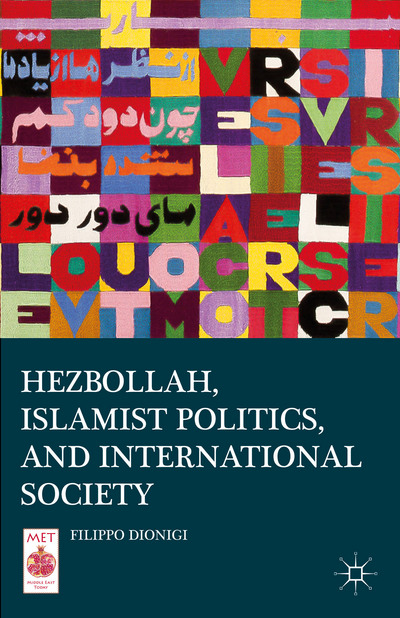
Dionigi, “Hezbollah, Islamist Politics, and International Society”

This month, Palgrave Macmillan releases “Hezbollah, Islamist Politics, and International Society,”  by Filippo Dionigi (Middle East Centre of the London School of Economics and Political Science). The publisher’s description follows:

How do the norms of the liberal international order influence the activity of Islamist movements? This book assesses the extent to which Islamist groups, which have traditionally attempted to shield their communities from ‘external’ moral conceptions, have been influenced by the principles that regulate international society. Through an analysis of Lebanon’s Hezbollah, Filippo Dionigi concludes that international norms are significant factors changing Islamist politics. We are still far from an accomplished resolve of the tension between Islamist communitarianism and liberal normative views, but a precarious equilibrium may emerge whereby Islamists are persuaded to rethink the idea of an allegedly ‘authentic’ Islamic morality as opposed to the legitimacy of international norms.

Mouline, “The Clerics of Islam”

This November, Yale University Press will release “The Clerics of Islam: Religious Authority and Political Power in Saudi Arabia” by Nabil Mouline (French National Center for Scientific Research).  The publisher’s description follows:

The Clerics of IslamFollowers of Muhammad b. ’Abd al-Wahhab, often considered to be Islam’s Martin Luther, shaped the political and religious identity of the Saudi state while also enabling the significant worldwide expansion of Salafist Islam. Studies of the movement he inspired, however, have often been limited by scholars’ insufficient access to key sources within Saudi Arabia. Nabil Mouline was granted rare interviews and admittance to important Saudi archives in preparation for this groundbreaking book, the first in-depth study of the Wahhabi religious movement from its founding to the modern day. Gleaning information from both written and oral sources and employing a multidisciplinary approach that combines history, sociology, and Islamic studies, Mouline presents a new reading of this movement that transcends the usual resort to polemics.

Event: “The Race Against ISIS: Efforts to Preserve Ancient Christian Culture in the Middle East” (Dec. 2)

On Tuesday, December 2 at noon, Hudson Institute’s Center for Religious Freedom will host Dr. Amal Marogy, originally from the northern Iraqi city of Kirkuk, to discuss “The Race Against ISIS: Efforts to Preserve Ancient Christian Culture in the Middle East.”

As ISIS continues to wage a campaign to eradicate the entire Christian presence and every trace of that ancient community’s existence in northern Iraq, a treasure of Christian patrimony, consisting of relics and manuscripts testifying to nearly two millennia of Christianity, is being systematically destroyed. Dr. Amal Marogy, originally from the northern Iraqi city of Kirkuk, fears that the ongoing jihadist religious cleansing of this 1,600-year-old Christian community means that Iraq’s Aramaic language and culture is in danger of dying out. ISIS has already burned some 1,500 biblical manuscripts held at the fourth-century monastery of St. Behnam, which was seized last summer in Nineveh. While some manuscripts, including those of Mar Behnam, have been digitized, many others have not.

Dr. Marogy is on an urgent mission to record the social history of her region, Duhok, and its Aramaic songs, prayers, and poetry. In 2013, she founded the Aradin Charitable Trust to help preserve Aramaic and the Christian heritage throughout the Middle East. She is an Affiliated Researcher in Neo-Aramaic Studies at Cambridge University and was previously Director of Studies in Asian and Middle Eastern Studies at King’s College.

Register for the event, which is in Washington, D.C., here.

You can also live stream the event on Hudson’s homepage.