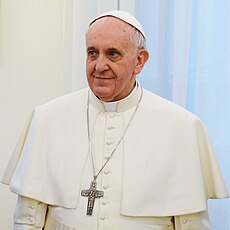
A Non-Political Pope?

You can’t tell too much from one interview, of course, but the interview Pope Francis gave an Italian Jesuit journal last month, and which was released last week, seems like a blockbuster. Everyone understands this. Progressive Catholics are elated. After long years in the wilderness, they believe, they have one of their own as pope. Traditionalists have been more circumspect, but it’s hard to miss the sense of alienation. Traditionalists are used to thinking that, however much they have to battle with progressives at the local level, the pope has their back. Now, that’s very unclear.

As an outsider, I don’t feel right getting involved in intra-Catholic debates. There’s too much I don’t know, and anyway it’s not polite. But this interview does suggest three observations. First, Pope Francis has a definite vision for the Catholic Church. When he gave his airborne interview on the way back from Brazil last month–the interview in which he famously said, “who am I to judge?”–some traditionalists consoled themselves that he had spoken off the cuff or allowed himself to be misunderstood. After this interview, it’s impossible to think so. He knows what he means and means what he says.

Second, I’m not sure the pope is correct to suggest that the Church has been obsessing over sexuality–abortion, gay marriage, contraception. Catholic friends tell me they almost never hear sermons on these subjects. One might say, with justification, that the wider society is obsessing about these issues and the Church is only responding. If the government adopts a new rule that says you must pay for your employees’ contraceptives and abortifacients, and you think such drugs are gravely wrong as a matter of conscience, what should you do? I suppose you could readjust your priorities and say nothing. But if you were to object to such a rule, you would hardly be “obsessing.”

Third, it’s striking that in a long interview the pope said virtually nothing about politics. Only twice did he refer to the Church’s position on public policy questions, once to state that the Church should stop talking so much about sexuality and once to refer to the proper approach to “social issues”:

When it comes to social issues, it is one thing to have a meeting to study the problem of drugs in a slum neighborhood and quite another thing to go there, live there and understand the problem from the inside and study it. There is a brilliant letter by Father Arrupe to the Centers for Social Research and Action on poverty, in which he says clearly that one cannot speak of poverty if one does not experience poverty, with a direct connection to the places in which there is poverty. The word insertion is dangerous because some religious have taken it as a fad, and disasters have occurred because of a lack of discernment. But it is truly important.

Note a couple of things here. For Pope Francis, the phrase “social issues” connotes what Americans would call “economic issues”–an interesting distinction. More important, to address these issues, Pope Francis did not call for political action. He did not say, “When it comes to social issues, the important thing is to redistribute wealth and nationalize health care.” He may favor such programs, I don’t know. But he apparently does not think political programs are terribly important. The essential thing is for the Church to live among poor people, to share their lives, to minister to them–in order to witness to the Gospel. 

In other words, Pope Francis’s interview does not suggest he would like the Catholic Church to adopt a “progressive” politics any more than a “conservative” politics. It suggests he thinks the Church is beyond politics. To me, this is the key take-away from the pope’s interview. There is an old, old debate in Christianity. Is the faith about healing souls or social justice? It’s about both, of course, but which is more important? If I read him correctly, Pope Francis leans strongly in the first direction: Christianity is an interior matter, a question of salvation, of walking humbly in the company of the Lord and his followers. Christians can never be completely beyond politics, of course, and it will be interesting to see how this all develops. But Pope Francis seems, in his way, a mystic. And mystics don’t do politics. 

Conference: Religious Traditions and Business Behavior (Oct. 31)

The Robert H. Smith School of Business at the University of Maryland will host a conference on religious traditions and business behavior on October 31:

This forum explores two central questions in the relationship between the world’s major religious traditions and the business behavior of adherents to those traditions:

First, what do the world’s major organized religious traditions – Protestantism, Catholicism, Islam, Hinduism, Buddhism, Judaism – prescribe about business and financial ethics and behavior?

Second, how and why have business and financial actors seriously compromised the leading religious traditions of their cultures?

By interrogating these two core questions, the conference will yield insights valuable to contemporary business and religious leaders about abiding questions such as: Do the scriptures and doctrines of these religions appear to have had a marked effect on financial behavior? Does religion appear to be a more potent or less potent influence than business ethics courses in fostering sound, ethical, and socially responsible financial behavior? How can religion best be promulgated to make financial behavior more sound, ethical, and socially responsible?

Speakers include past CLR Forum Guest Ron Colombo, who will present a paper, “Religious Liberty and the Business Corporation.” Details are here.

Villanova Starts Project on Religious and Economic Freedom

Congratulations to our friends at Villanova, especially Vice Dean Michael Moreland, on receiving a $200,000 grant from the John Templeton Foundation to start the Libertas Project, a series of workshops and conferences for academics and policymakers on religious and economic freedom. The National Law Journal has the story here.


Event: “Faith, Values and the Economy”

On July 18 in Washington, Brookings will release a new survey on economic policy and the views of religious progressives and conservatives:

On July 18, the religion, policy and politics project at Brookings will co-host an event with the Public Religion Research Institute (PRRI) to release a new survey and accompanying report co-authored by Brookings Senior Fellows E.J. Dionne and William Galston and PRRI CEO Robert P. Jones, PRRI Research Director Daniel Cox, and PRRI Research Associate Juhem Navarro-Rivera.

The 2013 Economic Values Survey tackles a range of topics, including perceptions of economic wellbeing and upward mobility; the role of government; how well capitalism is working; the importance and availability of equal opportunity; values that should guide government policy on economic issues; and specific economic policies. With its large sample size, the survey explores a range of fault lines on these issues, including racial and ethnic or generational divides. Additionally, the survey takes up the question of the existence and vitality of religious progressives compared to religious conservatives, and examines the relationship between theological beliefs and the views of both groups on capitalism and economic policy.

After the program, the speakers will take audience questions.

Details and the event registration form are here.

Rosenberg, “Critical Enthusiasm: Capital Accumulation and the Transformation of Religious Passion”

imageIn August, Oxford University Press will publish Critical Enthusiasm: Capital Accumulation and the Transformation of Religious Passion by Jordana Rosenberg (U. Mass.).  The publisher’s description follows.

The Atlantic world of the long eighteenth century was characterized by two major, interrelated phenomena: the onset of capital accumulation and the infusion of traditions of radical religious rapture into Enlightenment discourses. In exploring these cross-pollinations, Critical Enthusiasm shows that debates around religious radicalism are bound to the advent of capitalism at its very root: as legal precedent, as financial rhetoric, and as aesthetic form. To understand the period thus requires that we not only contextualize histories of religion in terms of the economic landscape of early modernity, but also recast the question of secularization in terms of the contradictions of capitalism.

McCall, “The Church and the Usurers”

Next month, Catholic University Press will publish The Church and the Usurers: Unprofitable Lending for the Modern Economy, by University of Oklahoma Law Professor Brian McCall. The publisher’s description follows:

Professor McCall explains in a scholarly yet accessible manner the core principles of the usury doctrine. Tracing its history from Biblical texts, through Aristotelian philosophy and Roman law, to the great scholastic synthesis Professor McCall separates the unchanging principles from the changes in there applications to the new economic realities.

Conference on Pacem in terris

The Lumen Christi Institute in Chicago will host a symposium on April 4, “Pacem in terris After 50 Years,” on the important Vatican II document:

On April 11, 1963, amid the global tensions of the Cold War, and shortly after the erection of the Berlin Wall, Pope John XXIII addressed his famous encyclical Pacem in terris to all people of good will. He invites them to consider the conditions for establishing universal peace on earth in truth, justice, charity, and liberty. On the 50th Anniversary of this event, this symposium will examine the affirmations of Pacem in terris as they bear on human rights, religious freedom, and the international political and economic order today.

Speakers include Mary Ann Glendon, Russ Hittinger, and Joseph Weiler. Details are here.