In August, Palgrave Macmillan released “Secularism on the Edge: Rethinking Church-State Relations in the United States, France, and Israel” edited by Jacques Berlinerblau (Edmund A. Walsh School of Foreign Service at Georgetown University), Sarah Fainberg (Tel Aviv University), and Aurora Nou (graduate student at American University). The publisher’s description follows:
What is secularism, and why does it matter? In an era marked by global 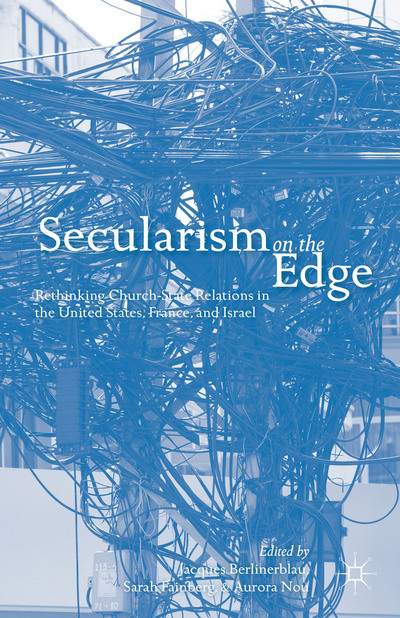
Prominent among the points addressed are the crippling nomenclatural confusions that have so hampered not only secularism as a political ideology, but secularism as an academic construct. This reader-friendly volume also offers a critical and nuanced look at how women are impacted by secular governance. Though secularism is often equated with modernity and progress, including with regard to gender equality, our contributors find that the truth is infinitely more complicated.

 and religion, using the concept of rule to illustrate the patterns of their interactions, and a multidisciplinary approach to demonstrate the global scope of their influence. It argues that the tension that often characterizes the relationship between these two cultural institutions results from their disagreements about the kinds of rule that should govern human life and society, and from where they should be derived. By combining theoretical analyses with tradition-specific and regional case studies, the book aims to advance our understanding of how the rule of law and the rule of religion should properly relate to each other, not only in a general way, but also in the context of addressing conflicts that may arise from their inevitable interaction. In addition to legal academics, the humanities scholars and students as well as the general public, will benefit from this book.
 sentiments in America. Drawing on both quantitative and qualitative research, authors George Yancey and David A. Williamson show that even though (or perhaps because) Christianity is the dominant religion in the United States, bias against Christians also exists—particularly against conservative Christians—and that this bias is worth understanding.
 place of the Bible in Jewish religion and culture. By thoroughly examining the complex link that the Jews have formed with the Bible, Jewish scholar Jean-Christophe Attias raises the uncomfortable question of whether it is still relevant for them.


 Robert George, Peter Steinfels, George Weigel, E. J. Dionne, and many more, exploring the unique elements of American Catholicism. The volume highlights the proceedings of the fifth annual Portsmouth Institute conference.