


Last night, the Mattone Center Reading Group met to discuss natural law in C.S. Lewis’s “Mere Christianity.” Great turnout for an important topic. Thanks to all the St. John’s Law students who participated!
Last night, the Mattone Center Reading Group met to discuss natural law in C.S. Lewis’s “Mere Christianity.” Great turnout for an important topic. Thanks to all the St. John’s Law students who participated!

Princeton’s Robert George is one of the world’s leading scholars of natural law. This is not a subject that keeps one out of controversy nowadays, but George has a unique ability to engage the public debate thoughtfully from a conservative perspective while retaining the respect of interlocutors on the other side. This summer, Encounter Books will release a new collection of essays from him on current issues, Seeking Truth and Speaking Truth: Law and Morality in Our Cultural Moment. Definitely worth reading. Here is the publisher’s description:
In Seeking Truth and Speaking Truth acclaimed political philosopher and legal scholar Robert P. George tackles some of the most vexing issues dividing Americans today. He argues that the “Age of Faith” of the Medieval period and the “Age of Reason” of the European Enlightenments have been followed by a modern “Age of Feeling,” in which people derive their beliefs not from faith or reason — or faith and reason — but from emotion, which becomes the central source of truth. And so, many have embraced a fierce moral absolutism on the basis of beliefs that are the products of nothing more than subjective inclinations and experiences.
This collection of essays challenges the “Age of Feeling” by appealing to reason in the pursuit of sound moral understanding on crucial and contentious topics including human dignity, the definition of marriage, philosophy of law, constitutional law, the nature of civil liberties, free markets, and others.
Robert George has taught generations of students at Princeton University and Harvard Law School, and he has long proclaimed that a teacher’s sacred mission is to form his students to be determined truth seekers and courageous truth speakers. In Seeking Truth and Speaking Truth he shows us how.

I’ve enjoyed Zondervan’s “Critical Points” series, which publishes brief and accessible introductions to contested questions in Christian thought. Here is a new volume in the series, Natural Law: Five Views, edited by Ryan Anderson and Andrew Walker. The book brings together scholars of natural law from the Protestant and Catholic traditions, which seem to be working in parallel. Here’s the publisher’s description:
The story of “natural law” – the idea that God has written a law on the human heart so that ethical norms derive from human nature – in twentieth-century Protestant ethics is one of rejection and resurgence. For half a century, luminaries like Karl Barth, Carl F. H. Henry, and Cornelius Van Til cast a shadow over natural law moral reflection because of its putative link to natural theology, autonomous reason, associations with Catholic theology, and ethical witness devoid of special revelation. However, over the past twenty years, Protestant theologians have renewed their interest in the subject, often animated by debates on Christian involvement in the public arena and on matters of life, death, and gender and sexuality. Much of this engagement has happened within Reformed circles and has largely been conducted without reference to Roman Catholic construals of the natural law. Conversely, Catholic developments in natural-law thinking have paid little attention to the surge of interest on the Protestant side. As a result, Protestant and Catholic natural proponents – and even those skeptical of the natural law – are not in conversation with one another.
The lack of dialog between the various schools of natural law has left a historic tradition within Christian moral thought underdeveloped in contemporary Protestant theology. By bringing together a variety of perspectives in much-needed conversation, this book helps readers to understand the various construals of natural law within the broader strands of Christian and classical traditions and clarifies its unique importance for Christian moral witness in a secular culture.

This month, the University of Notre Dame Press publishes an introduction what it calls the “new natural law,” Ethics, Politics, and Natural Law: Principles for Human Flourishing, by philosopher Melissa Moschella (Notre Dame). I’m in over my head here, but as I understand it, its proponents argue that new natural law theory (NNLT) integrates the three elements of goods, norms, and virtues more successfully than other approaches. Readers must judge for themselves. Here’s the description from the Notre Dame website:
The foundational principles of ethics and politics are principles that guide us to respect and promote human flourishing. In Ethics, Politics, and Natural Law Melissa Moschella provides an accessible explanation and development of the new natural law account of these principles while clarifying common misconceptions.
As a commonsense ethical theory, natural law grounds ethics in the fundamental dimensions of human flourishing. Moschella lays out the basic principles of natural law, their relationship to the virtues, and their social and political implications. Highlighting the importance of communities for flourishing, Moschella explains how this should shape our understanding of justice and the common good, and shows how natural law principles support limited government and civil liberties. She also considers the relationship between morality and God, and how natural law relates to Christian revelation. This fresh and compelling account of new natural law is the go-to resource to understand this important and influential theory.

In this episode, Fordham Law Professors Sean Griffith and Richard Squire join Mattone Center Director Mark Movsesian to talk about their experience leading a discussion of CS Lewis’s Mere Christianity in a student reading group this past semester. Sean and Richard discuss their goals in establishing the group, their students’ response to Lewis–in particular, his defense of natural law and Christian ethics–and the value of taking Christianity seriously as a matter of faith and intellect at a 21st-century American law school. A fascinating and wide-ranging discussion. Listen in!
Podcast: Play in new window | Download
Subscribe: RSS

As readers of this blog know, natural law has re-emerged as an important part of contemporary jurisprudence, especially among Catholic legal scholars. Evangelical scholars have shown interest in the subject, too, as evidenced by this forthcoming book from InterVarsity Press, Hopeful Realism: Evangelical Natural Law and Democratic Politics. The book addresses, from an Evangelical perspective, one of the thorniest practical problems with natural-law reasoning in a society like ours. How does one make a persuasive natural-law argument in a pluralistic society where people’s priors differ so greatly? The authors are political theorists Jesse Covington (Westmont College), Bryan T. McGraw (Wheaton College), and Micah Watson (Calvin University). The publisher’s description follows:
A Natural Law Framework for Evangelicals Today
During a time when political conversations are marked by deep polarization and difficult decision-making, what resources do evangelicals have to think critically and theologically about public life?
For political theorists Bryan T. McGraw, Jesse Covington, and Micah Watson, a crucial resource is to be found in natural law, a rich tradition of Christian political thought often neglected by evangelicals. Grounded in the hope and realism of the gospel, their evangelical natural law theory is deep in moral conviction yet oriented toward practical political decision-making. Relevant to all dimensions of political life, they show how an evangelical natural law framework can speak into debates about the economy, family life and marriage, violence and war, and religious freedom.
Hopeful Realism is a generous guide for evangelicals concerned with bringing their theological commitments to bear on their political judgments. A volume that brings together robust theory with practical cases, Covington, McGraw, and Watson show how evangelicals can participate as evangelicals in a pluralistic, often polarized, democracy.

This summer, Scholarship Roundup has focused on the revival (if that is the right word) of natural law thinking in American jurisprudence. That revival features especially prominently in scholarship in the Catholic tradition, and one of its leading figures is Russell Hittinger (University of Tulsa). This fall, Catholic University of America Press will publish a new volume of essays by Hittinger, On the Dignity of Society: Catholic Social Teaching and Natural Law. Here’s the description from the publisher’s website:
In this collection of essays, Francis Russell Hittinger shows that Catholic social teaching is not only an articulate defense of the dignity of the human person, but perhaps more fundamentally an elucidation of the dignity of society. Indeed, Hittinger enables us to see that one cannot properly defend the dignity of the person without also showing the dignity of societies in which human persons – as naturally familial, political, and ecclesial animals – seek their own perfection in communion with others. Hittinger has been a renowned scholar of Catholic social doctrine for some time now, and the essays presented here are the fruit of his mature thinking on the topic over the course of many years. As each chapter shows, Hittinger’s historically important body of work on Catholic moral and social philosophy and theology is rooted in natural law theory and Thomistic philosophy, but also animated by St. Augustine’s thought and thus consistently sensitive to historical contexts and arenas for moral and theological disputation. These magisterial essays therefore integrate historical studies of the development of Catholic social teaching with systematic exposition of the theological coherence of that tradition, while also articulating the essential role of philosophy and natural law within both.
The volume is divided into three parts. The first part is comprised of six essays on Catholic social teaching, the second part is made up of six essays on natural law and its role in social doctrine, and the third part includes two essays discussing the first principles of the Church’s teaching on social issues. This collection will no doubt become a standard in the field of scholarship on Catholic social teaching.
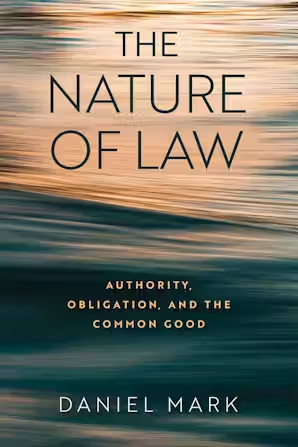
Here is another new book, this one from the University of Notre Dame Press, that reflects the academy’s growing interest in natural law: The Nature of Law: Authority, Obligation, and the Common Good, by political scientist Daniel Mark (Villanova). Mark argues that law should be understood as a set of commands oriented to the common good–which, of course, is the heart of Aquinas’s famous definition of law. Why scholars should be turning to natural law at this particular moment, when positivist theories like originalism and textualism have triumphed in the courts, is an interesting question. But the trend seems clear. Here’s a description of the book from the Notre Dame website:
Challenging the prevailing understanding of the authority of law, Daniel Mark offers a theory of moral obligation that is rooted both in command and in the law’s orientation to the common good.
When and why do we have an obligation to obey the law? Prevailing theories in the philosophy of law, starting with the work of H. L. A. Hart and Joseph Raz, fail to provide definitive answers regarding the nature of legal obligation. In this highly original and effective new work, Daniel Mark argues that there is a prima facie moral obligation to obey the law simply because it is the law. In Mark’s view, the best concept of law—one that allows for the possibility of justified authority and obligation—defines law as a set of commands oriented to the common good. Legal obligation, he proposes, shares defining features with moral obligation and with religious obligation while aligning wholly with neither.
This philosophically coherent view of legal obligation offers a viable framework for analyzing important and seemingly paradoxical puzzles about the law, such as why civil disobedience is punished as lawbreaking or why war-crimes trials for legal but immoral acts present a moral quandary.
By reconciling the concept of law as command with the role of law in promoting the common good, The Nature of Law provides an original and important scholarly contribution to the fields of legal philosophy and political thought.

As readers of our weekly Scholarship Roundup know, natural law is making a comeback in certain quarters of the American legal academy–a comeback that reflects concerns about the positivism that underlies prevailing theories like originalism and textualism. For most American law professors, natural law means Aquinas. But medieval jurisprudence isn’t the only natural-law game in town. A new book from Georgetown University Press discusses the work of a leading figure of the so-called “second scholasticism” at the time of the Counter Reformation, the Spanish Jesuit Francisco Suarez. The book is Law from Below: How the Thought of Francisco Suarez, S.J., Can Renew Contemporary Legal Engagement, by scholar Elizabeth Rain Kincaid (Loyola University New Orleans). Here’s the description from the Georgetown website:
The current political atmosphere would suggest that law is imposed only from above, specifically by the chief executive acting upon some sort of perceived populist mandate.
In Law from Below, Elisabeth Rain Kincaid argues that the theology of the early modern legal theorist and theologian, Francisco Suárez, SJ may be successfully retrieved to provide a constructive model of legal engagement for Christians today. Suárez’s theology was developed to combat an authoritarian view of law, suggesting that communities may work to change law from the ground up as they function within the legal system, not just outside it. Law from Below suggests that Suárez’s theory of law provides a theologically robust way to mount a counter-narrative to contemporary authoritarian theories of law, while still acknowledging the good in the rule of law and its imposition by a legislative authority. Suárez acknowledges the crucial contribution of citizens to improving law’s moral content, without removing the importance of law’s own authority or the role of the lawgiver.
Law from Below argues that the dialogue between legislators and the community provides Christian activists with a range of options for constructively engaging with law in order to have a positive impact on society.

The Morningside Institute will host two seminars on natural law, on March 22 and 29, at Columbia Law School. See below for details:
Natural Law: Aquinas, Locke, and the Moral Foundations of America
From the Declaration of Independence to Letter from Birmingham Jail, Americans have appealed to the natural law as the foundation of political action and justice in our society. Today, however, the natural law is widely contested and rejected by some as partisan or dangerous. In this seminar series, Philip Hamburger (Columbia) and Nathaniel Peters (Morningside) will explore Thomas Aquinas’s and John Locke’s conceptions of the natural law and how they might help us understand the moral foundations of twenty-first century America.
Part I of this seminar will meet from 6:00 PM-7:30 PM on March 22, 2023 in Case Lounge, 7th floor of main law school building, Jerome Greene Hall (435 W. 116th St). Due to policies at the law school, you must register to attend.
Part II of this seminar will meet from 6:00 PM-7:30 PM on March 29, 2023 in Room 416 of William and June Warren Hall on Amsterdan Avenue. Due to policies at the law school, you must register to attend.