NYU to Host Conference on People v. Phillips (April 12-14)

Next weekend, the Center for Irish and Irish-American Studies at NYU will host a conference marking the bicentennial of People v. Phillips, an early freedom-of-religion case involving the priest-penitent privilege:

Religious Freedom in America, 1813 to 2013: Bicentennial Reflections on People v. Philips” is a weekend of events that marks the landmark 1813 case that is the earliest known constitutional test of freedom of religion and the priest-penitent evidentiary privilege in American law. A dynamic line-up of events will demonstrate how a trial for a petty jewelry theft escalated into an argument for religious freedom when the local priest was subpoenaed to testify what he had heard in confession.
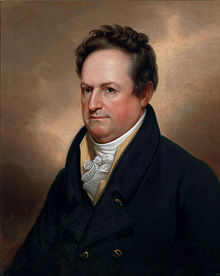
In People v. Philips, William Sampson — a banished political exile from Ireland and a Protestant — argued on behalf of the Trustees of St. Peter’s Roman Catholic Church on Barclay Street before the presiding judge, Mayor DeWitt Clinton [left]. William Sampson’s experience of religious-based intolerance in Ireland propelled him to persuade the court that America should not look to British common law for legal precedent when dealing with Catholics, then a small but growing minority in New York City.

William Sampson’s own published account of the case, The Catholic Question in America, will be presented in a staged reading adapted by Steve DiUbaldo of New York University’s Tisch School of the Arts on Friday evening, 12 April. A full-day symposium follows on Saturday, 13 April, where scholars from a wide variety of disciplines — especially law, religion, history, and politics — will comment on Sampson’s 1813 record of the trial and consider it in relation to their own understanding of contemporary issues. On Sunday morning 14 April, Green-Wood Cemetery in Brooklyn, the final resting place of lawyer William Sampson and DeWitt Clinton, will mark the 200th anniversary of the case with an encore reading of The Catholic Question and a wreath-laying ceremony.

Details are here.

Conference on Pacem in terris

The Lumen Christi Institute in Chicago will host a symposium on April 4, “Pacem in terris After 50 Years,” on the important Vatican II document:

On April 11, 1963, amid the global tensions of the Cold War, and shortly after the erection of the Berlin Wall, Pope John XXIII addressed his famous encyclical Pacem in terris to all people of good will. He invites them to consider the conditions for establishing universal peace on earth in truth, justice, charity, and liberty. On the 50th Anniversary of this event, this symposium will examine the affirmations of Pacem in terris as they bear on human rights, religious freedom, and the international political and economic order today.

Speakers include Mary Ann Glendon, Russ Hittinger, and Joseph Weiler. Details are here.

Pepperdine Law Review Publishes Religious Legal Theory Symposium

Papers from the third annual Religious Legal Theory Conference, organized by Bob Cochran and Mike Helfand at Pepperdine in 2012, have appeared in the Pepperdine Law Review. A great collection of papers, available on the law review’s website, here. Congratulations to Bob and Mike.

Call for Papers: “Religion, Democracy, and Equality”

The International Consortium for Law and Religion Studies (ICLRS) will host its third annual conference, “Religion, Democracy, and Equality,” in Richmond this coming August and has issued a call for papers on the following themes:

  • Religious pluralism and treatment of religious minorities
  • Religion and anti-discrimination norms
  • Hate speech, hate crimes, and religious minorities
  • Religion and gender issues.

Details are here.

The Second International Vatican Adult Stem Cell Conference (April 11-13)

On April 11-13, the Pontifical Council for Culture, NeoStem Inc., and The Stem for Life Foundation will host a second international conference on adult stem cell research entitled: “Regenerative Medicine — A Fundamental Shift in Science & Culture.” In addition to raising awareness about present opportunities in existing therapies and reducing misunderstandings about the field, the conference aims to  foster dialogue among researchers, physicians, philanthropists, faith leaders and policy makers to identify unmet medical needs that can benefit from the development of stem cell therapies. The conference will be held at the Vatican. The conference website can be found here.

Conference: Religion, Values and Immigration (March 21)

On March 21, the Brookings Institution will host a forum in connection with the release of a new national opinion survey on religion, values, and immigration reform. The event, in Washington, will be webcast live. Details are here.

Touro to Host Fourth Annual Religious Legal Theory Conference (April 10-12)

Touro Law School will host the fourth annual Religious Legal Theory Conference from April 10-12. This conference travels from school to school; CLR was honored to host the conference in 2010. This year’s theme is “Religious Legal Theory–Expanding the Conversation,”  and includes topics such as Religion and the Practice of Law, Media Perspectives on Law and Religion, and Religion and the Laws of War. Both Marc and I will moderate panels. Details are here.

Me at the Anti-Defamation League’s Brodsky Conference

Tomorrow evening, I will be on a panel hosted here in Manhattan by the Anti-Defamation League, as part of its annual Edward Brodsky Legal Conference.  The panel will be moderated by Noah Feldman (Harvard); my co-panelists are David Barkey (ADL), John Malcolm (Heritage Foundation), and Louise Melling (ACLU).

The subject of the panel is “The Boundaries of Religious Freedom: Mandates, Choices, and Liberties.”  Here’s some more information.  If you have time to come, please say hello.

Me at the Catholic Lawyers Guild this Friday

I’ll be giving a short talk at the Catholic Lawyers Guild of New York this Friday, March 1, at the kind invitation of Robert Crotty.  Mass is at 7:45 AM, there is a little light breakfast thereafter, and then I’ll offer some thoughts about the HHS contraceptives mandate, after which we’ll talk together.

The location is the Church of Our Saviour, 59 Park Avenue (Park Avenue at 38th Street).  Please stop in and say hello.

Conference, “Religious Freedom, Legal Pluralism and Democratic Constitutionalism”

Our friend Claudia Haupt (Columbia) reaches out with news of an interesting looking conference organized by political scientist Jean Cohen: “Religious Freedom, Legal Pluralism and Democratic Constitutionalism” at Columbia University on February 22-23.  Details follow.

Please save the date for:

Religious Freedom, Legal Pluralism and Democratic Constitutionalism
Organized by Political Science Professor Jean L. Cohen, Columbia University

Room 707, International Affairs Building

Friday, February 22, 2013

10:00am–12:00pm: Panel on Constitutionalism and Legal Pluralism

Paper by Dieter Grimm (Humboldt University) with comments by Andrew Arato (The New School)

2:00–4:00pm: Panel on Religious Legal Pluralism and Family Law

Paper by Linda McClain (Boston University) with comments by Mirjam Kunkler (Princeton University) and Karen Barkey (Columbia University)

Saturday, February 23, 2013

Room 707, International Affairs Building

10:00am–12:00pm: Panel on Republicanism and Freedom of Religion

Paper by Michel Troper (Paris X) with comments by Claudia Haupt (Columbia Law) and Stathis Gourgouris (Columbia University)

2:00–4:00pm: Panel on Freedom of Religion and Religious Establishment

Paper by Larry Sager (University of Texas, Austin) with comments by Nancy Rosenblum (Harvard University)