In December, the University of Chicago Press released “Beheading the Saint: Nationalism, Religion, and Secularism in Quebec,” by Geneviève Zubrzycki (University of Michigan). The publisher’s description follows:
Through much of its existence, Québec’s neighbors called it the “priest-ridden province.” Today, however, Québec society is staunchly secular, with a modern welfare  state built on lay provision of social services—a transformation rooted in the “Quiet Revolution” of the 1960s.
In Beheading the Saint, Geneviève Zubrzycki studies that transformation through a close investigation of the annual Feast of St. John the Baptist of June 24. The celebrations of that national holiday, she shows, provided a venue for a public contesting of the dominant ethno-Catholic conception of French Canadian identity and, via the violent rejection of Catholic symbols, the articulation of a new, secular Québécois identity. From there, Zubrzycki extends her analysis to the present, looking at the role of Québécois identity in recent debates over immigration, the place of religious symbols in the public sphere, and the politics of cultural heritage—issues that also offer insight on similar debates elsewhere in the world.
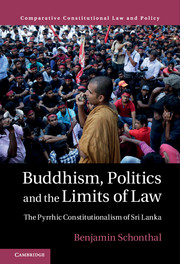 Drawing on groundbreaking research from Sri Lanka, this book argues persuasively for another possibility: when it comes to religion, relying on constitutional law may not be helpful, but harmful; constitutional practice may give way to pyrrhic constitutionalism. Written in a lucid and direct style, and aimed at both specialists and non-specialists, Buddhism, Politics and the Limits of Law explains why constitutional law has deepened, rather than diminished, conflicts over religion in Sri Lanka. Examining the roles of Buddhist monks, civil society groups, political coalitions and more, the book provides the first extended study of the legal regulation of religion in Sri Lanka as well as the first book-length analysis of the intersections of Buddhism and contemporary constitutional law.
 orientation. These disputes are often high-profile and frequently receive a lot of media attention and public debate. Starting from the basis that both these rights are valuable and worthy of protection, but that such disputes are often characterised by animosity, it contends that a proportionality analysis provides the best method for resolving these conflicts. The work takes a comparative approach, examining the law in England and Wales, Canada and the USA and examines four main areas of law, considering how a proportionality approach could be used in each. The book will be an invaluable resource for students and researchers in the areas of Public Law, Human Rights Law, Law and Religion, Discrimination Law, and Comparative Law.
 and remained applicable until the arrival of the British Colonial regime in Northern Nigeria in 1903. It sheds light on how the law survived colonial rule and continues until today.
 religious movements as conflict-prone and incapable of compromise, while religious actors may fear that anticlericalism will drive religion from public life. Yet such tensions are not inevitable: from Asia to Latin America, religious actors coexist with, and even help to preserve, democracy.
 More than two decades have passed since prime minister Yitzhak Rabin’s assassination in 1995, yet he remains an unusually intriguing and admired modern leader. A native-born Israeli, Rabin became an inextricable part of his nation’s pre-state history and subsequent evolution. This revealing account of his life, character, and contributions draws not only on original research but also on the author’s recollections as one of Rabin’s closest aides.
 Home to the largest Muslim minorities in Western Europe and Asia, France and India are both grappling with crises of secularism. In Politicizing Islam, Fareen Parvez offers an in-depth look at how Muslims have responded to these crises, focusing on Islamic revival movements in the French city of Lyon and the Indian city of Hyderabad. Presenting a novel comparative view of middle-class and poor Muslims in both cities, Parvez illuminates how Muslims from every social class are denigrated but struggle in different ways to improve their lives and make claims on the state. In Hyderabad’s slums, Muslims have created vibrant political communities, while in Lyon’s banlieues they have retreated into the private sphere. Politicizing Islam elegantly explains how these divergent reactions originated in India’s flexible secularism and France’s militant secularism and in specific patterns of Muslim class relations in both cities. This fine-grained ethnography pushes beyond stereotypes and has consequences for burning public debates over Islam, feminism, and secular democracy.
 Israel? This book provides a unique and detailed examination of the consequences of the ‘Jewish and democratic’ definition. It explores how the definition affects the internal ordering of the state, the operation of the law, and the ways it is used to justify, protect and regenerate certain features of Israeli constitutional law. It also considers the relationship between law and settler-colonialism, and how this relationship manifests itself in the constitutional order.
 leaders can play a constructive role. While religious fundamentalisms are in the news every day, we do not hear about the potential and actual role of religious actors in creating a peaceful and just society. Countering this trend, Sandal draws attention to how religious actors helped prepare the ground for stabilizing political initiatives, ranging from abolition of apartheid (South Africa), to the signing of the Lome Peace Agreement (Sierra Leone). Taking Northern Ireland as a basis and using declarations and speeches of more than forty years, this book builds a new perspective that recognizes the religious actors’ agency, showing how religious actors can have an impact on public opinion and policy making in today’s world.
 nations: the United States, France, England, Germany, the Netherlands, and Australia. As successful and stable political democracies, these countries share a commitment to protecting the religious rights of their citizens. The book demonstrates, however, that each has taken substantially different approaches to resolving basic church-state questions. The authors examine both the historical roots of those differences and more recent conflicts over Islam and other religious minorities, explain how contemporary church-state issues are addressed, and provide a framework for assessing the success of each of the six states in protecting the religious rights of its citizens using a framework based on the ideal of governmental neutrality and evenhandedness toward people of all faiths and of none.