Cox, “American Christianity”

Next month, the University of Texas Press will publish American Christianity by Stephen Cox (University of California, San Diego). The publisher’s description follows. American Christianity

Christianity takes an astonishing variety of forms in America, from churches that cherish traditional modes of worship to evangelical churches and fellowships, Pentecostal churches, social-action churches, megachurches, and apocalyptic churches—congregations ministering to believers of diverse ethnicities, social classes, and sexual orientations. Nor is this diversity a recent phenomenon, despite many Americans’ nostalgia for an undeviating “faith of our fathers” in the days of yore. Rather, as Stephen Cox argues in this thought-provoking book, American Christianity is a revolution that is always happening, and always needs to happen. The old-time religion always has to be made new, and that is what Americans have been doing throughout their history.

American Christianity is an engaging book, wide ranging and well informed, in touch with the living reality of America’s diverse traditions and with the surprising ways in which they have developed. Radical and unpredictable change, Cox argues, is one of the few dependable features of Christianity in America. He explores how both the Catholic Church and the mainline Protestant churches have evolved in ways that would make them seem alien to their adherents in past centuries. He traces the rise of uniquely American movements, from the Mormons to the Seventh-day Adventists and Jehovah’s Witnesses, and brings to life the vivid personalities—Aimee Semple McPherson, Billy Sunday, and many others—who have taken the gospel to the masses. He sheds new light on such issues as American Christians’ intense but constantly changing political involvements, their controversial revisions in the style and substance of worship, and their chronic expectation that God is about to intervene conclusively in human life. Asserting that “a church that doesn’t promise new beginnings can never prosper in America,” Cox demonstrates that American Christianity must be seen not as a sociological phenomenon but as the ever-changing story of individual people seeking their own connections with God, constantly reinventing their religion, making it more volatile, more colorful, and more fascinating.

Sirota, “The Christian Monitors: The Church of England and The Age of Benevolence, 1680-1730”

This month, Yale University Press published The Christian Monitors: The Church of England and The Age of Benevolence, 1680-1730 by Brent S. Sirota The Christian Monitors(North Carolina State University).  The publisher’s description follows.

This original and persuasive book examines the moral and religious revival led by the Church of England before and after the Glorious Revolution, and shows how that revival laid the groundwork for a burgeoning civil society in Britain. After outlining the Church of England’s key role in the increase of voluntary, charitable, and religious societies, Brent Sirota examines how these groups drove the modernization of Britain through such activities as settling immigrants throughout the empire, founding charity schools, distributing devotional literature, and evangelizing and educating merchants, seamen, and slaves throughout the British empire—all leading to what has been termed the “age of benevolence.”

Too “Christian” to Excite the Left, Too “Foreign” to Excite the Right

Here’s a great piece by The Week’s Michael Brendan Dougherty on the persecution of Mideast Christians. Doughtery offers an explanation for why the human rights community in the West is largely ignoring the problem:

Western activists and media have focused considerable outrage at Russia’s laws against “homosexual propaganda” in the lead-up to the 2014 Sochi Winter Olympics. It would only seem fitting that Westerners would also protest (or at the very least notice) laws that punish people with death for converting to Christianity.

And yet the Western world is largely ignorant of or untroubled by programmatic violence against Christians. Ed West, citing the French philosopher Regis Debray, distils the problem thusly: “The victims are ‘too Christian’ to excite the Left, and ‘too foreign’ to excite the Right.”

That really says it quite well.

Samuel Tadros to Discuss “Motherland Lost” at Georgetown (Jan 30)

The Hudson Institute’s Samuel Tadros will be discussing his important book, Motherland Lost:The Egyptian and Coptic Quest for Modernity, at Georgetown University on January 30. Details are here. I interviewed Sam about this book at CLR Forum last fall.

Wadsworth, “Ambivalent Miracles: Evangelicals and the Politics”

Next month, University of Virginia Press will publish Ambivalent Miracles: Evangelicals and the Politics by Nancy D. Wadsworth (University of Denver).  Wadsworth sk6.612345678.inddThe publisher’s description follows.

Over the past three decades, American evangelical Christians have undergone unexpected, progressive shifts in the area of race relations, culminating in a national movement that advocates racial integration and equality in evangelical communities. The movement, which seeks to build cross-racial relationships among evangelicals, has meant challenging well-established paradigms of church growth that built many megachurch empires. While evangelical racial change (ERC) efforts have never been easy and their reception has been mixed, they have produced meaningful transformation in religious communities. Although the movement as a whole encompasses a broad range of political views, many participants are interested in addressing race-related political issues that impact their members, such as immigration, law enforcement, and public education policy.

Ambivalent Miracles traces the rise and ongoing evolution of evangelical racial change efforts within the historical, political, and cultural contexts that have shaped them. Nancy D. Wadsworth argues that the stunning breakthroughs this movement has achieved, its curious political ambivalence, and its internal tensions are products of a complex cultural politics constructed at the intersection of U.S. racial and religious history and the meaning-making practices of conservative evangelicalism. Employing methods from the emerging field of political ethnography, Wadsworth draws from a decade’s worth of interviews and participant observation in ERC settings, textual analysis, and survey research, as well as a three-year case study, to provide the first exhaustive treatment of ERC efforts in political science.

Helping Mideast Christians

Last week, Robert George and Katrina Lantos Swett, the chair and vice-chair, respectively, of the US Commission on International Religious Freedom, published an important op-ed on the persecution of Mideast Christians. This topic receives far too little attention, for reasons I’ve explained, and George and Swett deserve praise for writing about it.

The situation is truly dire. For example, George and Swett discuss the plight of Egypt’s Copts, who celebrate Christmas today, as well as Christians in Iraq:

In Egypt, persecution against Coptic Christians, the region’s largest non-Muslim religious minority, numbering 8 million, has reached critical proportions. While Hosni Mubarak’s military-backed regime failed to punish attacks against Copts and other religious minorities, Mohammed Morsi’s election to the presidency in 2012 was followed by rhetoric leading to more violence before and since his ouster this July. Since mid-August, following a military crackdown on Morsi’s Muslim Brotherhood supporters, Brotherhood sympathizers have assaulted more than 200 Christian religious structures, homes, and businesses.

In Iraq, violence against Christians rose after Saddam Hussein’s fall. Christians have endured increasing levels of rape, torture, and murder, driving many away. On Christmas Day, at least 37 people died in bombings in Christian areas, including a car bombing outside of a church. Meanwhile, Prime Minister Nouri al-Maliki’s government has failed repeatedly to bring perpetrators to justice. Once home to about one million Christians, Iraq has half that number today.

The situation in Iraq, in particular, should embarrass the United States. America toppled Saddam Hussein and occupied Iraq for almost a decade. The result for Christians and some other religious minorities has been disaster. And security continues to deteriorate. Just last week, Fallujah fell to militants linked to Al Qaeda.

But I digress. At the end of their op-ed, George and Swett suggest some things that the US can do to help persecuted Mideast Christians now:

First, the United States must press governments to bring to justice those who assault religious minorities – not only Christians but Shi’a Muslims in Egypt, Iraq, and Saudi Arabia, Sunni Muslims and Baha’is in Iran, and Shi’a and Ahmadis in Pakistan.

Second, Washington must urge these governments to cease punishing the innocent. In countries like Egypt and Pakistan, Christians and others face not only violence from extremists who rarely are imprisoned for their misdeeds, but prison at the hands of these same governments, thanks to blasphemy laws which violate freedom of expression as well as religion.

Third, the United States must firmly support religious freedom as an antidote to religious extremism in these countries. By supporting a robust marketplace of beliefs and ideas, religious freedom enables more tolerant beliefs to compete in the struggle for hearts and minds.

Here I’d like to suggest a couple of friendly amendments. First, it’s not clear whether George and Swett are suggesting public action by the US. Public pressure could do more harm than good, in my view. Given the pathologies of the Mideast, overt advocacy on the part of religious minorities could expose them to a backlash. Christians are already seen, unfairly, as intruders and Western agents. Moreover, popular opinion in America would not support serious interventions on behalf of Mideast Christians. Public statements of support, without the will to back them up with concrete actions, would only raise expectations unfairly. This sort of thing has occurred to Mideast Christians many times in the past.

So pressure by the US should be private. Even private pressure could backfire, of course, especially if regional governments decide to make Christians scapegoats. But private pressure is less likely than public admonishment to cause greater problems for already vulnerable people.

Second, in addition to trying to improve the status of Christians in the region, the US and other Western countries should fast-track asylum applications from Copts and other Mideast Christians, to provide a haven for those who wish to leave the region. This is a very imperfect solution, of course, as it would accelerate the depopulation of ancient Christian communities in the Middle East. But leaving these Christians to their fate isn’t a good option, either.

The Massacre of the Innocents

Photo from The Guardian

From the New York Times this Christmas morning:

At least 26 people were killed and 38 others wounded on Wednesday when a car bomb exploded in a parking lot near St. John’s Catholic Church in Dura, south of Baghdad, according to the police and medical sources.

The bomb detonated at the end of Christmas prayers as worshipers were leaving the church, the officials said.

The victims, most of them Christians, included women and children, as well as number police officers posted as guards.

A few minutes before the church bombing, and barely a half-mile away, a series of three other bombings in a market in an Assyrian Christian neighborhood left 11 people dead and 22 wounded.

What can be said?

Prince Charles Draws Attention to Persecution of Mideast Christians

Photo from the BBC

This year has been a dreadful one for Mideast Christians. In Egypt, Islamists frustrated at the fall of the Morsi government have singled out Copts for vengeance. By some accounts, Copts are suffering the worst persecution they have experienced in 700 years. In Syria, Islamist rebels are targeting Christians, whom they accuse of siding with the Assad regime.  In Iraq, Islamist gangs demand exorbitant protection money from the few Christians who remain–unless the Christians agree to convert to Islam. Across the region, Christians are being kidnapped, driven from their homes, killed. Their churches are being burned, their schools bombed. Christianity faces an existential threat in the place where it was born.

Mostly, the persecution of Mideast Christians has failed to attract attention in the West–although the media seems to be catching on. Mideast Christians lack strong lobbies in Western capitals, and the Western human rights community has a hard time seeing any Christians as victims rather than oppressors. So praise goes to Britain’s Prince Charles, who last week met with representatives of Mideast Christians in London to draw attention to the ongoing persecution:

“It seems to me that we cannot ignore the fact that Christians in the Middle East are, increasingly, being deliberately targeted by fundamentalist Islamist militants,” he said. Noting Christianity’s roots in the region, the Prince observed that today the Middle East and North Africa have the lowest concentration of Christians in the world—just 4 percent—and that this has “dropped dramatically over the last century and is falling still further.” He said that the effect of this was that “we all lose something immensely and irreplaceably precious when such a rich tradition dating back 2,000 years begins to disappear.”

The BBC’s report of the Prince’s meeting is here.

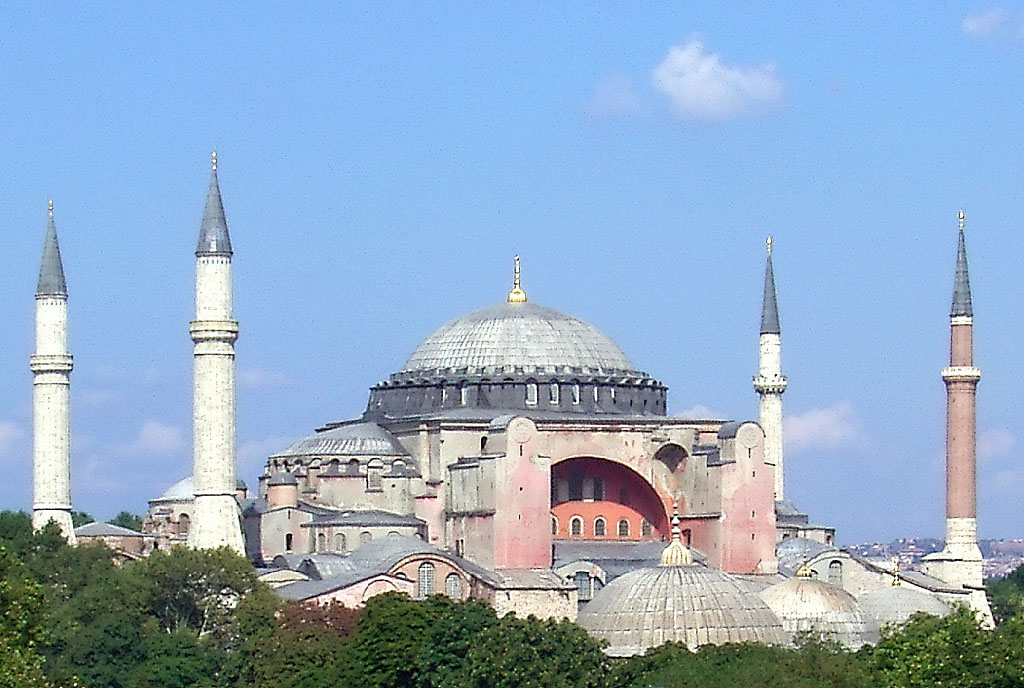
Will the Hagia Sophia Again Become a Mosque?

When I heard the rumors this fall, I have to confess, I dismissed them. And maybe it is only political posturing. But leading Turkish officials are actually talking about converting the famed Hagia Sophia in Istanbul back into a mosque.

The Hagia Sophia, or Church of the Holy Wisdom, was built by the Emperor Justinian in the sixth century. (“Solomon,” the emperor cried when he saw the completed church, “I have surpassed thee!”). For 1000 years, it was the largest Christian cathedral in the world and the emblem of Byzantium. After the empire fell in 1453, the Ottomans converted the church into a mosque. About 500 years after that, the secular Kemalist government made it a museum. And so it has remained.

Now, however, a nationalist party has introduced legislation to reconvert the building to a Muslim place of worship. The idea has support at very high levels. In October, the imam at the neighboring Sultan Ahmet Mosque–a government official–called for Hagia Sophia to reopen as a mosque. Last month, at a public event in Istanbul, Turkey’s Deputy Prime Minister, Bulent Arinc, referred approvingly to two other churches-turned-mosques-turned-museums-turned-mosques-again, one in Trabzon and one in Iznik (once known as Nicea). And he made this comment about the Hagia Sophia itself: “We currently stand next to the Hagia Sophia Mosque. We are looking at a sad Hagia Sophia but hopefully we will see it smiling again soon.”

Arinc’s implication is unmistakable. According to the Religion News Service, Turkey’s ruling party, the Islamist AKP, is trying to shore up its base ahead of March provincial elections. It’s smart politics. AKP rank-and-file see Kemalism as a huge historical mistake and wish to return to the pan-Islamism of the Ottoman Empire. Converting Byzantine and other historical Christian monuments from museums into mosques is a way of rejecting secularism and returning to Turkish roots. The Hagia Sophia is the greatest symbol of all. That’s why, in the words of one observer, “Supporting the reopening of Hagia Sophia has become the litmus test of the true believer.”

When it comes to appropriating the temples of the vanquished, no great religion is innocent. Historically, Christians often built churches on the ruins of pagan shrines. One of my favorite sites in Rome, the Basilica of San Clemente, sits atop a Mithraic temple, the ruins of which are still visible. After the Reconquista, Rod Dreher writes, Christians converted the great mosque of Cordoba into a cathedral. The point of such conduct is obvious. The victor wishes literally to squash the altars of the vanquished, to humiliate and demoralize followers of the old way. Our god is greater than yours.

But this sort of thing doesn’t happen anymore in the civilized world. As Dreher writes, converting the Hagia Sophia into a mosque now, after it has been a museum for decades, would be “a stunning act of cultural aggression” against Christians in Turkey, particularly the handful of Greeks who somehow have managed to hang on there. It would put the lie to claims of pluralism. And it would underline, as few other acts could, what Samuel Huntington famously called “the clash of civilizations.”

Conference: Christianity and Freedom (Dec.13-14)

For our readers in Europe, Georgetown’s Berkley Center will host what looks to be a fantastic conference in Rome this weekend, “Christianity and Freedom: Historical and Contemporary Perspectives.” The conference, which boasts an all-star lineup, will take place at the Pontifical Urbaniana University. Here’s the organizers’ description:

From Cairo and Damascus to Tehran and Beijing, religious freedom is under siege. Ironically, it is Christianity—a faith that contributed decisively to the rise of religious liberty—that now finds itself increasingly persecuted around the world. In view of this global crisis, Georgetown University’s Religious Freedom Project will host a two-day conference in Rome highlighting Christianity’s contributions to the understanding and practice of freedom for all people. The conference will present findings from a two-year study by dozens of scholars concerning Christianity’s contributions to freedom. This event is co-sponsored by Baylor University’s Institute for Studies of Religion and is made possible by a generous grant from the Historical Society’s Religion and Innovation in Human Affairs Program.