Law and Religion in Judaism and Christianity

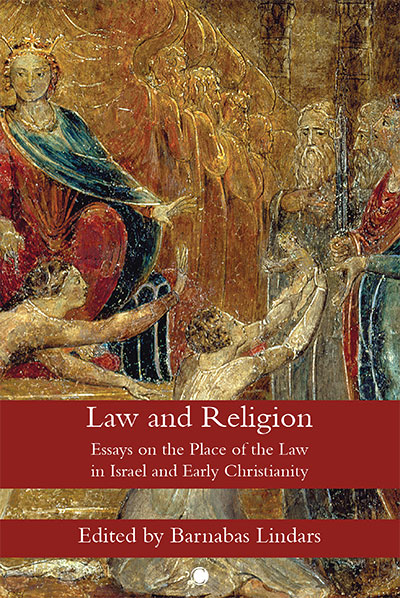
Jews and Christians–or, more correctly, Judaism and Christianity–have been contesting the place and purpose of law for two thousand years. It’s a debate that never exhausts itself, because each religion has defined itself largely as against the other, and law has been one of the central points of controversy. This month, the British publisher, James Clarke & Co., releases an addition to the debate, Law and Religion: Essays on the Place of the Law in Israel and Early Christianity, edited by the late Biblical scholar Barnabas Lindars of the University of Manchester. The book’s introduction indicates that most of the papers date from decades ago, so I’m not sure why the collection is appearing only now. Anyway, the table of contents looks very interesting. Here’s the publisher’s description:

The place of the Law and its relationship to religious observance and faith is a contested topic in the study of both the Old and New Testament. In Law and Religion, members of the Erhardt Seminar group provide an insight into the debate, probing key topics and offering new contributions to the subject. Their essays are grouped into three sections, focusing in turn on the Law’s place in Israelite religion, in the Jesus tradition, and in Paul and the Apostolic tradition.

Thus, the foundation of the connection between law and religion in ancient Israel is explored, along with the decisive influence of the Deuteronomic reform and the radical new understanding now emerging of the later development in Judaism of the New Testament Period. So, also, the contemporary challenge to the conventional picture of Jesus and the Law is addressed, the attitude of Paul is shown in new light, and post-Pauline developments are examined. Readers will find in this symposium a refreshing breadth of opinion on a debate that spans the gamut of disciplines within Biblical studies.

Decline and Fall

Gibbon, among others, famously argued that the rise of Christianity contributed to the fall of the Roman Empire, in the West, anyway: In the East, the Empire lasted another 1000 years, which is a long time to fall by any standards. A new book from Harvard University Press, The Tragedy of Empire: From Constantine to the Destruction of Roman Italy, discusses the establishment of Christianity in the Empire, among other topics, in its account of the last two centuries of the Empire in the West. The author is historian and classicist Michael Kulikowsi (Penn State). Here’s the publisher’s description:

A sweeping political history of the turbulent two centuries that led to the demise of the Roman Empire.

The Tragedy of Empire begins in the late fourth century with the reign of Julian, the last non-Christian Roman emperor, and takes readers to the final years of the Western Roman Empire at the end of the sixth century. One hundred years before Julian’s rule, Emperor Diocletian had resolved that an empire stretching from the Atlantic to the Euphrates, and from the Rhine and Tyne to the Sahara, could not effectively be governed by one man. He had devised a system of governance, called the tetrarchy by modern scholars, to respond to the vastness of the empire, its new rivals, and the changing face of its citizenry. Powerful enemies like the barbarian coalitions of the Franks and the Alamanni threatened the imperial frontiers. The new Sasanian dynasty had come into power in Persia. This was the political climate of the Roman world that Julian inherited.

Law Like Love?

It may seem a little strange to say it this way, given the fact that Christianity has been dealing with the subject for 2000 years, but lately the global legal academy has begun to show interest in Christian jurisprudence. Marc has written a couple of posts about the phenomenon, and our latest Legal Spirits podcast discusses it as well–specifically, what Marc has taken to calling the “Australian School.” Here is a new, interesting-looking collection of essays on Christian jurisprudence from Routledge, Christianity, Ethics, and the Law: The Concept of Love in Christian Legal Thought, edited by Zachary Calo (Hamad bin Khalifa University, Qatar), Joshua Neoh (Australian National University), and A. Keith Thompson (University of Notre Dame, Australia). The Australian School seems very much in evidence. The essays focus on how the central Christian virtue of love can influence law and legal philosophy:

This book examines how Christian love can inform legal thought. The work introduces love as a way to advance the emergent conversation between constructive theology and jurisprudence that will also inform conversations in philosophy and political theory.

Love is the central category for Christian ethical understanding. Yet, the growing field of law and religion, and relatedly law and theology, rarely addresses how love can shape our understanding of law. This reflects, in part, a common assumption that law and love stand in necessary tension. Love applies to the private and the personal. Law, by contrast, applies to the public and the political, realms governed by power. It is thus a mistake to envisage love as having anything but a negative relationship to law. This conclusion continues to govern Christian understandings of the meaning and vocation of law. The animating idea of this volume is that the concept of love can and should inform Christian legal thought. The project approaches this task from the perspective of both historical and constructive theology. Various contributions examine how such thinkers as Augustine, Aquinas, and Calvin utilised love in their legal thought. These essays highlight often neglected aspects of the Christian tradition. Other contributions examine Christian love in light of contemporary legal topics including civility, forgiveness, and secularism. Love, the book proposes, not only matters for law but can transform the terms on which Christians understand and engage it.

The book will be of interest to academics and researchers working in the areas of legal theory; law and religion; law and philosophy; legal history; theology and religious studies; and political theory.

On Law and Love

“Love does no wrong to a neighbor,” the Apostle Paul wrote in Romans; “therefore, love is the fulfilling of the law.” We close out this year’s book notes with a collection of essays that explores the meaning of this Biblical admonition. Next week, Routledge releases Christianity, Ethics and the Law: The Concept of Love in Christian Legal Thought. The editors are law professors Zachary Calo (Hamad bin Khalifa University, Qatar), Joshua Neoh (Australian National University), and A. Keith Thompson (University of Notre Dame Australia). Looks very interesting. Here’s the publisher’s description:

This book examines how Christian love can inform legal thought. The work introduces love as a way to advance the emergent conversation between constructive theology and jurisprudence that will also inform conversations in philosophy and political theory.

Love is the central category for Christian ethical understanding. Yet, the growing field of law and religion, and relatedly law and theology, rarely addresses how love can shape our understanding of law. This reflects, in part, a common assumption that law and love stand in necessary tension. Love applies to the private and the personal. Law, by contrast, applies to the public and the political, realms governed by power. It is thus a mistake to envisage love as having anything but a negative relationship to law. This conclusion continues to govern Christian understandings of the meaning and vocation of law. The animating idea of this volume is that the concept of love can and should inform Christian legal thought. The project approaches this task from the perspective of both historical and constructive theology. Various contributions examine how such thinkers as Augustine, Aquinas, and Calvin utilised love in their legal thought. These essays highlight often neglected aspects of the Christian tradition. Other contributions examine Christian love in light of contemporary legal topics including civility, forgiveness, and secularism. Love, the book proposes, not only matters for law but can transform the terms on which Christians understand and engage it.

The book will be of interest to academics and researchers working in the areas of legal theory; law and religion; law and philosophy; legal history; theology and religious studies; and political theory.

Christian and Muslim Approaches to Law

One of the very earliest recorded encounters between a Christian and a Muslim, a public debate between a Syriac patriarch and an Arab emir shortly after the Arab conquest of Syria, concerns the role of law in religion. Without a body of law, the emir insisted, Christianity could not call itself a religion; Christians should convert to Islam, a real religion that had the Sharia. The patriarch responded that Christians indeed had law, though not as Muslims understood it; Christians had no need to convert. I thought of this debate when I saw a notice for a forthcoming book from Cambridge, Law and the Rule of God: A Christian Engagement with Sharia, by Joshua Rallston (Edinburgh). Law–or, rather, the proper conception of law–is a major point of contention between these two world religions, and a comparative study like this one seems very promising. The publisher’s description follows:

Sharī’a is one of the most hotly contested and misunderstood concepts and practices in the world today. Debates about Islamic law and its relationship to secularism and Christianity have dominated political and theological discourse for centuries. Unfortunately, Western Christian theologians have failed to engage sufficiently with the challenges and questions raised by Islamic political theology, preferring instead to essentialize or dismiss it. In Law and the Rule of God, Joshua Ralston presents an innovative approach to Christian-Muslim dialogue. Eschewing both polemics and apologetics, he proposes a comparative framework for Christian engagement with Islamic debates on sharī’a. Ralston draws on a diverse range of thinkers from both traditions including Karl Barth, Ibn Taymiyya, Thomas Aquinas, and Mohammad al-Jabri. He offers an account of public law as a provisional and indirect witness to the divine rule of justice. He also demonstrates how this theology of public law deeply resonates with the Christian tradition and is also open to learning from and dialoguing with Islamic and secular conceptions of law, sovereignty, and justice.

Legal Spirits Episode 041: Learning in War-Time

In this episode of Legal Spirits, Center Co-Directors Mark Movsesian and Marc DeGirolami explore C.S. Lewis’s great essay on the calling of the Christian scholar, “Learning in War-Time.” Lewis wrote the essay at the start of World War II, but it continues to speak to students and faculty today–Christian and non-Christian. As Lewis observes, “human life is always lived on the edge of a precipice,” and the question why people should devote what little time they have on earth to academic pursuits when so many other things call for our attention is a perennial one. Lewis’s message is one of humility, courage, and controlled hope, even in the worst of times. Listen in!

Christianity and Conservatism’s Multiethnic Future

At the First Things site today, I have an essay on how a broad, ecumenical Christianity will feature in a new, multiethnic conservative movement. Here’s a sample:

The factors Salam identifies no doubt figure in minorities’ increasing affinity for conservative politics. But I think his explanation misses another important factor: conservative Christianity. The media typically presents conservative Christians as monolithically white, but that is not the case. For example, about one-quarter of evangelicals are members of racial and ethnic minorities, and Republicans apparently did very well among them. According to Gaston Espinoza, a researcher at Claremont McKenna College who conducted a survey of Latino voters, it was “Latino evangelicals” who “helped Trump to do better than anyone expected in Texas … and in Florida.”

I don’t know of studies that analyze minority voters in terms of church attendance, but in the general population, religious observance correlates with voting for the GOP, and that pattern presumably holds for many minorities as well. According to the AP Vote Cast Survey, people who attend church regularly—up to a few times a month—broke solidly for Trump, 54 percent to 45 percent. People who attend church once a week or more voted 61 percent for Trump. By contrast, people who never attend church went strongly for Biden, 63 percent to 32 percent. (This last figure is consistent with surveys that reveal that more than two-thirds of Democrats “never attend religious services.”) To be sure, differences exist among minority communities; black Christians, for example, continue to vote Democrat in very large numbers. Still, it is reasonable to think that, with respect to minorities, as with respect to the American public generally, the religiously observant tend to vote Republican.

If Republicans are to become a multiethnic, middle-class movement, a popular, ecumenical Christianity of the sort I observed at the Museum of the Bible will likely have an important place in it. In fact, the religious identity of the movement need not be exclusively Christian. Americans are famously non-sectarian when it comes to public religion, and it’s possible to imagine a political coalition of the traditionally religious from all faith communities. Although good studies are difficult to find, some suggest that Orthodox Jews increasingly vote Republican. And President Trump drew one-third of Muslim voters in 2020, a large increase over 2016.

You can read the whole essay here.

Around the Web

Here are some important law-and-religion news stories from around the web:

Around the Web

Here are some important law-and-religion news stories from around the web:

Around the Web

Here are some important law-and-religion news stories from around the web: