Hittinger on Natural Law

This summer, Scholarship Roundup has focused on the revival (if that is the right word) of natural law thinking in American jurisprudence. That revival features especially prominently in scholarship in the Catholic tradition, and one of its leading figures is Russell Hittinger (University of Tulsa). This fall, Catholic University of America Press will publish a new volume of essays by Hittinger, On the Dignity of Society: Catholic Social Teaching and Natural Law. Here’s the description from the publisher’s website:

In this collection of essays, Francis Russell Hittinger shows that Catholic social teaching is not only an articulate defense of the dignity of the human person, but perhaps more fundamentally an elucidation of the dignity of society. Indeed, Hittinger enables us to see that one cannot properly defend the dignity of the person without also showing the dignity of societies in which human persons – as naturally familial, political, and ecclesial animals – seek their own perfection in communion with others. Hittinger has been a renowned scholar of Catholic social doctrine for some time now, and the essays presented here are the fruit of his mature thinking on the topic over the course of many years. As each chapter shows, Hittinger’s historically important body of work on Catholic moral and social philosophy and theology is rooted in natural law theory and Thomistic philosophy, but also animated by St. Augustine’s thought and thus consistently sensitive to historical contexts and arenas for moral and theological disputation. These magisterial essays therefore integrate historical studies of the development of Catholic social teaching with systematic exposition of the theological coherence of that tradition, while also articulating the essential role of philosophy and natural law within both.

The volume is divided into three parts. The first part is comprised of six essays on Catholic social teaching, the second part is made up of six essays on natural law and its role in social doctrine, and the third part includes two essays discussing the first principles of the Church’s teaching on social issues. This collection will no doubt become a standard in the field of scholarship on Catholic social teaching.

Around the Web

Here are some important law-and-religion news stories from around the web:

  • In The Satanic Temple, Inc. v. City of Boston, the 1st Circuit ruled that the Boston City Council did not violate the 1st Amendment by choosing not to invite representatives of the Satanic Temple to deliver invocations at Council meetings. The court found no evidence of religious bias in the selection process as Council members choose speakers based on personal or community ties.
  • In StandWithUs Center for Legal Justice v. Massachusetts Institute of Technology, a Massachusetts district court dismissed a suit against MIT, which alleged that the university showed deliberate indifference to a hostile environment affecting Jewish and Israeli students in violation of Title VI. The court found that MIT took various steps to address the escalating protests and threats, indicating that its response was not clearly unreasonable.
  • A Massachusetts district judge denied Harvard’s motion to dismiss a lawsuit by six Jewish students alleging the university failed to address pervasive antisemitism on campus, citing the university’s “deliberate indifference”. The decision is particularly notable as it comes shortly after the same judge dismissed a similar lawsuit against MIT (see above).
  • In Spillane v. Lamont, the Connecticut Supreme Court decided that parents cannot pursue constitutional challenges to the removal of religious exemptions from vaccination requirements because of sovereign immunity. However, the court allowed a statutory claim under the Connecticut Religious Freedom Restoration Act, stating that sovereign immunity does not block this type of claim.
  • Americans United for Separation of Church and State faces internal conflict and allegations of a troubled work culture. A staff union and former board members complain that the group’s leadership prioritizes publicity over the organization’s core mission of protecting the separation of church and state, which has resulted in resignations and accusations of a toxic environment.

On Law and the Common Good

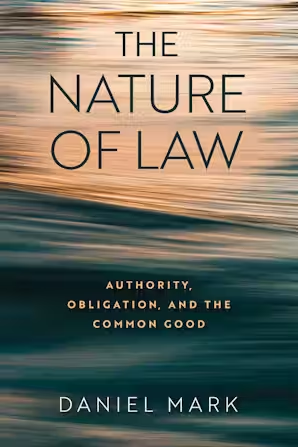
Here is another new book, this one from the University of Notre Dame Press, that reflects the academy’s growing interest in natural law: The Nature of Law: Authority, Obligation, and the Common Good, by political scientist Daniel Mark (Villanova). Mark argues that law should be understood as a set of commands oriented to the common good–which, of course, is the heart of Aquinas’s famous definition of law. Why scholars should be turning to natural law at this particular moment, when positivist theories like originalism and textualism have triumphed in the courts, is an interesting question. But the trend seems clear. Here’s a description of the book from the Notre Dame website:

Challenging the prevailing understanding of the authority of law, Daniel Mark offers a theory of moral obligation that is rooted both in command and in the law’s orientation to the common good.

When and why do we have an obligation to obey the law? Prevailing theories in the philosophy of law, starting with the work of H. L. A. Hart and Joseph Raz, fail to provide definitive answers regarding the nature of legal obligation. In this highly original and effective new work, Daniel Mark argues that there is a prima facie moral obligation to obey the law simply because it is the law. In Mark’s view, the best concept of law—one that allows for the possibility of justified authority and obligation—defines law as a set of commands oriented to the common good. Legal obligation, he proposes, shares defining features with moral obligation and with religious obligation while aligning wholly with neither.

This philosophically coherent view of legal obligation offers a viable framework for analyzing important and seemingly paradoxical puzzles about the law, such as why civil disobedience is punished as lawbreaking or why war-crimes trials for legal but immoral acts present a moral quandary.

By reconciling the concept of law as command with the role of law in promoting the common good, The Nature of Law provides an original and important scholarly contribution to the fields of legal philosophy and political thought.

Around the Web

Here are some important law-and-religion news stories from around the web:

  • The U.S. Department of Education determined that a school district in New Jersey violated federal law by asking students about their religious identities without parental consent.
  • In two separate cases concerning Covid vaccine requirements, the 7th Circuit ruled that claims for religious exemptions under Title VII may include secular as well as religious elements.
  • A federal district court in Maine rejected both parties’ motions for summary judgment in Pines Church v. Hermon School District, in which a church claims a school district discriminated against it, based on religion, by denying the church’s application for a long-term lease. The court ruled the case must go to trial.
  • In Gethsemani Baptist Church v. City of San Luis, the US Department of Justice filed a statement of interest indicating that a Baptist church could file an RLUIPA challenge to city zoning laws without first applying for a conditional-use permit.
  • In Athey Creek Christian Fellowship v. Clackamas County, an Oregon federal district court dismissed an RLUIPA claim concerning a requirement for a conditional use permit to build additions to a church building. The court held that requiring the plaintiff to reapply did not resemble what traditionally constitute substantial burdens under the RLUIPA.
  • In Frankel v. Regents of the University of California, a federal judge ordered the University of California to devise a plan to curb the antisemitic treatment of Jewish students on campus.

On Suarez and “Law from Below”

As readers of our weekly Scholarship Roundup know, natural law is making a comeback in certain quarters of the American legal academy–a comeback that reflects concerns about the positivism that underlies prevailing theories like originalism and textualism. For most American law professors, natural law means Aquinas. But medieval jurisprudence isn’t the only natural-law game in town. A new book from Georgetown University Press discusses the work of a leading figure of the so-called “second scholasticism” at the time of the Counter Reformation, the Spanish Jesuit Francisco Suarez. The book is Law from Below: How the Thought of Francisco Suarez, S.J., Can Renew Contemporary Legal Engagement, by scholar Elizabeth Rain Kincaid (Loyola University New Orleans). Here’s the description from the Georgetown website:

The current political atmosphere would suggest that law is imposed only from above, specifically by the chief executive acting upon some sort of perceived populist mandate.

In Law from Below, Elisabeth Rain Kincaid argues that the theology of the early modern legal theorist and theologian, Francisco Suárez, SJ may be successfully retrieved to provide a constructive model of legal engagement for Christians today. Suárez’s theology was developed to combat an authoritarian view of law, suggesting that communities may work to change law from the ground up as they function within the legal system, not just outside it. Law from Below suggests that Suárez’s theory of law provides a theologically robust way to mount a counter-narrative to contemporary authoritarian theories of law, while still acknowledging the good in the rule of law and its imposition by a legislative authority. Suárez acknowledges the crucial contribution of citizens to improving law’s moral content, without removing the importance of law’s own authority or the role of the lawgiver.

Law from Below argues that the dialogue between legislators and the community provides Christian activists with a range of options for constructively engaging with law in order to have a positive impact on society.

Around the Web

Here are some important law-and-religion news stories from around the web:

  • A federal district court in Colorado granted a preliminary injunction against the Town of Castle Rock, preventing the Town from enforcing zoning regulations that interfere with a church’s use of an RV and a trailer on church property for the purpose of providing temporary shelter to homeless individuals and small families. The court reasoned that the church was likely to succeed in its RLUIPA claim against Castle Rock, as the church satisfied its burden in pleading that Castle Rock’s zoning restrictions place a “substantial burden” upon the church’s religious obligation to provide for the needy on church property.
  • In Shlomo Hyman v. Rosenbaum Yeshiva of North Jersey, the New Jersey Supreme Court affirmed the dismissal of a defamation claim brought against an Orthodox Jewish school by a Judaic Studies teacher. The court held that the ministerial exception applied because the teacher conceded that his role constituted that of a minister in the yeshiva.
  • In Indiana, a man was sentenced to 24 months in prison and two years of supervised release for willfully transmitting, in interstate commerce, threats to injure other people and for choosing his victims because of their religion. For roughly five months, the defendant left eight voicemails using antisemitic slurs in threats to kill or assault Jews.
  • Representatives of over 39 countries and international organizations published the Global Guidelines for Countering Antisemitism, a set of legally nonbinding policies aimed at monitoring and combatting antisemitism in a way that can be adapted to a wide variety of national, regional, and cultural contexts. The guidelines include, but are not limited to, calls for political leaders to denounce antisemitism wherever it arises, calls for leaders to consider appointing national coordinators, special envoys, or designated officials to proactively address antisemitism, and emphasis on a need to enforce hate crime and anti-discrimination laws.
  • In Jewish Community Council of Montreal v. Canada (Attorney General), a Canadian Federal Court granted an interlocutory injunction against the Canadian Food Inspection Agency, preventing the Agency from enforcing animal slaughter guidelines that require slaughterhouses to go through a series of measures, including applying the three indicators of unconsciousness when slaughtering a food animal. The court reasoned that the applicants were likely to succeed in their claim that the guidelines infringed their right to freedom of religion under subsection 2(a) of the Canadian Charter of Rights and Freedoms.
  • In India, representatives from the United Christian Forum (UCF), a human rights group based in New Delhi, recently met with Kiren Rijiju, Indian Minister for Minority Affairs, in an attempt to discuss recent increases in faith-motivated attacks against Christians, largely attributable to mobs who seek to make India a purely Hindu nation. According to UCF National President Michael Williams, the meeting yielded few promises, prompting UCF to state that the national government is doing little to curb police and mob brutality against Christians.

Jewish & Christian Butchers in Rome

There’s an old joke about legal systems, which I’ve heard a few different ways, but which goes basically like this: in France, everything is permitted, except that which is expressly forbidden; in Germany, everything is forbidden, except that which is expressly permitted; and in Italy, everything is permitted, including that which is expressly forbidden. I thought of the joke when I saw the announcement for this fun-looking book forthcoming from Harvard this fall, Feeding the Eternal City: Jewish and Christian Butchers in the Eternal City, by historian Kenneth Stow (Haifa). The book explores the way Jewish and Christian butchers in the Papal States evaded legal restrictions and (mostly) cooperated to sell meat at good prices, to the economic benefit of both. Doux commerce! Here’s the description from the Harvard website:

A surprising history of interfaith collaboration in the Roman Ghetto, where for three centuries Jewish and Christian butchers worked together to provision the city despite the proscriptions of Church law.

For Rome’s Jewish population, confined to a ghetto between 1555 and 1870, efforts to secure kosher meat were fraught with challenges. The city’s papal authorities viewed kashrut—the Jewish dietary laws—with suspicion, and it was widely believed that kosher meat would contaminate any Christian who consumed it. Supplying kosher provisions entailed circumventing canon law and the institutions that regulated the butchering and sale of meat throughout the city.

Kenneth Stow finds that Jewish butchers collaborated extensively with their Christian counterparts to ensure a supply of kosher meat, regardless of the laws that prohibited such interactions. Jewish butchers sold nonkosher portions of slaughtered animals daily to Christians outside the ghetto, which in turn ensured the affordability of kosher meat. At the same time, Christian butchers also found it profitable to work with Jews, as this enabled them to sell good meat otherwise unavailable at attractive prices. These relationships could be warm and almost intimate, but they could also be rife with anger, deception, and even litigation. Nonetheless, without this close cooperation—and the willingness of authorities to turn a blind eye to it—meat-eating in the ghetto would have been nearly impossible. Only the rise of the secular state in the late nineteenth century brought fundamental change, putting an end to canon law and allowing the kosher meat market to flourish.

A rich social history of food in early modern Rome, Feeding the Eternal City is also a compelling narrative of Jewish life and religious acculturation in the capital of Catholicism.

Legal Spirits 061: Is a Catholic Charter School Constitutional?

Source: KFOR

Last month, in a much-watched case, the Oklahoma Supreme Court ruled that a new Catholic charter school, St. Isidore of Seville Catholic Virtual School, violates the First Amendment’s Establishment Clause–and, alternatively, that denying St. Isidore a charter does not violate the school’s rights under the Free Exercise Clause. In this episode, Center Director Mark Movsesian and Notre Dame Law Professor Richard Garnett debate whether the Oklahoma court got the decision right. Is a Catholic charter school constitutional? And are religiously affiliated charter schools a good idea in the first place? Listen in!

Around the Web

Here are some important law-and-religion news stories from around the web:

  • In Queens, NY, statues depicting Christ and the Virgin Mary were vandalized and decapitated outside of a Catholic Church, resulting in the perpetrator being charged with a hate crime. The incident took place outside of Holy Family Catholic Church in Fresh Meadows, Queens, with the attack being fully recorded by the church’s camera.
  • The Center for Religion, Culture, & Democracy recently released the 2023 iteration of their Religious Liberty in the United States survey, which measures each state’s statutory protections against religious discrimination. West Virginia finished last, whereas Illinois finished first, providing an insight into how cultural norms can misalign with formal legal protections.
  • In Chino Valley Unified School System v. Newsom, a California school district sued the state of California, claiming that recent legislation prohibiting parental notification of a child’s gender transition violated parents’ free exercise rights.
  • In Behrend v. San Francisco Zen Center, Inc., a Buddhist novice’s disability discrimination suit was dismissed due to the ministerial exception doctrine.
  • In L.F. v. M.A., a New York state trial court held that a Coptic Orthodox wedding was sufficient to render a couple civilly married for the purposes of a divorce action. The court held that the belief of both parties, as well as testimony from the officiating bishop, were enough to overcome the lack of formal marriage license.

Justice Breyer on Constitutional Interpretation

In the law-and-religion world, former Justice Stephen Breyer is most famous for a phrase in a concurrence in one of the 10 Commandments cases from about 20 years ago (yikes, has it been that long?). In his concurring opinion in Van Orden v. Perry, which ruled in favor of a 10 Commandments monument on the Texas state capitol grounds, Breyer explained that bright-line tests are inadvisable in such cases: “there is no test-related substitute for the exercise of legal judgment.” Legal judgment, he continued, did not mean subjectivity, but a consideration of the purposes of a constitutional text, the historical and social context, and practical consequences. The older I get, the more I see the wisdom of this approach, even though most of my academic colleagues, on the right and the left, find it maddeningly vague and under-theorized. In law, it seems to me, including constitutional law, there’s really no escaping the sort of judgment Breyer describes. That’s why we call them judges.

I’m sure Justice Breyer discusses all this in a his new book–which I’m a little late to get to–Reading the Constitution: Why I Choose Pragmatism, Not Textualism. The publisher is Simon & Schuster. Here’s the description from the publisher’s website:

The relatively new judicial philosophy of textualism dominates the Supreme Court. Textualists claim that the right way to interpret the Constitution and statutes is to read the text carefully and examine the language as it was understood at the time the documents were written.

This, however, is not Justice Breyer’s philosophy nor has it been the traditional way to interpret the Constitution since the time of Chief Justice John Marshall. Justice Breyer recalls Marshall’s exhortation that the Constitution must be a workable set of principles to be interpreted by subsequent generations.

Most important in interpreting law, says Breyer, is to understand the purposes of statutes as well as the consequences of deciding a case one way or another. He illustrates these principles by examining some of the most important cases in the nation’s history, among them the Dobbs and Bruen decisions from 2022 that he argues were wrongly decided and have led to harmful results.