Rome & Israel: Rivals in Law

The civilizational conflict between Rome and Israel in antiquity is much discussed. A new book from Princeton, Jews and Their Roman Rivals: Pagan Rome’s Challenge to Israel, maintains that the conflict was partly about law–specifically, whose law was superior. Looks very interesting. The author is French scholar Katell Berthelot (Aix-Marseille University). Here’s the description from the Princeton website:

Throughout their history, Jews have lived under a succession of imperial powers, from Assyria and Babylonia to Persia and the Hellenistic kingdoms. Jews and Their Roman Rivals shows how the Roman Empire posed a unique challenge to Jewish thinkers such as Philo, Josephus, and the Palestinian rabbis, who both resisted and internalized Roman standards and imperial ideology.

Katell Berthelot traces how, long before the empire became Christian, Jews came to perceive Israel and Rome as rivals competing for supremacy. Both considered their laws to be the most perfect ever written, and both believed they were a most pious people who had been entrusted with a divine mission to bring order and peace to the world. Berthelot argues that the rabbinic identification of Rome with Esau, Israel’s twin brother, reflected this sense of rivalry. She discusses how this challenge transformed ancient Jewish ideas about military power and the use of force, law and jurisdiction, and membership in the people of Israel. Berthelot argues that Jewish thinkers imitated the Romans in some cases and proposed competing models in others.

Shedding new light on Jewish thought in antiquity, Jews and Their Roman Rivals reveals how Jewish encounters with pagan Rome gave rise to crucial evolutions in the ways Jews conceptualized the Torah and conversion to Judaism.

Oman on Law and the LDS Church

I’m delighted to highlight a new book by my friend (and sometime Forum contributor and Tradition Project participant) Nate Oman on the relationship between law and LDS thought, Law and the Restoration: Law and Latter-day Saint Thought and Scripture, from Greg Kofford Books. Nate, a professor at William and Mary Law, writes in contracts and in law-and-religion, and is always a careful scholar. Amazon lists Nate’s new book as the #1 New Release in Christian Canon Law. Here’s the description from the publisher’s website:

Law and the Restoration: Law and Latter-day Saint History is a profound exploration of the intricate legal history of The Church of Jesus Christ of Latter-day Saints. In this first of two volumes, Nathan B. Oman delves into the unique intersection of law and religion, uncovering how legal frameworks have shaped and been shaped by the experiences of Latter-day Saints. Through a series of meticulously researched essays, Oman reveals the profound impact of legal conflicts and developments on the growth and identity of the Church. From the early struggles for legal recognition and the battles over polygamy to the establishment of corporate entities and the role of religious courts, this book offers a comprehensive and enlightening narrative of the Church’s legal journey.

Oman’s scholarly work extends beyond mere historical recounting; it situates the Mormon legal experience within the broader context of American legal history. By examining the ways in which the Latter-day Saints navigated the legal challenges posed by a predominantly Protestant legal system, Oman provides invaluable insights into the broader themes of religious freedom, church-state relations, and legal pluralism. Each chapter is a testament to the resilience and adaptability of the Church, highlighting pivotal moments and key figures who influenced its legal standing.

Black Churches, Israel, and Palestine

Black churches have had enormous influence on American law and politics. Mostly, that influence is domestic. But like other Christians, African American Christians also take an interest in foreign policy and have tried to influence US international relations. Earlier this year, Columbia University Press published a study of African Americans’ engagement with the Israel-Palestine conflict. The book is Black Visions of the Holy Land: African American Christian Engagement with Israel and Palestine, by sociologist Roger Baumann (Hope College). Here is the description from Columbia’s website:

Since at least the high point of the civil rights movement, African American Christianity has been widely recognized as a potent force for social change. Most attention to the political significance of Black churches, however, focuses on domestic protest and electoral politics. Yet some Black churches take a deep interest in the global issue of Israel and Palestine. Why would African American Christians get involved—and even take sides—in Palestine and Israel, and what does that reveal about the political significance of “the Black Church” today?

This book examines African American Christian involvement in Israel and Palestine to show how competing visions of “the Black Church” are changing through transnational political engagement. Considering cases ranging from African American Christian Zionists to Palestinian solidarity activists, Roger Baumann traces how Black religious politics transcend domestic arenas and enter global spaces. These cases, he argues, illuminate how the meaning of the ostensibly singular and unifying category of “the Black Church”—spanning its history, identity, culture, and mission—is deeply contested at every turn. Black Visions of the Holy Land offers new insights into how Black churches understand their political role and social significance; the ways race, religion, and politics both converge and diverge; and why the meaning of overlapping racial and religious identities shifts when moving from national to global contexts.

The Paradox of Islamic Finance

Even people who know little about Islamic law know it forbids the lending of money at interest. A new book from Princeton, The Paradox of Islamic Finance: How Shariah Scholars Reconcile Religion and Capitalism, shows, perhaps surprisingly, that the ban on interest has not created obstacles for contemporary finance, as scholars have developed alternative ways for observant Muslims to participate in the global economy. How religious law adapts to modernity is always a fascinating topic. The author is sociologist Ryan Calder (Johns Hopkins). Here’s the description from the publisher’s website:

In just fifty years, Islamic finance has grown from a tiny experiment operated from a Volkswagen van to a thriving global industry worth more than the entire financial sector of India, South America, or Eastern Europe. You can now shop with an Islamic credit card, invest in Islamic bonds, and buy Islamic derivatives. But how has this spectacular growth been possible, given Islam’s strictures against interest? In The Paradox of Islamic Finance, Ryan Calder examines the Islamic finance boom, arguing that shariah scholars—experts in Islamic law who certify financial products as truly Islamic—have made the industry a profitable, if controversial, hybrid of religion and markets.

Critics say Islamic finance merely reproduces conventional interest-based finance, with the shariah scholars’ blessing. From an economic perspective, they are right: the most popular Islamic products act like conventional interest-bearing ones, earning healthy profits for Islamic banks and global financial heavyweights like Deutsche Bank and Goldman Sachs. Yet as Calder shows by delving into the shariah scholars’ day-to-day work, what seem like high-tech work-arounds to outsiders carry deep and nuanced meaning to the scholars—and to the hundreds of millions of Muslims who respect their expertise. He argues that Shariah scholars’ conception of Islamic finance is perfectly suited to the age of financialization and the global efflorescence of shariah-minded Islam.

A New Edition of Tocqueville

If Western philosophy consists of a series of footnotes to Plato, American sociology consists of a series of footnotes to Tocqueville. Again and again one finds, in researching religion or democracy in the US, that contemporary scholars repeat or develop observations that appear first in Democracy in America. Like the Simpsons, Tocqueville already did it.

Last month, Regnery released a new edition of Democracy in America, edited by law professor Bruce Frohnen (Ohio Northern). Here’s the description of the new edition from the publisher’s website:

This classic analysis of America’s unique political character is quoted heavily by politicians and perennially pops up on history professors’ reading lists.

The enduring appeal of Democracy in America lies in the eloquent, prophetic voice of Alexis de Tocqueville (1805–1859), a French aristocrat who visited the United States in 1831. A thoughtful young man in a still-young country, he succeeded in penning this penetrating study of America’s people, culture, history, geography, politics, legal system, and economy.

Tocqueville asserts, “I confess that in America I saw more than America; I sought the image of democracy itself, with its inclinations, its character, its prejudices, and its passions, in order to learn what we have to fear or hope from its progress.”

As Bruce Frohnen notes in his introduction to this edition, this republication of Henry Reeve’s “important translation” beautifully showcases “one of the world’s greatest achievements in political philosophy.”

Hittinger on Natural Law

This summer, Scholarship Roundup has focused on the revival (if that is the right word) of natural law thinking in American jurisprudence. That revival features especially prominently in scholarship in the Catholic tradition, and one of its leading figures is Russell Hittinger (University of Tulsa). This fall, Catholic University of America Press will publish a new volume of essays by Hittinger, On the Dignity of Society: Catholic Social Teaching and Natural Law. Here’s the description from the publisher’s website:

In this collection of essays, Francis Russell Hittinger shows that Catholic social teaching is not only an articulate defense of the dignity of the human person, but perhaps more fundamentally an elucidation of the dignity of society. Indeed, Hittinger enables us to see that one cannot properly defend the dignity of the person without also showing the dignity of societies in which human persons – as naturally familial, political, and ecclesial animals – seek their own perfection in communion with others. Hittinger has been a renowned scholar of Catholic social doctrine for some time now, and the essays presented here are the fruit of his mature thinking on the topic over the course of many years. As each chapter shows, Hittinger’s historically important body of work on Catholic moral and social philosophy and theology is rooted in natural law theory and Thomistic philosophy, but also animated by St. Augustine’s thought and thus consistently sensitive to historical contexts and arenas for moral and theological disputation. These magisterial essays therefore integrate historical studies of the development of Catholic social teaching with systematic exposition of the theological coherence of that tradition, while also articulating the essential role of philosophy and natural law within both.

The volume is divided into three parts. The first part is comprised of six essays on Catholic social teaching, the second part is made up of six essays on natural law and its role in social doctrine, and the third part includes two essays discussing the first principles of the Church’s teaching on social issues. This collection will no doubt become a standard in the field of scholarship on Catholic social teaching.

On Law and the Common Good

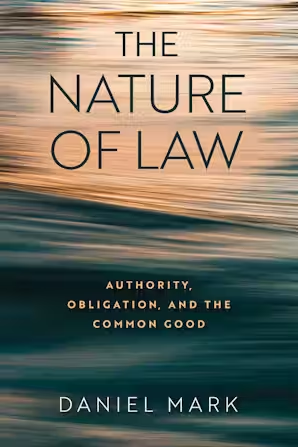
Here is another new book, this one from the University of Notre Dame Press, that reflects the academy’s growing interest in natural law: The Nature of Law: Authority, Obligation, and the Common Good, by political scientist Daniel Mark (Villanova). Mark argues that law should be understood as a set of commands oriented to the common good–which, of course, is the heart of Aquinas’s famous definition of law. Why scholars should be turning to natural law at this particular moment, when positivist theories like originalism and textualism have triumphed in the courts, is an interesting question. But the trend seems clear. Here’s a description of the book from the Notre Dame website:

Challenging the prevailing understanding of the authority of law, Daniel Mark offers a theory of moral obligation that is rooted both in command and in the law’s orientation to the common good.

When and why do we have an obligation to obey the law? Prevailing theories in the philosophy of law, starting with the work of H. L. A. Hart and Joseph Raz, fail to provide definitive answers regarding the nature of legal obligation. In this highly original and effective new work, Daniel Mark argues that there is a prima facie moral obligation to obey the law simply because it is the law. In Mark’s view, the best concept of law—one that allows for the possibility of justified authority and obligation—defines law as a set of commands oriented to the common good. Legal obligation, he proposes, shares defining features with moral obligation and with religious obligation while aligning wholly with neither.

This philosophically coherent view of legal obligation offers a viable framework for analyzing important and seemingly paradoxical puzzles about the law, such as why civil disobedience is punished as lawbreaking or why war-crimes trials for legal but immoral acts present a moral quandary.

By reconciling the concept of law as command with the role of law in promoting the common good, The Nature of Law provides an original and important scholarly contribution to the fields of legal philosophy and political thought.

On Suarez and “Law from Below”

As readers of our weekly Scholarship Roundup know, natural law is making a comeback in certain quarters of the American legal academy–a comeback that reflects concerns about the positivism that underlies prevailing theories like originalism and textualism. For most American law professors, natural law means Aquinas. But medieval jurisprudence isn’t the only natural-law game in town. A new book from Georgetown University Press discusses the work of a leading figure of the so-called “second scholasticism” at the time of the Counter Reformation, the Spanish Jesuit Francisco Suarez. The book is Law from Below: How the Thought of Francisco Suarez, S.J., Can Renew Contemporary Legal Engagement, by scholar Elizabeth Rain Kincaid (Loyola University New Orleans). Here’s the description from the Georgetown website:

The current political atmosphere would suggest that law is imposed only from above, specifically by the chief executive acting upon some sort of perceived populist mandate.

In Law from Below, Elisabeth Rain Kincaid argues that the theology of the early modern legal theorist and theologian, Francisco Suárez, SJ may be successfully retrieved to provide a constructive model of legal engagement for Christians today. Suárez’s theology was developed to combat an authoritarian view of law, suggesting that communities may work to change law from the ground up as they function within the legal system, not just outside it. Law from Below suggests that Suárez’s theory of law provides a theologically robust way to mount a counter-narrative to contemporary authoritarian theories of law, while still acknowledging the good in the rule of law and its imposition by a legislative authority. Suárez acknowledges the crucial contribution of citizens to improving law’s moral content, without removing the importance of law’s own authority or the role of the lawgiver.

Law from Below argues that the dialogue between legislators and the community provides Christian activists with a range of options for constructively engaging with law in order to have a positive impact on society.

Jewish & Christian Butchers in Rome

There’s an old joke about legal systems, which I’ve heard a few different ways, but which goes basically like this: in France, everything is permitted, except that which is expressly forbidden; in Germany, everything is forbidden, except that which is expressly permitted; and in Italy, everything is permitted, including that which is expressly forbidden. I thought of the joke when I saw the announcement for this fun-looking book forthcoming from Harvard this fall, Feeding the Eternal City: Jewish and Christian Butchers in the Eternal City, by historian Kenneth Stow (Haifa). The book explores the way Jewish and Christian butchers in the Papal States evaded legal restrictions and (mostly) cooperated to sell meat at good prices, to the economic benefit of both. Doux commerce! Here’s the description from the Harvard website:

A surprising history of interfaith collaboration in the Roman Ghetto, where for three centuries Jewish and Christian butchers worked together to provision the city despite the proscriptions of Church law.

For Rome’s Jewish population, confined to a ghetto between 1555 and 1870, efforts to secure kosher meat were fraught with challenges. The city’s papal authorities viewed kashrut—the Jewish dietary laws—with suspicion, and it was widely believed that kosher meat would contaminate any Christian who consumed it. Supplying kosher provisions entailed circumventing canon law and the institutions that regulated the butchering and sale of meat throughout the city.

Kenneth Stow finds that Jewish butchers collaborated extensively with their Christian counterparts to ensure a supply of kosher meat, regardless of the laws that prohibited such interactions. Jewish butchers sold nonkosher portions of slaughtered animals daily to Christians outside the ghetto, which in turn ensured the affordability of kosher meat. At the same time, Christian butchers also found it profitable to work with Jews, as this enabled them to sell good meat otherwise unavailable at attractive prices. These relationships could be warm and almost intimate, but they could also be rife with anger, deception, and even litigation. Nonetheless, without this close cooperation—and the willingness of authorities to turn a blind eye to it—meat-eating in the ghetto would have been nearly impossible. Only the rise of the secular state in the late nineteenth century brought fundamental change, putting an end to canon law and allowing the kosher meat market to flourish.

A rich social history of food in early modern Rome, Feeding the Eternal City is also a compelling narrative of Jewish life and religious acculturation in the capital of Catholicism.

Justice Breyer on Constitutional Interpretation

In the law-and-religion world, former Justice Stephen Breyer is most famous for a phrase in a concurrence in one of the 10 Commandments cases from about 20 years ago (yikes, has it been that long?). In his concurring opinion in Van Orden v. Perry, which ruled in favor of a 10 Commandments monument on the Texas state capitol grounds, Breyer explained that bright-line tests are inadvisable in such cases: “there is no test-related substitute for the exercise of legal judgment.” Legal judgment, he continued, did not mean subjectivity, but a consideration of the purposes of a constitutional text, the historical and social context, and practical consequences. The older I get, the more I see the wisdom of this approach, even though most of my academic colleagues, on the right and the left, find it maddeningly vague and under-theorized. In law, it seems to me, including constitutional law, there’s really no escaping the sort of judgment Breyer describes. That’s why we call them judges.

I’m sure Justice Breyer discusses all this in a his new book–which I’m a little late to get to–Reading the Constitution: Why I Choose Pragmatism, Not Textualism. The publisher is Simon & Schuster. Here’s the description from the publisher’s website:

The relatively new judicial philosophy of textualism dominates the Supreme Court. Textualists claim that the right way to interpret the Constitution and statutes is to read the text carefully and examine the language as it was understood at the time the documents were written.

This, however, is not Justice Breyer’s philosophy nor has it been the traditional way to interpret the Constitution since the time of Chief Justice John Marshall. Justice Breyer recalls Marshall’s exhortation that the Constitution must be a workable set of principles to be interpreted by subsequent generations.

Most important in interpreting law, says Breyer, is to understand the purposes of statutes as well as the consequences of deciding a case one way or another. He illustrates these principles by examining some of the most important cases in the nation’s history, among them the Dobbs and Bruen decisions from 2022 that he argues were wrongly decided and have led to harmful results.