A New Translation of Ficino

This is more in Marc’s wheelhouse than mine, but here goes. Marsilio Ficino was a Renaissance humanist, director of the new iteration of Plato’s Academy that Cosimo de Medici tried to establish in Florence and tutor to Cosimo’s son, Lorenzo the Magnificent. The Florentine Renaissance was an attempt to meld pagan and Christian thought; like many such attempts, it was extraordinarily productive but quite unstable, as Savonarola, another Florentine, demonstrated. This new translation of Ficino’s work, On the Christian Religion, to be released by the University of Toronto Press later this year, looks very interesting. The translators are Dan Attrell and David Porecca, both of the University of Waterloo, and independent scholar Brett Bartlett. Here’s the publisher’s description:

This is the first translation into English of Marsilio Ficino’s De Christiana religione, a text first written in Latin in 1474, the year after its author’s ordination in the Roman Catholic Church. On the Christian Religion is this Florentine humanist’s attempt to lay out the history of the religion of Christ, the Logos (“Word” or “Reason”), in accordance with the doctrines of ancient philosophy. The work focuses on how Christ in his pre-incarnate form was revealed as much to certain ancient pagan sages and prophets as to those of the Old Testament, and how both groups played an equal role in foreshadowing the ultimate fulfillment of all the world’s religions in Christianity.

The first part elucidates the history of the prisca theologia – the ancient theology – a single natural religion shared by the likes of Zoroaster, Hermes Trismegistus, Orpheus, Aglaophemus, Pythagoras, and Plato, and how it was fulfilled by Christ’s incarnation and the spread of his Church through his apostles. The second part of the work, however, constitutes a series of attacks against the ways in which the Old Testament were variously interpreted by Islamic and, more importantly, Jewish sages who threatened Ficino’s own Christological interpretations of Scripture.

This new English translation includes an introduction that situates the text within the broader scope of Ficino’s intellectual activity and historical context. The book allows us to encounter a more nuanced image of Ficino, that of him as a theologian, historian, and anti-Jewish, anti-Islamic, anti-pagan polemicist.

Protagoras and the Purposes of Centers of Knowledge and Inquiry (Lectures by Leo Strauss)

A little bit at a distance from our normal fare, but still within range. The Protagoras is one of Plato’s dialogues, though perhaps not one of the best known. But it is one of my favorites and one that I will introduce into a new course I am teaching this year on “Freedom of Speech and Freedom of Inquiry.” It contains Plato’s views on the relationship between speech and knowledge. And, more broadly, one can read the dialogue as a set of reflections on the nature and function of centers of learning and knowledge (or, as we say in the modern period, universities)–in particular, what the relationship is between knowledge and virtue or human excellence. This new book, Leo Strauss on Plato’s Protagoras (University of Chicago Press, edited and with an introduction by Robert C. Bartlett), is about the well-known 20th century political philosopher’s lectures on Protagoras. It is sure to be full of insight about the Protagoras and its general themes–ones that are pressing and vital today.

This book offers a transcript of Strauss’s seminar on Plato’s Protagoras taught at the University of Chicago in the spring quarter of 1965, edited and introduced by renowned scholar Robert C. Bartlett. These lectures have several important features. Unlike his published writings, they are less dense and more conversational.  Additionally, while Strauss regarded himself as a Platonist and published some work on Plato, he published little on individual dialogues. In these lectures Strauss treats many of the great Platonic and Straussian themes: the difference between the Socratic political science or art and the Sophistic political science or art of Protagoras; the character and teachability of virtue, its relation to knowledge, and the relations among the virtues, courage, justice, moderation, and wisdom; the good and the pleasant; frankness and concealment; the role of myth; and the relation between freedom of thought and freedom of speech.
 
In these lectures, Strauss examines Protagoras and the sophists, providing a detailed discussion of Protagoras as it relates to Plato’s other dialogues and the work of modern thinkers. This book should be of special interest to students both of Plato and of Strauss.

Augustine and Contemporary Social Issues

Readers of the Forum know that we have a special interest in Augustine. We’ve noted a number of books about him, and covered City of God last year in our Reading Society. This month, Routledge publishes a collection of essays applying Augustine to present-day debates, Augustine and Contemporary Social Issues, edited by theologian Paul L. Allen (Corpus Cristi College–Vancouver). Looks interesting. Here’s the publisher’s description:

This book focuses on applying the thought of Saint Augustine to address a number of persistent 21st-century socio-political issues. Drawing together Augustinian ideas such as concupiscence, virtue, vice, habit, and sin through social and textual analysis, it provides fresh Augustinian perspectives on new—yet somehow familiar—quandaries. The volume addresses the themes of fallenness, politics, race, and desire. It includes contributions from theology, philosophy, and political science. Each chapter examines Augustine’s perspective for deepening our understanding of human nature and demonstrates the contemporary relevance of his thought.

A History of Modern Catholicism

From the important historian of religion, John T. McGreevy, comes this new treatment of the history of Catholicism in the modern period: Catholicism: A Global History From the French Revolution to Pope Francis (Norton, forthcoming). I’ve relied on Professor McGreevy’s excellent history, Catholicism and American Freedom, before, and I am looking forward to this comprehensive study.

A magisterial history of the centuries-long conflict between “progress” and “tradition” in the world’s largest international institution.

The story of Roman Catholicism has never followed a singular path. In no time period has this been more true than over the last two centuries. Beginning with the French Revolution, extending to the Second Vatican Council in the 1960s, and concluding with present-day crises, John T. McGreevy chronicles the dramatic upheavals and internal divisions shaping the most multicultural, multilingual, and global institution in the world.

Through powerful individual stories and sweeping birds-eye views, Catholicism provides a mesmerizing assessment of the Church’s complex role in modern history: both shaper and follower of the politics of nation states, both conservator of hierarchies and evangelizer of egalitarianism. McGreevy documents the hopes and ambitions of European missionaries building churches and schools in all corners of the world, African Catholics fighting for political (and religious) independence, Latin American Catholics attracted to a theology of liberation, and Polish and South Korean Catholics demanding democratic governments. He includes a vast cast of riveting characters, known and unknown, including the Mexican revolutionary Fr. Servando Teresa de Mier; Daniel O’Connell, hero of Irish emancipation; Sr. Josephine Bakhita, a formerly enslaved Sudanese nun; Chinese statesman Ma Xiaobang; French philosopher and reformer Jacques Maritain; German Jewish philosopher and convert, Edith Stein; John Paul II, Polish pope and opponent of communism; Gustavo Gutiérrez, Peruvian founder of liberation theology; and French American patron of modern art, Dominique de Menil.

Throughout this essential volume, McGreevy details currents of reform within the Church as well as movements protective of traditional customs and beliefs. Conflicts with political leaders and a devotional revival in the nineteenth century, the experiences of decolonization after World War II and the Second Vatican Council in the twentieth century, and the trauma of clerical sexual abuse in the twenty-first all demonstrate how religion shapes our modern world. Finally, McGreevy addresses the challenges faced by Pope Francis as he struggles to unite the over one billion members of the world’s largest religious community.

The Shadow of God

It’s not a new insight that many contemporary secular movements substitute for God. Communism, nationalism, left-liberalism, and other encompassing causes offer a kind of transcendence for individuals, who can find meaning in commitments to moral progress in the world. But what happens when progress doesn’t occur? The failure of secular movements to deliver can lead to great frustration and bitterness, without the consolations of ultimate justice in the world to come. That, suggests Harvard philosopher Michael Rosen in a new book from Harvard University Press, The Shadow of God, is our current predicament. Here is the publisher’s description:

Once in the West, our lives were bounded by religion. Then we were guided out of the darkness of faith, we are often told, by the cold light of science and reason. To be modern was to reject the religious for the secular and rational. In a bold retelling of philosophical history, Michael Rosen explains the limits of this story, showing that many modern and apparently secular ways of seeing the world were in fact profoundly shaped by religion.

The key thinkers, Rosen argues, were the German Idealists, as they sought to reconcile reason and religion. It was central to Kant’s philosophy that, if God is both just and assigns us to heaven or hell for eternity, we must know what is required of us and be able to choose freely. In trying to live moral lives, Kant argued, we are engaged in a collective enterprise as members of a “Church invisible” working together to achieve justice in history. As later Idealists moved away from Kant’s ideas about personal immortality, this idea of “historical immortality” took center stage. Through social projects that outlive us we maintain a kind of presence after death. Conceptions of historical immortality moved not just into the universalistic ideologies of liberalism and revolutionary socialism but into nationalist and racist doctrines that opposed them. But how, after global wars and genocide, can we retain faith in any conception of shared moral progress and, if not, what is to become of the idea of historical immortality? That is our present predicament.

A seamless blend of philosophy and intellectual history, The Shadow of God is a profound exploration of secular modernity’s theistic inheritance.

Evangelicalism and Migrants

We’ll see what happens, but one of the big political stories of 2022 seems to be a movement of Latino voters to the Republican Party. I’ve thought for some time that an underreported element in this story is a movement of Latinos to evangelical Christianity. A new book from Princeton University Press, In the Hands of God: How Evangelical Belonging Transforms Migrant Experience in the United States, by anthropologist Johanna Bard Richlin (University of Oregon) explores the latter phenomenon. Here’s the publisher’s description:

Why do migrants become more deeply evangelical in the United States and how does this religious identity alter their self-understanding? In the Hands of God examines this question through a unique lens, foregrounding the ways that churches transform what migrants feel. Drawing from her extensive fieldwork among Brazilian migrants in the Washington, DC, area, Johanna Bard Richlin shows that affective experience is key to comprehending migrants’ turn toward intense religiosity, and their resulting evangelical commitment.

The conditions of migrant life—family separation, geographic isolation, legal precariousness, workplace vulnerability, and deep uncertainty about the future—shape specific affective maladies, including loneliness, despair, and feeling stuck. These feelings in turn trigger novel religious yearnings. Evangelical churches deliberately and deftly articulate, manage, and reinterpret migrant distress through affective therapeutics, the strategic “healing” of migrants’ psychological pain. Richlin offers insights into the affective dimensions of migration, the strategies pursued by evangelical churches to attract migrants, and the ways in which evangelical belonging enables migrants to feel better, emboldening them to improve their lives.

Looking at the ways evangelical churches help migrants navigate negative emotions, In the Hands of God sheds light on the versatility and durability of evangelical Christianity.

The Constituents of Fanaticism

Fanaticism is a term almost always used pejoratively. The connotations are of excessive devotion, commitment, extremism, and uncritical enthusiasm. Often enough, fanaticism is paired with religion, as in, “he’s a religious fanatic,” and here one sees the presuppositions of liberal rationalism concerning the nature of religion in the phrase. But is there more of substance to fanaticism as a concept? Something more than simply a shallow term of conventional dismissal or disapproval? In this new book, Fanaticism: A Political Philosophical History, (U. Penn. Press) Professor Zachary Goldsmith argues that there is, focusing on elements that include the pursuit of abstraction and novelty; violence to achieve messianic political ends; and the special appeal fanaticism has held for the intellectual class. Professor Goldsmith seems to contrast liberal political commitments with fanatical ones, and it will be interesting to see just what he means by this.

As the post-WWII liberal democratic consensus comes under increasing assault around the globe, Zachary R. Goldsmith investigates a timely topic: the reemergence of fanaticism. His book demonstrates how the concept of fanaticism, so often flippantly invoked with little forethought, actually has a long history stretching back to ancient times. Tracing this history through the Reformation and the Enlightenment to our present moment of political extremism run amok, Goldsmith offers a novel account of fanaticism, detailing its transformation from a primarily religious to a political concept around the time of the French Revolution. He draws on the work of Immanuel Kant, Edmund Burke, and Fyodor Dostoevsky—all keen observers of fanaticism, and especially its political variant—in order to explore this crucial moment in the development of political fanaticism.

Examining conceptualizations of fanaticism from different geographical, political, temporal, and contextual backgrounds, Goldsmith reveals how the concept has changed over time and resists easy definition. Nevertheless, his analysis of the writings of key figures from the tradition of political thought regarding fanaticism yields a complex and nuanced understanding of the concept that allows us to productively identify and observe its most salient characteristics: irrationality, messianism, the embrace of abstraction, the desire for novelty, the pursuit of perfection, a lack of limits in politics, the embrace of violence, certainty, passion, and its perennial attraction to intellectuals. Goldsmith’s political-philosophical history of fanaticism offers us an argument and warning against fanaticism itself, demonstrating that fanaticism is antidemocratic, illiberal, antipolitical, and never necessary.

Rediscovering Conservatism

One of the questions we addressed in the first meeting of our Tradition Project back in 2016 was this: is it possible to speak of an American conservatism? Isn’t what we call conservatism in America really just classical liberalism, a philosophy committed to individual rights, the free market, and a limited state that maintains neutrality with respect to religion and other big issues? In a new book from Regnery, Conservatism: A Rediscovery, Yoram Hazony (Edmund Burke Foundation) argues that American conservatism and classical liberalism are two separate things. Here’s the publisher’s description:

The idea that American conservatism is identical to “classical” liberalism—widely held since the 1960s—is seriously mistaken.

The award-winning political theorist Yoram Hazony argues that the best hope for Western democracy is a return to the empiricist, religious, and nationalist traditions of America and Britain—the conservative traditions that brought greatness to the English-speaking nations and became the model for national freedom for the entire world.

Conservatism: A Rediscovery explains how Anglo-American conservatism became a distinctive alternative to divine-right monarchy, Puritan theocracy, and liberal revolution. After tracing the tradition from the Wars of the Roses to Burke and across the Atlantic to the American Federalists and Lincoln, Hazony describes the rise and fall of Enlightenment liberalism after World War II and the present-day debates between neoconservatives and national conservatives over how to respond to liberalism and the woke left.

Going where no political thinker has gone in decades, Hazony provides a fresh theoretical foundation for conservatism. Rejecting the liberalism of Hayek, Strauss, and the “fusionists” of the 1960s, and drawing on decades of personal experience in the conservative movement, he argues that a revival of authentic Anglo-American conservatism is possible in the twenty-first century.

Universities Past and Future

In preparing for teaching a new course about freedom of speech and freedom of inquiry (about which more soon), I was reflecting on the nature and aims of the university–historically one of the central sites for the freedom of inquiry. Of course, this is a perennial topic and it is striking to see different conceptions and ideas of the university across time–stretching from the ancient model of learning (which one can read in the work of Plato and Aristotle, especially); to the medieval and renaissance Christian intellectual strongholds of Bologna, Paris, and others; to the 19th century modern period beginning with the German model and Cardinal Newman’s still-insightful “Idea of a University”; all the way to the 20th century model whose characteristic expositor remains John Dewey. And today, the university is under new pressures to change and become something else–something quite different from what it was even relatively recently.

It was in this spirit that I noticed and look forward to reading Professor William C. Kirby’s new book, Empires of Ideas: Creating the Modern University from German to American to China (Harvard UP). Professor Kirby, an expert on China, focuses his attention on the 19th and 20th centuries and on the future, which he sees as especially powerful in Chinese universities as American universities recede in importance.

The modern university was born in Germany. In the twentieth century, the United States leapfrogged Germany to become the global leader in higher education. Will China challenge its position in the twenty-first?

Today American institutions dominate nearly every major ranking of global universities. Yet in historical terms, America’s preeminence is relatively new, and there is no reason to assume that U.S. schools will continue to lead the world a century from now. Indeed, America’s supremacy in higher education is under great stress, particularly at its public universities. At the same time Chinese universities are on the ascent. Thirty years ago, Chinese institutions were reopening after the catastrophe of the Cultural Revolution; today they are some of the most innovative educational centers in the world. Will China threaten American primacy?

Empires of Ideas looks to the past two hundred years for answers, chronicling two revolutions in higher education: the birth of the research university and its integration with the liberal education model. William C. Kirby examines the successes of leading universities—The University of Berlin and the Free University of Berlin in Germany; Harvard, Duke, and the University of California, Berkeley, in the United States—to determine how they rose to prominence and what threats they currently face. Kirby draws illuminating comparisons to the trajectories of three Chinese contenders: Tsinghua University, Nanjing University, and the University of Hong Kong, which aim to be world-class institutions that can compete with the best the United States and Europe have to offer.

But Chinese institutions also face obstacles. Kirby analyzes the challenges that Chinese academic leaders must confront: reinvesting in undergraduate teaching, developing new models of funding, and navigating a political system that may undermine a true commitment to free inquiry and academic excellence.

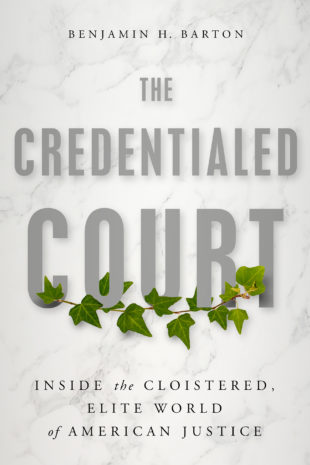
Our Credentialed Court

Earlier this year, Encounter Books published a new history of the membership of the Supreme Court from its first years to today, The Credentialed Court, by University of Tennessee Law Professor Benjamin H. Barton. Barton points out that the current membership is historically narrow in terms of life experience. All justices but one have gone to Ivy League law schools; most have been lower court judges; an increasing number are former law clerks. Nothing wrong with any of that–but perhaps something is lost when the justices’ backgrounds are so circumscribed and similar. For example, do the backgrounds of the justices influence their work in religion clause cases? It’s hard to see why that would not be the case. Would the Court’s jurisprudence over the last 50 years have looked different with the graduate of an evangelical college on the bench–or a yeshiva or madrassa?

Looks very interesting. Here’s the publisher’s description:

The Credentialed Court starts by establishing just how different today’s Justices are from their predecessors. The book combines two massive empirical studies of every Justice’s background from John Jay to Amy Coney Barrett with short, readable bios of past greats to demonstrate that today’s Justices arrive on the Court with much narrower experiences than they once did. Today’s Justices have spent more time in elite academic settings (both as students and faculty) than any previous Courts. Every Justice but Barrett attended either Harvard or Yale Law School, and four of the Justices were tenured professors at prestigious law schools. They also spent more time as Federal Appellate Court Judges than any previous Courts. These two jobs (tenured law professor and appellate judge) share two critical components: both jobs are basically lifetime appointments that involve little or no contact with the public at large. The modern Supreme Court Justices have spent their lives in cloistered and elite settings, the polar opposite of past Justices.

The current Supreme Court is packed with a very specific type of person: type-A overachievers who have triumphed in a long tournament measuring academic and technical legal excellence. This Court desperately lacks individuals who reflect a different type of “merit.” The book examines the exceptional and varied lives of past greats from John Marshall to Thurgood Marshall and asks how many, if any, of these giants would be nominated today. The book argues against our current bookish and narrow version of meritocracy. Healthier societies offer multiple different routes to success and onto bodies like our Supreme Court.