On Law and the Common Good

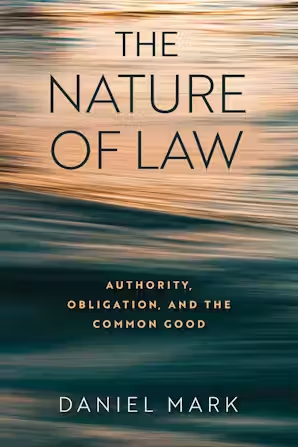
Here is another new book, this one from the University of Notre Dame Press, that reflects the academy’s growing interest in natural law: The Nature of Law: Authority, Obligation, and the Common Good, by political scientist Daniel Mark (Villanova). Mark argues that law should be understood as a set of commands oriented to the common good–which, of course, is the heart of Aquinas’s famous definition of law. Why scholars should be turning to natural law at this particular moment, when positivist theories like originalism and textualism have triumphed in the courts, is an interesting question. But the trend seems clear. Here’s a description of the book from the Notre Dame website:

Challenging the prevailing understanding of the authority of law, Daniel Mark offers a theory of moral obligation that is rooted both in command and in the law’s orientation to the common good.

When and why do we have an obligation to obey the law? Prevailing theories in the philosophy of law, starting with the work of H. L. A. Hart and Joseph Raz, fail to provide definitive answers regarding the nature of legal obligation. In this highly original and effective new work, Daniel Mark argues that there is a prima facie moral obligation to obey the law simply because it is the law. In Mark’s view, the best concept of law—one that allows for the possibility of justified authority and obligation—defines law as a set of commands oriented to the common good. Legal obligation, he proposes, shares defining features with moral obligation and with religious obligation while aligning wholly with neither.

This philosophically coherent view of legal obligation offers a viable framework for analyzing important and seemingly paradoxical puzzles about the law, such as why civil disobedience is punished as lawbreaking or why war-crimes trials for legal but immoral acts present a moral quandary.

By reconciling the concept of law as command with the role of law in promoting the common good, The Nature of Law provides an original and important scholarly contribution to the fields of legal philosophy and political thought.

On Suarez and “Law from Below”

As readers of our weekly Scholarship Roundup know, natural law is making a comeback in certain quarters of the American legal academy–a comeback that reflects concerns about the positivism that underlies prevailing theories like originalism and textualism. For most American law professors, natural law means Aquinas. But medieval jurisprudence isn’t the only natural-law game in town. A new book from Georgetown University Press discusses the work of a leading figure of the so-called “second scholasticism” at the time of the Counter Reformation, the Spanish Jesuit Francisco Suarez. The book is Law from Below: How the Thought of Francisco Suarez, S.J., Can Renew Contemporary Legal Engagement, by scholar Elizabeth Rain Kincaid (Loyola University New Orleans). Here’s the description from the Georgetown website:

The current political atmosphere would suggest that law is imposed only from above, specifically by the chief executive acting upon some sort of perceived populist mandate.

In Law from Below, Elisabeth Rain Kincaid argues that the theology of the early modern legal theorist and theologian, Francisco Suárez, SJ may be successfully retrieved to provide a constructive model of legal engagement for Christians today. Suárez’s theology was developed to combat an authoritarian view of law, suggesting that communities may work to change law from the ground up as they function within the legal system, not just outside it. Law from Below suggests that Suárez’s theory of law provides a theologically robust way to mount a counter-narrative to contemporary authoritarian theories of law, while still acknowledging the good in the rule of law and its imposition by a legislative authority. Suárez acknowledges the crucial contribution of citizens to improving law’s moral content, without removing the importance of law’s own authority or the role of the lawgiver.

Law from Below argues that the dialogue between legislators and the community provides Christian activists with a range of options for constructively engaging with law in order to have a positive impact on society.

Jewish & Christian Butchers in Rome

There’s an old joke about legal systems, which I’ve heard a few different ways, but which goes basically like this: in France, everything is permitted, except that which is expressly forbidden; in Germany, everything is forbidden, except that which is expressly permitted; and in Italy, everything is permitted, including that which is expressly forbidden. I thought of the joke when I saw the announcement for this fun-looking book forthcoming from Harvard this fall, Feeding the Eternal City: Jewish and Christian Butchers in the Eternal City, by historian Kenneth Stow (Haifa). The book explores the way Jewish and Christian butchers in the Papal States evaded legal restrictions and (mostly) cooperated to sell meat at good prices, to the economic benefit of both. Doux commerce! Here’s the description from the Harvard website:

A surprising history of interfaith collaboration in the Roman Ghetto, where for three centuries Jewish and Christian butchers worked together to provision the city despite the proscriptions of Church law.

For Rome’s Jewish population, confined to a ghetto between 1555 and 1870, efforts to secure kosher meat were fraught with challenges. The city’s papal authorities viewed kashrut—the Jewish dietary laws—with suspicion, and it was widely believed that kosher meat would contaminate any Christian who consumed it. Supplying kosher provisions entailed circumventing canon law and the institutions that regulated the butchering and sale of meat throughout the city.

Kenneth Stow finds that Jewish butchers collaborated extensively with their Christian counterparts to ensure a supply of kosher meat, regardless of the laws that prohibited such interactions. Jewish butchers sold nonkosher portions of slaughtered animals daily to Christians outside the ghetto, which in turn ensured the affordability of kosher meat. At the same time, Christian butchers also found it profitable to work with Jews, as this enabled them to sell good meat otherwise unavailable at attractive prices. These relationships could be warm and almost intimate, but they could also be rife with anger, deception, and even litigation. Nonetheless, without this close cooperation—and the willingness of authorities to turn a blind eye to it—meat-eating in the ghetto would have been nearly impossible. Only the rise of the secular state in the late nineteenth century brought fundamental change, putting an end to canon law and allowing the kosher meat market to flourish.

A rich social history of food in early modern Rome, Feeding the Eternal City is also a compelling narrative of Jewish life and religious acculturation in the capital of Catholicism.

Justice Breyer on Constitutional Interpretation

In the law-and-religion world, former Justice Stephen Breyer is most famous for a phrase in a concurrence in one of the 10 Commandments cases from about 20 years ago (yikes, has it been that long?). In his concurring opinion in Van Orden v. Perry, which ruled in favor of a 10 Commandments monument on the Texas state capitol grounds, Breyer explained that bright-line tests are inadvisable in such cases: “there is no test-related substitute for the exercise of legal judgment.” Legal judgment, he continued, did not mean subjectivity, but a consideration of the purposes of a constitutional text, the historical and social context, and practical consequences. The older I get, the more I see the wisdom of this approach, even though most of my academic colleagues, on the right and the left, find it maddeningly vague and under-theorized. In law, it seems to me, including constitutional law, there’s really no escaping the sort of judgment Breyer describes. That’s why we call them judges.

I’m sure Justice Breyer discusses all this in a his new book–which I’m a little late to get to–Reading the Constitution: Why I Choose Pragmatism, Not Textualism. The publisher is Simon & Schuster. Here’s the description from the publisher’s website:

The relatively new judicial philosophy of textualism dominates the Supreme Court. Textualists claim that the right way to interpret the Constitution and statutes is to read the text carefully and examine the language as it was understood at the time the documents were written.

This, however, is not Justice Breyer’s philosophy nor has it been the traditional way to interpret the Constitution since the time of Chief Justice John Marshall. Justice Breyer recalls Marshall’s exhortation that the Constitution must be a workable set of principles to be interpreted by subsequent generations.

Most important in interpreting law, says Breyer, is to understand the purposes of statutes as well as the consequences of deciding a case one way or another. He illustrates these principles by examining some of the most important cases in the nation’s history, among them the Dobbs and Bruen decisions from 2022 that he argues were wrongly decided and have led to harmful results.

Religious Freedom & National Security

Before states established religious freedom as a constitutional principle, they saw it as a matter of diplomacy and national security. “Cuius regio eius religio” was meant to keep peace among nations, not so much within them. And religious freedom continues to figure in international relations today–though, sadly, religious freedom is often honored more in words than deeds. A new collection of essays from Routledge, Security, Religion, and the Rule of Law: International Perspectives, argues that national security depends on states’ honoring the religious freedom of their own citizens. The editors are Tania Pagotto (University of Milan-Bicocca), Joshua Roose (Deakin University) and G.P. Marcar (University of Otago). Here’s the description from the publisher’s website:

Security, Religion, and the Rule of Law argues that true, substantive, and sustainable national security is only possible through respect for the rule of law, human rights, and religious freedom.

Despite the emphasis on national security and the war on terror that has preoccupied governments for over two decades, nations – and the world – seem to be more divided than ever, with a concomitant impact of increasing the risk of terrorism and religious and political violence. The national security paradigm, previously reserved primarily for foreign threats, has been turned increasingly inwards, focusing on a state’s own citizens as potential threats. This is often along religious lines, threatening fundamental human freedoms. This book provides a series of critical engagements on some of the most pressing issues at the interface of religion and security today, including proposing a deeper engagement with theology when dealing with freedom of religious belief, exploring a better understanding between domestic peace and international relations, abiding by the rule of law while countering terrorism, and developing a broader understanding of identities and of the nature of citizenship. It provides the resources to further reflect upon and address these topics, as well as stimulate further discussions on religion and security matters across a range of different disciplines. Wide-ranging case studies consider Australia, China, Europe, the Kurdish people, Nigeria, Russia, Ukraine, the United Nations, and the United States.

This book will appeal to students and scholars across a range of disciplines, including international relations, law, philosophy, political science, religious studies, security studies, and theology. It will also appeal to human rights lawyers, judges, NGO researchers, governmental agency specialists, and policy makers.

On the Oklahoma Charter School Decision

Earlier this week, in a much-watched case, the Oklahoma Supreme Court ruled that a charter school, St. Isidore of Seville, is unconstitutional under state and federal law. In a post at the Volokh site today, I argue that this ruling was probably correct. As a charter school, St. Isidore is a hybrid, a cross between a public and a private school, and that makes its legal position complicated. Here’s an excerpt:

It’s not quite as clear as the Oklahoma court makes it seem, but the decision is probably correct, at least respecting the federal constitutional claims. Legally speaking, St. Isidore is caught in a dilemma—a dilemma that its hybrid nature as a charter school creates. If St. Isidore qualifies as a public school, there’s an obvious Establishment Clause problem. St. Isidore argued that it shouldn’t be seen as a public school, but as an independent contractor. But the Oklahoma statute specifically provides that charter schools are “public.” And that’s not just a matter of form, but also substance. As a charter school, St. Isidore is funded entirely by the state, must take all students who apply, and must comply with curricular and other requirements that don’t apply to private schools.

On the other hand, if St. Isidore is a private actor, the US Supreme Court’s recent free exercise cases may not help it too much. In Carson and Espinoza, the Court ruled that the state cannot exclude private religious schools from tuition assistance programs simply because they are religious—that would violate the schools’ right to practice their religion. That seems correct to me. But in those cases, the Court stressed that public funds went to private schools through the filter of parental choice. Parents who received tuition assistance designated which schools would receive the money.

St. Isidore would be entirely free, by contrast, and Oklahoma would be funding the school directly. True, the amount of money St. Isidore would receive would depend, presumably, on the number of students it enrolled—and that would depend on parental choice. But the state is more in the foreground (and the parents more in the background) in this case than in either Carson or Espinoza, and it feels different, somehow.

You can read the whole post here.

On Law & Ritual in Hasidic Judaism

This one is a little outside my wheelhouse, but it looks quite interesting. Hasidic Judaism is known for its ecstatic approach. And yet, ironically, it is also one of Judaism’s most traditional expressions, with a serious focus on religious law. What explains this paradox? A new book from Stanford University Press, Laws of the Spirit: Ritual, Mysticism, and the Commandments in Early Hasidism, argues (if I understand it right) that Hasidism sees law as a matter of ritual rather than rules for worshippers to work out and follow. Of course, ritual is important in most religions, and in secular law as well, and I wonder if these insights could in some way apply in other contexts, too. The author is religious studies scholar Ariel Mayse (Stanford). Here’s the publisher’s description:

The compelling vision of religious life and practice found in Hasidic sources has made it the most enduring and successful Jewish movement of spiritual renewal of all time. In this book, Ariel Evan Mayse grapples with one of Hasidism’s most vexing questions: how did a religious movement known for its radical views about immanence, revelation, and the imperative to serve God with joy simultaneously produce strict adherence to the structures and obligations of Jewish law? Exploring the movement from its emergence in the mid-1700s until 1815, Mayse argues that the exceptionality of Hasidism lies not in whether its leaders broke or upheld rabbinic norms, but in the movement’s vivid attempt to rethink the purpose of Jewish ritual and practice. Rather than focusing on the commandments as law, he turns to the methods and vocabulary of ritual studies as a more productive way to reckon with the contradictions and tensions of this religious movement as well as its remarkable intellectual vitality.

Mayse examines the full range of Hasidic texts from the eighteenth and early nineteenth centuries, from homilies and theological treatises to hagiography, letters, and legal writings, reading them together with contemporary theories of ritual. Arguing against the notion that spiritual integrity requires unshackling oneself from tradition, Laws of the Spirit is a sweeping attempt to rethink the meaning and significance of religious practice in early Hasidism.

A New Book on Christianity and Law

Christianity has a complicated relationship to law. Unlike Judaism and Islam, which are nomocentric religions, Christianity doesn’t have a law per se. Believers don’t worship God primarily by discovering and following a system of divinely ordained rules. There is no Christian “law” of inheritance, for example, that directs beneficiaries how to divide up property. But Christianity doesn’t entirely reject law. The Catholic tradition, in particular, places emphasis on natural law as a rational system–an emphasis that Orthodox and Protestants view with great suspicion. As I say, it’s complicated.

When it comes to the relationship between Christianity and civil law, things are complex as well. The Bible teaches Christians to give Caesar his due, but not more than that–to comply with civil law, but not if that means violating God’s law. Where to draw the line, especially in a contemporary, religiously pluralistic society, is often debatable.

A new book by Australian law professor Benjamin Saunders (Deakin University), The Crisis of Civil Law: What the Bible Teaches about Law and What It Means Today, addresses these complications. The publisher is Lexham Press. Looks very interesting. Here is the description from the publisher’s website:

How should Christians think about law?

In every age, this is one of the most difficult questions faced by followers of Christ. Within the modern church, there is little unity on how Scripture addresses issues like gun control, abortion, and whether we should disobey unjust laws. In The Crisis of Civil Law, legal scholar Benjamin B. Saunders draws from Scripture and the Christian tradition to provide valuable guidance on contemporary legal questions and the role of civil government. We can gain greater clarity by wisely applying the moral law found in Scripture—as well as the universal standards of the natural law—to the changing circumstances of human societies.

The Crisis of Civil Law includes detailed discussion of the biblical material on law as well as practical case studies that contextualize scriptural principles in modern Western society.

Teaching American Religious History

Here at the Mattone Center, we focus on the study of law-and-religion, that is, the relationship between these two social institutions. Mostly, we emphasize the “law” part. But from the beginning we have tried to pay attention as well to religion as a subject in itself, especially to the history of religion in the West generally and the United States particularly. In my law-and-religion seminar, for example, I spend significant time on American religious history, much of which students are learning for the first time. I believe the material is essential. Without a knowledge of our religious history, it’s difficult to understand why our law with respect to religion has developed as it has.

A book out this month from the University of Wisconsin Press, Understanding and Teaching Religion in US History, seems a very good resource for instructors getting into this material. The editors are historian Karen J. Johnson (Wheaton College) and religious studies scholar Jonathan M. Yeager (University of Tennessee at Chattanooga). Here’s the description from the publisher’s website:

How to learn, think, and teach about a vital and sometimes contentious topic

Religion is deeply embedded in American history, and one cannot understand American history’s broad dynamics without accounting for it. Without detailing the history of religions, teachers cannot properly explain key themes in US survey courses, such as politics, social dynamics, immigration and colonization, gender, race, or class. From early Native American beliefs and practices, to European explorations of the New World, to the most recent presidential elections, religion has been a significant feature of the American story. In Understanding and Teaching Religion in US History, a diverse group of eminent historians and history teachers provide a practical tool for teachers looking to improve history instruction at the upper-level secondary and undergraduate level.

This book offers a breadth of voices and approaches to teaching this crucial part of US history. Religion can be a delicate topic, especially in public education, and many students and teachers bring strongly held views and identities to their understanding of the past. The editors and contributors aim to help the reader see religion in fresh ways, to present sources and perspectives that may be unfamiliar, and to suggest practical interventions in the classroom that teachers can use immediately.

Movsesian on Munoz on Original Meaning

Happy to report that my review of Phillip Munoz’s excellent new book on the original meaning of the religion clauses, Religious Liberty and the American Founding, is up on the website of the Journal of Law & Religion (Cambridge). Munoz persuasively argues that the Framers disagreed on precisely what the Religion Clauses of the First Amendment protect, apart from the freedom to worship. And, I argue, that’s why original meaning can’t provide closure on many of our debates about religious liberty today.

Here’s an excerpt:

Religious Liberty and the American Founding is a pleasure to read. Muñoz writes well and exceptionally clearly, and his book will appeal both to the educated public and to constitutional lawyers and scholars who spend their time immersed in doctrinal debates. He offers a wealth of detail on the drafting and ratification of the religion clauses. And the story he tells is a persuasive one. History is argument without end, but Muñoz’s basic point that the framers disagreed on the precise meaning of establishment and free exercise in the First Amendment but understood those terms in light of their background conception of religious liberty seems entirely plausible. Precisely because the framers could not agree on what the natural right of religious liberty itself entailed with respect to specific government policies, though, it is not clear how helpful a natural-rights construction of original meaning can be in resolving specific constitutional disputes.