Walzer, “In God’s Shadow: Politics in the Hebrew Bible”

In May 2012, Yale University Press published In God’s Shadow: Politics in the Hebrew Bible by Michael Walzer (Institute For Advanced Study, Princeton). The publisher’s description follows.
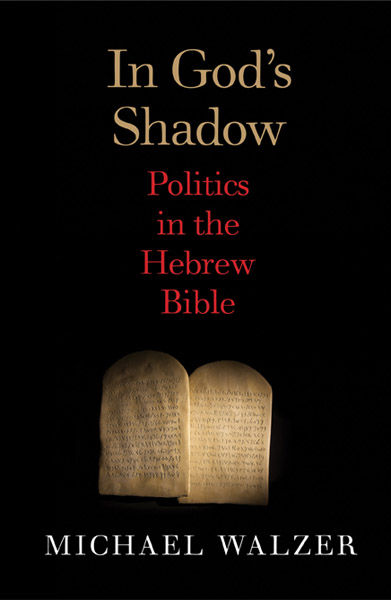
In this eagerly awaited book, political theorist Michael Walzer reports his findings after decades of thinking about the politics of the Hebrew Bible. Attentive to nuance while engagingly straightforward, Walzer examines the laws, the histories, the prophecies, and the wisdom of the ancient biblical writers and discusses their views on such central political questions as justice, hierarchy, war, the authority of kings and priests, and the experience of exile.

Because there are many biblical writers with differing views, pluralism is a central feature of biblical politics. Yet pluralism, Walzer observes, is never explicitly defended in the Bible; indeed, it couldn’t be defended since God’s word had to be as singular as God himself. Yet different political regimes are described in the biblical texts, and there are conflicting political arguments—and also a recurrent anti-political argument: if you have faith in God, you have no need for strong institutions, prudent leaders, or reformist policies. At the same time, however, in the books of law and prophecy, the people of Israel are called upon to overcome oppression and “let justice well up like water, righteousness like an unfailing stream.”
Luhmann, “A Systems Theory of Religion”

This October, Stanford University Press will publish A Systems Theory of Religion by Niklas Luhmann (translated by David A. Brenner and Adrian Hermann). The publisher’s description follows.

A Systems Theory of Religion, still unfinished at Niklas Luhmann’s death in 1998, was first published in German two years later thanks to the editorial work of André Kieserling. One of Luhmann’s most important projects, it exemplifies his later work while redefining the subject matter of the sociology of religion. Religion, for Luhmann, is one of the many functionally differentiated social systems that make up modern society. All such subsystems consist entirely of communications and all are “autopoietic,” which is to say, self-organizing and self-generating. Here, Luhmann explains how religion provides a code for coping with the complexity, opacity, and uncontrollability of our world. Religion functions to make definite the indefinite, to reconcile the immanent and the transcendent.

Synthesizing approaches as disparate as the philosophy of language, historical linguistics, deconstruction, and formal systems theory/cybernetics, A Systems Theory of Religion takes on important topics that range from religion’s meaning and evolution to secularization, turning decades of sociological assumptions on their head. It provides us with a fresh vocabulary and a fresh philosophical and sociological approach to one of society’s most fundamental phenomena.

Antrim, “Routes and Realms: The Power of Place in the Early Islamic World”

This August, Oxford University Press will publish Routes and Realms: The Power of Place in the Early Islamic World by Zayde Antrim (Trinity College). The publisher’s description follows.

Routes and Realms explores the ways in which Muslims expressed attachment to land from the ninth through the eleventh centuries, the earliest period of intensive written production in Arabic. In this groundbreaking first book, Zayde Antrim develops a “discourse of place,” a framework for approaching formal texts devoted to the representation of territory across genres. The discourse of place included such varied works as topographical histories, literary anthologies, religious treatises, world geographies, poetry, travel literature, and maps.

 By closely reading and analyzing these works, Antrim argues that their authors imagined plots of land primarily as homes, cities, and regions and associated them with a range of claims to religious and political authority. She contends that these are evidence of the powerful ways in which the geographical imagination was tapped to declare loyalty and invoke belonging in the early Islamic world, reinforcing the importance of the earliest regional mapping tradition in the Islamic world.

Routes and Realms challenges a widespread tendency to underestimate the importance of territory and to over-emphasize the importance of religion and family to notions of community and belonging among Muslims and Arabs, both in the past and today.

Karp, “The Politics of Jewish Commerce”

This October, Cambridge University Press will publish The Politics of Jewish Commerce by Jonathan Karp (State University of New York, Binghamton). The publisher’s description follows.

This study demonstrates the centrality of economic rationales to debates on Jews’ status in Italy, Britain, France, and Germany during the course of two centuries. It delineates the common motifs that informed these discussions. It thus provides the first overview of the political-economic dimensions of the Jewish emancipation literature of this period viewed against the backdrop of broader controversies within European society over the effects of commerce on inherited political values and institutions.