Welcoming our Mattone Center Student Fellows for 2024-2025

L-R: Mesrobian, Cadet, Xenakis, and Markowitz

They have been working hard on the blog and the podcasts since the summer, but now that the term has begun, I’d like to formally welcome our Mattone Center Student Fellows for 2024-2025: Noa Cadet ‘3L, Riki Markowitz ‘2L, Kalina Mesrobian ‘2L, and Panayiotis Xenakis ‘3L. You can read more about them in the Law School’s press release, here. Welcome aboard, gang!

The Paradox of Islamic Finance

Even people who know little about Islamic law know it forbids the lending of money at interest. A new book from Princeton, The Paradox of Islamic Finance: How Shariah Scholars Reconcile Religion and Capitalism, shows, perhaps surprisingly, that the ban on interest has not created obstacles for contemporary finance, as scholars have developed alternative ways for observant Muslims to participate in the global economy. How religious law adapts to modernity is always a fascinating topic. The author is sociologist Ryan Calder (Johns Hopkins). Here’s the description from the publisher’s website:

In just fifty years, Islamic finance has grown from a tiny experiment operated from a Volkswagen van to a thriving global industry worth more than the entire financial sector of India, South America, or Eastern Europe. You can now shop with an Islamic credit card, invest in Islamic bonds, and buy Islamic derivatives. But how has this spectacular growth been possible, given Islam’s strictures against interest? In The Paradox of Islamic Finance, Ryan Calder examines the Islamic finance boom, arguing that shariah scholars—experts in Islamic law who certify financial products as truly Islamic—have made the industry a profitable, if controversial, hybrid of religion and markets.

Critics say Islamic finance merely reproduces conventional interest-based finance, with the shariah scholars’ blessing. From an economic perspective, they are right: the most popular Islamic products act like conventional interest-bearing ones, earning healthy profits for Islamic banks and global financial heavyweights like Deutsche Bank and Goldman Sachs. Yet as Calder shows by delving into the shariah scholars’ day-to-day work, what seem like high-tech work-arounds to outsiders carry deep and nuanced meaning to the scholars—and to the hundreds of millions of Muslims who respect their expertise. He argues that Shariah scholars’ conception of Islamic finance is perfectly suited to the age of financialization and the global efflorescence of shariah-minded Islam.

Legal Spirits 062: Can a Public School Ask Kids to State Their Religion?

(Robert Sciarrino/The Star-Ledger)

When the Cedar Grove School District in New Jersey surveyed students about their religious identities and other sensitive matters, St. John’s Law Professor Patricia Montana went into action. She and other parents sued the district for violating student privacy laws, including the Protection of Pupil Rights Amendment, a federal statute. Last month, the US Department of Education ruled in the parents’ favor. In this episode, Montana talks about her successful legal challenge and explains why she and other parents fought the district’s policy. Listen in!

Around the Web

Here are some important law-and-religion stories from around the web:

  • In Youth 71Five Ministries v. Williams, the 9th Circuit issued an injunction allowing a Christian organization to participate in Oregon’s Youth Community Investment Grant Program after the state canceled its grants due to religious-based hiring practices. The court found that Oregon selectively enforced its Certification Rule against the organization while continuing to fund secular groups that also violated the rule.
  • In Resurrection House Ministries, Inc. v. City of Brunswick, a Georgia federal court dismissed the ministry’s Religious Land Use And Institutionalized Persons Act claim but allowed its other constitutional claims to proceed. The court found that the ministry sufficiently alleged the city’s nuisance action was retaliatory and aimed at deterring its religious practices.
  • In Knights of Columbus Council 2616 v. Town of Fairfield, a Connecticut federal court allowed the Knights of Columbus to proceed with free speech, free exercise, and equal protection claims after the town denied the group a permit to hold a Christmas Vigil in a public park. The court found that the town’s stated COVID-19 concerns were likely pretextual and that the Special Events Permitting Scheme lacked adequate standards, giving the Commission unbridled discretion.
  • In Desmarais v. Granholm, a D.C. federal court allowed a Title VII claim to proceed in which a Department of Energy employee alleged that his request for a religious exemption from the Covid vaccine mandate was deprioritized compared to medical exemptions. The court found that the employee plausibly alleged a causal connection between his religious beliefs and the decision to delay his accommodation request.
  • In North United Methodist Church v. New York Annual Conference, a Connecticut trial court dismissed the local church’s petition for a declaratory judgment on its disaffiliation from the parent church, citing the need to avoid involvement in church policy matters.

“The Best Man,” Sixty Years Later

For people who are interested, over at Law & Liberty, I have an essay on the 60th anniversary of Gore Vidal’s classic film on presidential nominating conventions, 1964’s “The Best Man.” I’ve always loved the film, which captures some of the fun and banality of democratic politics–as well as its deeply cynical, even nihilistic side. Very relevant this election year. Here’s an excerpt:

This year marks the 60th anniversary of perhaps the greatest political film of all time, 1964’s The Best Man. Based on a play of the same name by Gore Vidal, who also wrote the screenplay, The Best Man tells the story of a deadlocked political convention at which two candidates vie for their party’s presidential nomination. Sixty years on, the film remains tremendously entertaining: clever, suspenseful, with an exceptional cast. The dialogue is outstanding. Considering what we have witnessed in the current presidential campaign—and it’s only August—Americans might again find interest in Vidal’s depiction of the backroom intrigue that determines a nomination.

The Best Man holds up for its mordant but profound observations about American democracy. There’s not much idealism here. The film’s most principled character has flaws that make him unfit to lead and the ultimate nominee is a “nobody” whose lack of record is his best quality. But there are important lessons about the sort of person who seeks high office in a democracy—and the sort of person high office requires. Perhaps surprisingly, given that Vidal was a man of the Left and had a rather acid personality, The Best Man offers a basically fair, even forgiving, depiction of progressives and conservatives. Neither are wholly good nor wholly bad, just human.

You can read the whole essay here.

A New Edition of Tocqueville

If Western philosophy consists of a series of footnotes to Plato, American sociology consists of a series of footnotes to Tocqueville. Again and again one finds, in researching religion or democracy in the US, that contemporary scholars repeat or develop observations that appear first in Democracy in America. Like the Simpsons, Tocqueville already did it.

Last month, Regnery released a new edition of Democracy in America, edited by law professor Bruce Frohnen (Ohio Northern). Here’s the description of the new edition from the publisher’s website:

This classic analysis of America’s unique political character is quoted heavily by politicians and perennially pops up on history professors’ reading lists.

The enduring appeal of Democracy in America lies in the eloquent, prophetic voice of Alexis de Tocqueville (1805–1859), a French aristocrat who visited the United States in 1831. A thoughtful young man in a still-young country, he succeeded in penning this penetrating study of America’s people, culture, history, geography, politics, legal system, and economy.

Tocqueville asserts, “I confess that in America I saw more than America; I sought the image of democracy itself, with its inclinations, its character, its prejudices, and its passions, in order to learn what we have to fear or hope from its progress.”

As Bruce Frohnen notes in his introduction to this edition, this republication of Henry Reeve’s “important translation” beautifully showcases “one of the world’s greatest achievements in political philosophy.”

Around the Web

Here are some important law-and-religion stories from around the web:

  • A California federal court recently issued a temporary injunction barring the University of California from allowing protestors to prevent Jewish students from attending class. The lawsuit was initiated by three Jewish students who claimed they were prevented from accessing certain portions of UCLA’s campus without wearing a wristband signifying their refusal to recognize the State of Israel.
  • In Saint Dominic Academy v. Makin, a Maine federal court refused to enjoin the enforcement of a statute that requires schools receiving tuition aid for out-of-district students to refrain from discriminating on the basis of religion or sexual orientation. The Court found that the statute met the strict scrutiny standard of review placed upon it by the Supreme Court, despite the Plaintiff’s claim that it amounts to a de facto ban on parochial schools receiving the desired aid.
  • In In re Covid-Related Restrictions on Religious Services, the Delaware Supreme Court upheld the dismissal of two challenges to the Governor’s orders restricting religious gatherings in the early stages of the Covid-19 pandemic. The Court held that any injury caused could not be redressed by the suit due the lifting of the restrictions as well as a binding commitment by the Governor not to impose similar restrictions in the future, rendering the desired declarative judgment incapable of changing the status quo.

Hittinger on Natural Law

This summer, Scholarship Roundup has focused on the revival (if that is the right word) of natural law thinking in American jurisprudence. That revival features especially prominently in scholarship in the Catholic tradition, and one of its leading figures is Russell Hittinger (University of Tulsa). This fall, Catholic University of America Press will publish a new volume of essays by Hittinger, On the Dignity of Society: Catholic Social Teaching and Natural Law. Here’s the description from the publisher’s website:

In this collection of essays, Francis Russell Hittinger shows that Catholic social teaching is not only an articulate defense of the dignity of the human person, but perhaps more fundamentally an elucidation of the dignity of society. Indeed, Hittinger enables us to see that one cannot properly defend the dignity of the person without also showing the dignity of societies in which human persons – as naturally familial, political, and ecclesial animals – seek their own perfection in communion with others. Hittinger has been a renowned scholar of Catholic social doctrine for some time now, and the essays presented here are the fruit of his mature thinking on the topic over the course of many years. As each chapter shows, Hittinger’s historically important body of work on Catholic moral and social philosophy and theology is rooted in natural law theory and Thomistic philosophy, but also animated by St. Augustine’s thought and thus consistently sensitive to historical contexts and arenas for moral and theological disputation. These magisterial essays therefore integrate historical studies of the development of Catholic social teaching with systematic exposition of the theological coherence of that tradition, while also articulating the essential role of philosophy and natural law within both.

The volume is divided into three parts. The first part is comprised of six essays on Catholic social teaching, the second part is made up of six essays on natural law and its role in social doctrine, and the third part includes two essays discussing the first principles of the Church’s teaching on social issues. This collection will no doubt become a standard in the field of scholarship on Catholic social teaching.

Around the Web

Here are some important law-and-religion news stories from around the web:

  • In The Satanic Temple, Inc. v. City of Boston, the 1st Circuit ruled that the Boston City Council did not violate the 1st Amendment by choosing not to invite representatives of the Satanic Temple to deliver invocations at Council meetings. The court found no evidence of religious bias in the selection process as Council members choose speakers based on personal or community ties.
  • In StandWithUs Center for Legal Justice v. Massachusetts Institute of Technology, a Massachusetts district court dismissed a suit against MIT, which alleged that the university showed deliberate indifference to a hostile environment affecting Jewish and Israeli students in violation of Title VI. The court found that MIT took various steps to address the escalating protests and threats, indicating that its response was not clearly unreasonable.
  • A Massachusetts district judge denied Harvard’s motion to dismiss a lawsuit by six Jewish students alleging the university failed to address pervasive antisemitism on campus, citing the university’s “deliberate indifference”. The decision is particularly notable as it comes shortly after the same judge dismissed a similar lawsuit against MIT (see above).
  • In Spillane v. Lamont, the Connecticut Supreme Court decided that parents cannot pursue constitutional challenges to the removal of religious exemptions from vaccination requirements because of sovereign immunity. However, the court allowed a statutory claim under the Connecticut Religious Freedom Restoration Act, stating that sovereign immunity does not block this type of claim.
  • Americans United for Separation of Church and State faces internal conflict and allegations of a troubled work culture. A staff union and former board members complain that the group’s leadership prioritizes publicity over the organization’s core mission of protecting the separation of church and state, which has resulted in resignations and accusations of a toxic environment.

On Law and the Common Good

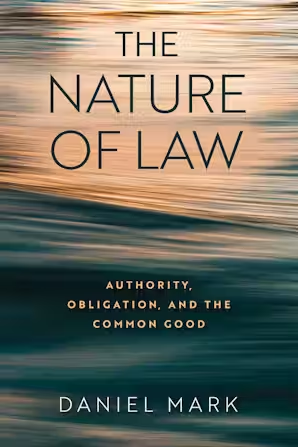
Here is another new book, this one from the University of Notre Dame Press, that reflects the academy’s growing interest in natural law: The Nature of Law: Authority, Obligation, and the Common Good, by political scientist Daniel Mark (Villanova). Mark argues that law should be understood as a set of commands oriented to the common good–which, of course, is the heart of Aquinas’s famous definition of law. Why scholars should be turning to natural law at this particular moment, when positivist theories like originalism and textualism have triumphed in the courts, is an interesting question. But the trend seems clear. Here’s a description of the book from the Notre Dame website:

Challenging the prevailing understanding of the authority of law, Daniel Mark offers a theory of moral obligation that is rooted both in command and in the law’s orientation to the common good.

When and why do we have an obligation to obey the law? Prevailing theories in the philosophy of law, starting with the work of H. L. A. Hart and Joseph Raz, fail to provide definitive answers regarding the nature of legal obligation. In this highly original and effective new work, Daniel Mark argues that there is a prima facie moral obligation to obey the law simply because it is the law. In Mark’s view, the best concept of law—one that allows for the possibility of justified authority and obligation—defines law as a set of commands oriented to the common good. Legal obligation, he proposes, shares defining features with moral obligation and with religious obligation while aligning wholly with neither.

This philosophically coherent view of legal obligation offers a viable framework for analyzing important and seemingly paradoxical puzzles about the law, such as why civil disobedience is punished as lawbreaking or why war-crimes trials for legal but immoral acts present a moral quandary.

By reconciling the concept of law as command with the role of law in promoting the common good, The Nature of Law provides an original and important scholarly contribution to the fields of legal philosophy and political thought.