In November, Oxford University Press will release “We Gather Together: The Religious Right and the Problem of Interfaith Politics” by Neil J. Young (formerly, Princeton University). The publisher’s description follows:
The story of the birth of the Religious Right is a familiar one. In the 1970s, 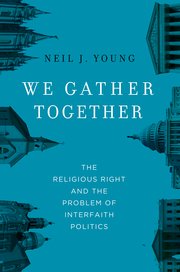 mainly in response to Roe v. Wade, evangelicals and conservative Catholics put aside their longstanding historical prejudices and theological differences and joined forces to form a potent political movement that swept across the country. In this provocative book, Neil J. Young argues that almost none of this is true. Young offers an alternative history of the Religious Right that upends these widely-believed myths.
Theology, not politics, defined the Religious Right. The rise of secularism, pluralism, and cultural relativism, Young argues, transformed the relations of America’s religious denominations. The interfaith collaborations among liberal Protestants, Catholics, and Jews were met by a conservative Christian counter-force, which came together in a loosely bound, politically-minded coalition known as the Religious Right. This right-wing religious movement was made up of Mormons, conservative Catholics, and evangelicals, all of whom were united–paradoxically–by their contempt for the ecumenical approach they saw the liberal denominations taking. Led by the likes of Jerry Falwell, they deemed themselves the “pro-family” movement, and entered full-throated into political debates about abortion, school prayer, the Equal Rights Amendment, gay rights, and tax exemptions for religious schools. They would go on to form a critical new base for the Republican Party.
Examining the religious history of interfaith dialogue among conservative evangelicals, Catholics, and Mormons, Young argues that the formation of the Religious Right was not some brilliant political strategy hatched on the eve of a history-altering election but rather the latest iteration of a religious debate that had gone on for decades. This path breaking book will reshape our understanding of the most important religious and political movement of the last 30 years.
 age. While most dialogue works on past and contemporary matters, this volume takes on the relations among the Abrahamic religions and looks forward, toward the possibility of real and lasting dialogue. The book centers upon inter-faith issues. It identifies problems that stand in the way of fostering healthy dialogues both within particular religious traditions and between faiths. The volume’s contributors strive for a realization of already existing common ground between religions. They engagingly explore how inter-religious dialogue can be re-energized for a new century.
 the making of the Chinese Buddhist canon from the fourth century to the digital era. Approaching the subject from a historical perspective, the book ties the religious, social, and textual practices of canon formation to the development of East Asian Buddhist culture and opens up the study of Chinese Buddhist texts to readers interested in the evolution of Chinese writing in general and the Confucian and Daoist traditions in particular.
 position in rights discourses, and the principles supporting its interpretation receive increasing attention from courts and legislative bodies. This book critically evaluates religious pluralism as an emerging legal principle arising from attempts to define the boundaries of freedom of religion. It examines religious pluralism as an underlying aspect of different human rights regimes and constitutional traditions. It is, however, the static and liberal shape religious pluralism has assumed that is taken up critically here. In order to address how difference is vulnerable to elimination, rather than recognition, the book takes up a contemporary ethics of alterity. More generally, and through its reconstruction of a more difference-friendly vision of religious pluralism, it tackles the problem of the role of rights in the era of diverse narratives of emancipation.
 shows that theological discourse is never philosophically neutral and always politically loaded. Raising questions concerning the conditions of modern philosophy, religion, and political ideas, Marius Timmann Mjaaland follows a dark thread of thought back to its origin in Martin Luther. Thorough analyses of the genealogy of secularization, the political role of the apocalypse, the topology of the self, and the destruction of metaphysics demonstrate the continuous relevance of this highly subtle thinker.