“Buddhism in Mongolian History, Culture and Society” (Wallace, ed.)

This January, Oxford University Press will release “Buddhism in Mongolian History, Culture and Society” edited by Vesna A. Wallace (University of California, Santa Barbara).  The publisher’s description follows:

BuddhismBuddhism in Mongolian History, Culture, and Society explores the unique elements of Mongolian Buddhism while challenging its stereotyped image as a mere replica of Tibetan Buddhism. Vesna A. Wallace brings together an interdisciplinary group of leading scholars to explore the interaction between the Mongolian indigenous culture and Buddhism, the features that Buddhism acquired through its adaptation to the Mongolian cultural sphere, and the ways Mongols have constructed their Buddhist identity. The contributors explore the ways that Buddhism retained unique Mongolian features through Qing and Mongol support, and bring to light the ways in which Mongolian Buddhists saw Buddhism as inseparable from “Mongolness.” They show that by being greatly supported by Mongol and Qing empires, suppressed by the communist governments, and experiencing revitalization facilitated by democratization and the challenges posed by modernity, Buddhism underwent a series of transformations while retaining unique Mongolian features.

The book covers historical events, social and political conditions, and influential personages in Mongolian Buddhism from the sixteenth century to the present, and addresses the artistic and literary expressions of Mongolian Buddhism and various Mongolian Buddhist practices and beliefs.

Bouasria, “Sufism and Politics in Morocco”

This January, Routledge Press will release “Sufism and Politics in Morocco: Activism and Dissent” by Abdelilah Bouasria (George Mason University).  The publisher’s description follows:

Presenting a political history and sociology of Moroccan Sufism from colonialism to the modern day, this book studies the Sufi model of Master and Disciple in relation to social and political life, comparing the different eras of acquiescent versus dissident Sufism.

This comparative fieldwork study offers new perspectives on the connection between the monarchy and mystic realms with a specific coverage of the Boutchichi order and Abdessalam Yassine’s Al Adl Wal Ihsane, examining the myth of apolitical Sufism throughout the Middle East and North Africa. Drawing on Michel Foucault and James Scott, this book fuses thinking about the political dimension of Sufism, a “hidden transcript,” involving power struggles, patronage and justice and its esoteric spiritual ethics of care.

Addressing the lacuna in English language literature on the Boutchichi Sufi order in Morocco, this book will be of interest to students and scholars of Islamic Studies, Comparative Politics and the MENA region.

If you really want to know what Judge ___ is like, read his opinions

Forgive me for a post not particularly law-and-religion related, but certainly law-related.

I’ve been enjoying Professor Ronald Collins’s series on Judge Richard Posner over at the Concurring Opinions blog. The Collins biography is extremely substantive and scholarly; it’s not really the subject of this post at all. I’m more interested here in “Posner on Posner,” which is basically a collection of interviews, reflections, bon mots, aphorisms, scattered wisdom about cats, opinionation about the virtues and vices of spicy food (or was it jurisprudence?), and so on. The latest installment is a smorgasbord of law professor queries about various scraps of miscellany, answered by Judge Posner in his genially efficient fashion. It’s a fun little window on Richard Posner the man. It reminds me of the way that James Fitzjames Stephen used to produce regular victuals for the insatiably voracious Victorian English intelligentsia.

The Posner on Posner format, though, is such that I’m afraid folks might perhaps be misled to believe that when Judge Posner makes statements like, “I think the role of legal doctrine in judicial decisions is considerably overrated,” that means that legal doctrine is likely actually to play very little role in his judicial decision making. Law professors so like to ask questions about things like pragmatism, and the influence of law and economics and sundry other ideological precommitments on judging, how judging will change “in the future,” and whether Posner reads any Lon Fuller (or enjoys the filmography of Lon Chaney). And, of course, Judge Posner is rather able at providing law professors with what they so much want to hear–interesting, provocative, sometimes perhaps a little shocking (not too much!), always eminently Posnerian responses to these sorts of questions. Indeed, he’s made something of an extrajudicial second career in writing great numbers of books whose theme is a tell-it-like-it-is forthrightness that shows the emperor in his resplendent nudity (and the repeated announcement of that theme, just in case you missed the last 19 times it was pressed, as something altogether novel coming from a judge). Professor Collins’s series is certainly of a piece with this spectacularly prodigious extrajudicial output.

Still, if you really want to know what Posner the judge is like–and here one could substitute really anybody when writing as a judge–you might do better simply to read his opinions. Failing that, or for the sake of saving a little time, may I humbly submit that you read my piece with Kevin Walsh about the several ways in which Posner the judge is often altogether different from Posner the public intellectual who explains what it is like to be a judge. It’s only after pursuing this sort of course that the differences between a judge and an explanation (even from the most able of judges) of ‘what-it-is-like-to-be-a judge’ (with apologies to Thomas Nagel) come into view–differences that for various reasons may run deep in Judge Posner’s particular case.

Conference: The Economic & Business Case for Freedom of Religion or Belief (Dec. 10)

On December 10, the United Nations NGO Committee on Freedom of Religion or Belief in New York will explore the connection between religious freedom and economic growth with a panel discussion featuring Dr. Brian Grim, president of the Religious Freedom & Business Foundation, and with responses from Prof. Silvio Ferrari, an expert on freedom of religion and the law, and Jeffrey French, an expert in the peacemaking potential of business.

Get more information here.

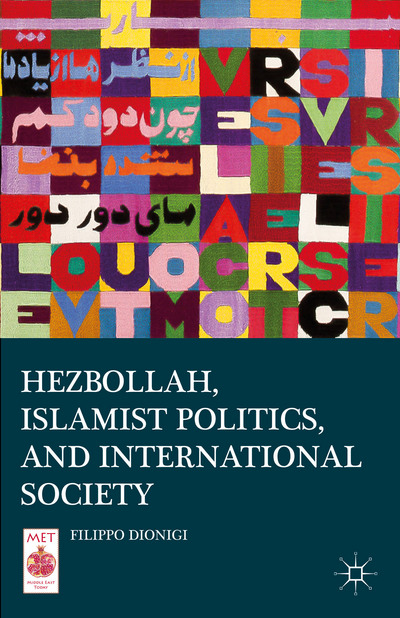
Dionigi, “Hezbollah, Islamist Politics, and International Society”

This month, Palgrave Macmillan releases “Hezbollah, Islamist Politics, and International Society,”  by Filippo Dionigi (Middle East Centre of the London School of Economics and Political Science). The publisher’s description follows:

How do the norms of the liberal international order influence the activity of Islamist movements? This book assesses the extent to which Islamist groups, which have traditionally attempted to shield their communities from ‘external’ moral conceptions, have been influenced by the principles that regulate international society. Through an analysis of Lebanon’s Hezbollah, Filippo Dionigi concludes that international norms are significant factors changing Islamist politics. We are still far from an accomplished resolve of the tension between Islamist communitarianism and liberal normative views, but a precarious equilibrium may emerge whereby Islamists are persuaded to rethink the idea of an allegedly ‘authentic’ Islamic morality as opposed to the legitimacy of international norms.

Francavilla, “The Roots of Hindu Jurisprudence: Sources of Dharma and Interpretations of Mimamsa and Dharmashastra”

In January, Oxford University Press will release “The Roots of Hindu Jurisprudence: Sources of Dharma and Interpretations of Mimamsa and Dharmashastra” by Domenico Francavilla (Institute of Canon Law and Comparative Religious Laws, Lugano). The publisher’s description follows:

This book is a detailed, innovative, and comprehensive examination of the sources of dharma, which is among the key concepts in Hindu jurisprudence. The book is also an introduction to the main topics of Hindu legal theory. Underlying the work of authors of various texts of Sanskrit juridical literature, including the dharmashastra, commentaries, andnibandhs, as well as of interpreters of questions concerning dharma, is a theory of the sources of dharma. Understanding the theory requires in-depth examination of the basis of the authority of different sources and of the issues that arise in case of conflict. The book begins with a detailed analysis the concept of dharma itself and the general problems concerning the knowledge of dharma (chapters 1-2). Then it studies the arguments used in the literature to establish the authority of sources (chapters 3-5). It pays special attention to the authority of smrti andsadâcâra, which are the two crucial sources in the practical functioning of the system. It examines the theory of sources of dharma as reconstructed mainly through an analysis of Medhatithi’s commentary on Manu II.6-15 and of thesmrtipada of the Tantravarttika of Kumarila Bhatta, a pivotal text in the Mimamsa philosophical tradition. It concludes with a look at wider issues of legal theory, the acceptance of universal and particular authorities in Hindu jurisprudence, the role of rulers, and the law in practice.

Smith on “Decisional Originalism”

You should take a look at Steve Smith’s superb piece criticizing original meaning originalism and proposing something that he calls decisional originalism. More and more, I am coming to believe that original expected applications originalism has a lot more going for it than is commonly thought. Opponents as well as advocates (in fact, especially advocates) of original meaning originalism don’t have much time for it. But Steve is on to something important in this short reflection. Note, also, the relevance of the method of common law reasoning for constitutional interpretation in Steve’s presentation of decisional originalism, something that I also agree is regrettably sidelined today:

If original meaning does not avoid the authority and rationality objections that gave rise to originalism, is there some criterion that would better serve the originalists’ purposes?

Maybe. Or at least the foregoing discussion has already suggested a possibility. Constitutional interpretation might attempt to ascertain and follow the original constitutional decision. After all, authority exerts itself, and rationality manifests itself, in decisions. To be sure, once made, those decisions are expressed in words—words that have meanings. We necessarily use the words (among other things, such as the historical context) to try to understand and reconstruct the decisions. Still, if our goal is to respect the constitutional assignment of authority and to facilitate rational decision-making, then we should not care about either the words or their meanings for their own sakes. We pay attention to them, rather, for the purpose of ascertaining and following the enactors’ decisions.

This distinction between meanings and decisions is subtle, but it is not wholly unfamiliar. Back when lawyers and scholars took common law reasoning more seriously than perhaps they do now, even a legal realist like Herman Oliphant could intelligibly contend that what binds in a legal precedent is what the court decided, not what the court said. Stare decisis, not stare dictis. My suggestion is that a similar distinction might be employed in the context of constitutional interpretation. In common law reasoning, to be sure, the distinction may seem more manifest because there is no canonical statement of the decision, anyway. With constitutional provisions (and statutes) there is a canonical wording; but that fact, I think, need not dissolve the distinction between decision, on the one hand, and textual meaning, on the other.

Just how an approach focusing on the original decision would differ from one focusing on original meaning is a complicated question, about which I cannot say much in a short essay….

For now, though, two observations may be suggestive.

There should be no great difficulty in concluding that the Fourth Amendment “search and seizure” provision applies to wiretaps. That sort of invasion of privacy might well be seen as covered by the enactors’ decision even though telephones did not exist in 1789. We might imagine a conversation in which we explain to the Framers: “In the future, it will be possible for officials to invade people’s privacy electronically without physically entering their dwellings. Would your decision apply to that sort of thing?” And we might plausibly suppose that they would reply, “Of course.”

Suppose, however, that someone proposes that a constitutional provision be interpreted to do something we are reasonably confident the enactors did not contemplate and very likely would not have desired. Someone proposes, for example, that the due process clause be used to invalidate restrictions on abortion. Or that the equal protection clause be used to invalidate traditional marriage laws. And we are confident, perhaps, that the enactors of those provisions would have been startled to learn of these proposals, and would have protested, “Are you serious? Our decision had nothing to do with that sort of thing.” If such “interpretations” had been foreseen, the provisions almost surely would have been reworded to avoid the unwanted results, or would not have been enacted at all.

Sarkissian, “The Varieties of Religious Repression”

This February, Oxford University Press will release “The Varieties of Religious Repression: Why Governments Restrict Religion” by Ani Sarkissian (Michigan State University).  The publisher’s description follows:

The Varieties of Religious RepressionReligious repression–the non-violent suppression of civil and political rights–is a growing and global phenomenon. Though most often practiced in authoritarian countries, levels of religious repression nevertheless vary across a range of non-democratic regimes, including illiberal democracies and competitive authoritarian states.

In The Varieties of Religious Repression, Ani Sarkissian argues that seemingly benign regulations and restrictions on religion are tools that non-democratic leaders use to repress independent civic activity, effectively maintaining their hold on power. Sarkissian examines the interaction of political competition and the structure of religious divisions in society, presenting a theory of why religious repression varies across non-democratic regimes. She also offers a new way of understanding the commonalties and differences of non-democratic regimes by focusing on the targets of religious repression.

Drawing on quantitative data from more than one hundred authoritarian states, as well as case studies of sixteen countries from around the world, Sarkissian explores the varieties of repression that states impose on religious expression, association, and political activities, describing the obstacles these actions present for democratization, pluralism, and the development of an independent civil society.

Little, “Essays on Religion and Human Rights”

This February, Cambridge University Press will release “Essays on Religion and Human Rights: Ground to Stand On” by David Little (Georgetown University).  The publisher’s description follows:

Religion and Human RightsThis collection of seminal essays by David Little addresses the subject of human rights in relation to the historical settings in which its language was drafted and adopted. Featuring five original essays, Little articulates his long-standing view that fascist practices before and during World War II vivified the wrongfulness of deliberately inflicting severe pain, injury, and destruction for self-serving purposes and that the human rights corpus, developed in response, was designed to outlaw all practices of arbitrary force. Drawing on the natural rights tradition, the book contends that while there must be an accountable human rights standard, it should nevertheless guarantee wide latitude for the expression and practice of religious and other conscientious beliefs, consistent with outlawing arbitrary force. This book further details the theoretical grounds of the relationship between religion and human rights, and concludes with essays on U.S. policy and the restraint of force in regard to terrorism and to cases like Vietnam, Afghanistan, and Pakistan. With a foreword by John Kelsey, this book stands as a capstone of the work of this influential writer on religion, philosophy, and law.

“Religion, Postcolonialism, and Globalization: A Sourcebook” (Reid, ed.)

In February, Bloomsbury Press will release “Religion, Postcolonialism, and Globalization: A Sourcebook,” by Jennifer Reid (University of Maine, Farmington). The publisher’s description follows:

Religion, Postcolonialism and Globalization: A Sourcebook shows how the roots of our globalized world run deeper than the 1980s or even the end of WWII, tracing back to 15th century European colonial expansion through which the ‘modern world system’ came into existence.

The Sourcebook is divided into four sections, each with a critical introduction by the editor, a series of readings, and discussion questions based on the readings. Canonical readings in religion, globalization and postcolonialism are paired with lesser-known texts in order to invite critical analysis. Extracts explored include work by Max Weber, Edward Said, David Chidester, and Kant, as well as political documents such as the British Parliament’s 1813 Act regarding the East India Company. Sources range from the origins of the common phrase “jihad vs. McWorld” in the work of Benjamin Barber, to personal essays reflecting religious responses to globalization.

Focusing on a history of religions approach, Religion, Postcolonialism, and Globalization provides an alternative to existing sociological work on religion and globalization.