Trollope on American Religion

Anthony Trollope is a wonderful novelist of the Victorian period.  His Chronicles of Barsetshire series is both a window on nineteenth-century Britain and a stylistic masterpiece.  And he is the author of as stingingly elegant a line about literary talent as I have run across (composed at the expense of my man, James Fitzjames Stephen): “a poor novelist, when he attempts to rival Dickens or rise above Fitzjeames, commits no fault, though he may be foolish.” (from “Barchester Towers”)

Here is a fascinating quote from his travelogue, “North America” (1862), written long before President Eisenhower said something vaguely similar, though in a very different register:

I have said that it is not a common thing to meet an American who belongs to no denomination of Christian worship.  This I think is so: but I would not wish to be taken as saying that religion on that account stands on a satisfactory footing in the States.  Of all subjects of discussion, this is the most difficult.  It is one as to which most of us feel that to some extent we must trust to our prejudices rather than our judgments.  It is a matter on which we do not dare to rely implicitly on our own reasoning faculties, and therefore throw ourselves on the opinions of those whom we believe to have been better men and deeper thinkers than ourselves . . . .

It is a part of [the American] system that religion shall be perfectly free, and that no man shall be in any way constrained in that matter.  Consequently, the question of a man’s religion is regarded in a free-and-easy way.  It is well, for instance, that a young lad should go somewhere on a Sunday; but a sermon is a sermon, and it does not much concern the lad’s father whether his son hear the discourse of a free-thinker in the music-hall, or the eloquent but lengthy outpouring of a preacher in a Methodist chapel.  Everybody is bound to have a religion, but it does not much matter what it is.

Levine et al., “The Joy of Secularism”

Secularism, as we say in this business, is a radically contested term. Does it refer j9433 to a political program, a moral philosophy, or a description of reality? Does it suggest a rejection of religion or a religion all its own? Princeton University Press has come out with a paperback edition of last year’s collection of essays, The Joy of Secularism: 11 Essays for How We Live Now (2011), that explores the topic. The collection is edited by George Levine, a professor emeritus of English at Rutgers. Here’s the publisher’s description:

 Can secularism offer us moral, aesthetic, and spiritual satisfaction? Or does the secular view simply affirm a dog-eat-dog universe? At a time when the issues of religion, evolution, atheism, fundamentalism, Darwin, and science fill headlines and invoke controversy, The Joy of Secularism provides a balanced and thoughtful approach for understanding an enlightened, Read more

If Only the Aztecs Had Known

Here’s something you don’t see every day, even if you follow the law reviews. On SSRN, George Mason University economist Peter Leeson has posted an abstract for a new paper that explains human sacrifice in terms of property rights (Human Sacrifice). Although economists typically dismiss the practice as irrational, he argues, human sacrifice is actually a rational social strategy that allows a group to signal to outsiders that it’s poor and therefore not worth plundering. Religious commandments are useful in creating incentives — to get people comfortable with the idea of ritual immolation — but really are only secondary. Leeson hasn’t posted his paper on SSRN, but you can find it on his website. Here’s the abstract:

This paper develops a theory of rational human sacrifice: the purchase and ritual slaughter of innocent persons to appease divinities. I argue that human sacrifice is a technology for protecting property rights. It improves property protection by destroying part of sacrificing communities’ wealth, which depresses the expected payoff of plundering them. Human sacrifice is a highly effective vehicle for destroying wealth to protect property rights because it’s an excellent public meter of wealth destruction. Human sacrifice is spectacular, publicly communicating a sacrificer’s destruction far and wide. And immolating a live person is nearly impossible to fake, verifying the amount of wealth a sacrificer has destroyed. To incentivize community members to contribute wealth for destruction, human sacrifice is presented as a religious obligation. To test my theory I investigate human sacrifice as practiced by the most significant and well-known society of ritual immolators in the modern era: the Konds of Orissa, India. Evidence from the Konds supports my theory’s predictions.

I don’t know enough about the Konds or economics to evaluate Professor Leeson’s paper, but it does suggest a strategy for religious communities that seek to influence public debate. Don’t make sectarian arguments that might be inaccessible and off-putting to non-believers. Find an economist.

Kontorovich on Sex With (German) Animals

Eugene Kontorovich, whose blogging is a treat, has a wonderful post up on the new German zoophilia.  The old German zoophilia was manifested in the civil right to bestiality back in 1969, and the rise of predictably associated phenomena of moral decay — the taste for which, it seems, is on the rise.  The new zoophilia champions the rights of animals to be left alone — one might even call it a right of privacy — in seeking to have these libertine liberties reversed (note that animal cruelty laws do not seem to be in issue, though I haven’t studied the challengers’ case well enough to know).  The difficulty is the question of the grounding of the right, since moralistic reasons, or reasons of “legal moralism” (whatever those may be) are now widely deemed outré in Germany.  The law and religion angle?  Well, historically “legal moralist” reasons have included religious reasons as a kind of core example.  Professor Kontorovich has an interesting observation about the issue of consent:

I suspect the motives behind the ban are entirely moralistic. Yet the government cannot come out and say so. Thus effort is made to distinguish the matter from Germany’s libertarian approach to sexual matters by suggesting the animals do not consent in the way consenting humans do. Yes, but they don’t consent to being bought or sold, or butchered, either, and they are not human, so consent is a red herring. This would not pass intermediate scrutiny in the U.S.

He then notes the now-common move of grounding the moralistic regulation of sexuality in arguments from social harm and public policy, but here perhaps I differ a bit with Professor Kontorovich.  It was always the case that the retrograde moralizers grounded their arguments in ideas of social harm, beneficent social policy, and so on.  The distinction is not of the method of argumentation now and then, but of the difference between what passes for harm now and then.  These two excellent papers — one by Bernard Harcourt (but sadly unavailable without payment) and the other by Steve Smith — come at matters from fairly different angles but gesture toward the same larger idea.

Symposium, “Religion in the 21st Century”

The current issue of the Erasmus Law Review (Erasmus University Rotterdam) has a symposium, “Religion in the 21st Century: Debating the Post-Secular Turn.” This is from the introduction by Erasmus Professors Wooter de Been and Sanne Taekema:

For a long time there seemed to be a broad consensus in Western democracies – at least among political theorists and legal scholars – concerning the place of religion in the public sphere and the separation of church and state. However, since the end of the last century, religion has again become a highly contentious issue. With the arrival of sizable groups of immigrants for whom religion remains an integral part of their identity – not only Muslims, but also evangelical Christians – religion is back in the public square of many modern Western democracies (a place, arguably, it never really disappeared from in the United States). This reassertion of religion, Stanley Fish observed in 2005, has ‘re-alerted us to the fact […] that hundreds of millions of people in the world do not observe the distinction between the private and the public, or between belief and knowledge, and that it is no longer possible for us to regard such persons as quaintly pre-modern or as needy recipients of our saving (an ironic word) wisdom’. In the same article, Fish predicted that religion was going to be the wave of the future in academics: ‘Announce a lecture or panel on ‘religion in our time’ and you will have to hire a larger hall’. Intrigued by this resurgence of religion – and tempted by a high attendance rate – we hired a larger hall and convened a conference on ‘Religion in the 21st Century’ at the Erasmus School of Law, in September 2011. The focus of this conference was the question: Does the revival of religion confront us with a familiar phenomenon that we can describe and analyse in tried-and-tested categories, or has religious experience transformed into something altogether different, which demands a new approach, a new way of relating to religion? The articles collected in this special issue all originate from this gathering and all, in their own way, try to come to terms with its central theme.

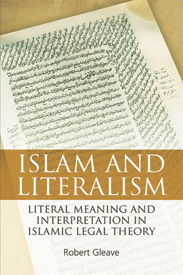
Gleave, “Islam and Literalism”

In August, Columbia University Press published Islam and Literalism: Literal app (1) Meaning and Interpretation in Islamic Legal Theory (2012), by Arabic Studies Professor Professor Robert Gleave (Exeter). The publisher’s description follows:

A commitment to a scriptural text as the sole source of knowledge, and an insistence on the literal interpretation of this text, is one of the characteristics of the “conservative religious revival’ movements in Judaism, Christianity and Islam. Yet little has been to done to investigate the idea that the literal meaning is the only acceptable one. This book fills this gap, looking both at literal meaning and literalism in Islam. The focus is on the tradition of Muslim legal writings: in this literature there exists a complex procedure of how to identify the literal meaning and the Read more

Welcome to Nelson Tebbe!

We are delighted to announce that Nelson Tebbe will be joining us as a guest for the month of December.  Nelson’s scholarship focuses on both religious liberty and constitutional law and theory more generally.  Among his many important and interesting articles are:

One of my own favorites of his pieces is this small gem about the Smith decision, which has greatly helped me to think about modern free exercise. We are very much looking forward to having him with us.  Welcome Nelson!!