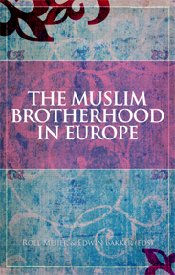
The Muslim Brotherhood in Europe

In May, Columbia University Press will publish The Muslim Brotherhood in Europe, edited by Edwin Bakker, Professor of Terrorism and Counterterrorism at Leiden University in Holland, and Roel Meijer of the Netherlands Institute of International Relations.  The volume collects articles presenting different views on the Muslim Brotherhood‘s activities in Europe.  The articles explore the extent to which these activities mirror the Brotherhood’s activities in the Middle East and whether their presence in Europe promotes a positive rallying force for Europe’s Muslim communities or the dangerous potential of national and international destabilization by fomenting inter-communal and inter-religious conflict.

Please see the publisher’s description after the jump. Read more

What is the object of “human rights”?

To ban works of literature, of course.  Dante’s Divine Comedy is on the chopping block, even at universities.  From the story:

The classic work should be removed from school curricula, according to Gherush 92, a human rights organisation which acts as a consultant to UN bodies on racism and discrimination.

Dante’s epic is “offensive and discriminatory” and has no place in a modern classroom, said Valentina Sereni, the group’s president . . . .

It represents Islam as a heresy and Mohammed as a schismatic and refers to Jews as greedy, scheming moneylenders and traitors, Miss Sereni told the Adnkronos news agency.

“The Prophet Mohammed was subjected to a horrific punishment – his body was split from end to end so that his entrails dangled out, an image that offends Islamic culture,” she said.

Homosexuals are damned by the work as being “against nature” and condemned to an eternal rain of fire in Hell.

“We do not advocate censorship or the burning of books, but we would like it acknowledged, clearly and unambiguously, that in the Divine Comedy there is racist, Islamophobic and anti-Semitic content. Art cannot be above criticism,” Miss Sereni said.

The concession about not burning books is truly magnanimous.  Perhaps the woman may have missed the exquisite pain previewed for Popes Clement V and Boniface VIII in the Eighth Circle.  But the latter probably deserved a bit of hell, given his pretensions to temporal power.  Perhaps Dante and Ms. Sereni agree on the issue of simony. 

No matter –Dante was banished in his own time, so it is fitting that some right-thinking folks wish to banish him today.  Still, if I could offer a little lawyerly advice to Messrs. Cervantes, Chaucer, and Shakespeare — keep your heads down.

Krivenko on the Islamic Veil and Gender Equality

Ekaterina Yahyaoui Krivenko (University of Montreal – Faculty of Law) has posted The Islamic Veil and its Discontents: How Do they Undermine Gender Equality. The abstract follows.

The article addresses the use of notions of gender equality and non-discrimination in the discussions concerning the practice of Islamic veiling by the European Court of Human Rights as well as by French authorities in relation to the recent adoption of the law banning full face veils in public spaces in France. The author argues that the use of the rhetoric of gender equality without the required knowledge and understanding of the justifications for and discussions about this practice existing within Islam is in both cases very inadequate and leads to results opposite to those they intended to promote. Based on insights into the discussions of Muslims about the practice of veiling the author makes some proposals for a more adequate approach to this practice both from the point of view of women’s status as well as from the point of view of relationship between Islam and the West.


Churches Protest Lending Practices

On March 9, Samuel G. Freedman reported in the New York Times on the growing trend of Christian congregations’ closing their bank accounts at financial institutions implicated in the abuses that led to the mortgage crisis.  PICO National Network (People Improving Communities through Organizing) leads the campaign, which PICO estimates has motivated dozens of congregational organizations and their individual members to withdraw some $31 million from particularly complicit institutions, such as JPMorgan Chase, Wells Fargo, and Bank of America, and deposit those funds in other institutions.  For more on this movement, please follow the jump. Read more

Movsesian at Fordham Law School: “Sharing Sacred Space In Jerusalem”

My colleague Mark will give a presentation at Fordham Law School on March 27, at 6:00 pm, as part of a panel on the subject, “Sharing Sacred Space in Jerusalem.”  Details here.  And for some of Mark’s reflections on this subject, see this post.

Michael McConnell at St. John’s Law School

The Center for Law and Religion is delighted to announce that Professor Michael McConnell (Stanford) will visit us at St. John’s Law School next Monday, March 19, at 5:30 pm.  His is the fourth session in our ongoing seminar, Colloquium in Law: Law and Religion.  Professor McConnell will reconsider Employment Division v. Smith in light of Hosanna-Tabor v. EEOC, and he will offer us his always illuminating thoughts about the future of free exercise (those who have not read Professor McConnell’s two 1990 pieces on free exercise — one on the historical origins of free exercise and one in response to Smith — will profit from them greatly).

Academics in the New York area and beyond are welcome to attend.  Please let me know.

Prélot on France’s Full Veil Prohibition

Pierre-Henri Prélot (University of Cergy-Pontoise) has posted Religious Symbols and the Law of 1905: Reflections on the Prohibition of the Full Veil in Light of the French Law on Religious Practice. The abstract follows.

There is a recurrent debate in France on the conflict between the principle of secularism and the expression of religious convictions in public places. The liberal approach, which is open to all forms of public expression including the religious convictions of individuals, is opposed to a much more restrictive conception, which understands secularism as limiting religious convictions to the private sphere, with the corollary of the interdiction, or at least a strict restriction, of their public manifestation, whether they be individual or collective. In today’s highly secularized French society, which feels itself undermined by religious factors deriving from international conflicts and internal tensions, the sometimes radical affirmation of identities tends to weaken the liberal interpretation which is at the basis of the law of 1905, in favor of a much more restrictive vision of the principle of secularism. That is revealed by the law of October 11, 2010, on the prohibition of the covering of the face in public places, which falls within the very old royal tradition, derived from Gallicanism, of the public regulation of religious practices. Although it carefully avoids any reference to religious practices or convictions, the law of October 11, 2010 must be understood as a law implementing a religious policy.

Read more

Kwall on Copyright Law and Jewish Process Theology

Roberta Rosenthal Kwall  (DePaul U. College of Law) has posted The Lessons of Living Gardens and Jewish Process Theology for Authorship and Moral Rights. The abstract follows.

This Article examines the issues of authorship, fixation and moral rights through the lens of Jewish Process Theology. Jewish Process Theology is an application of Process Thought, which espouses a developmental and fluid perspective with respect to creation and creativity. This discipline offers important insights for how to shape and enforce copyright law. The issue of “change” and authorship is more important now than ever before given how the digital age is revolutionizing the way we think about authorship. The Seventh Circuit’s recent decision wrongly maintaining that a living garden is not capable of copyright protection since it is unfixed, changeable and partially the product of non-human authorship illustrates the need for interdisciplinary guidance with respect to copyright law and policy.

Render on Religious Practices, Sex Discrimination and Toleration

Meredith Render (U. of Alabama School of Law) has posted Religious Practice and Sex Discrimination: An Uneasy Case for Toleration. The abstract follows.

This essay considers two questions: (1) whether there are moral or instrument reasons to tolerate religious practices that contravene our fundamental public values; and (2) in instances in which there is no moral or instrumental reason to tolerate a practice that contravenes public values, whether it is appropriate to condition the availability of tax exempt status on religious institutions’ fidelity to public values.

The essay offers a response and supplement to the insights contained in Caroline Mala Corbin’s interesting essay, “Expanding the Bob Jones Compromise” in which Corbin thoughtfully argues that we should withdraw tax exempt status from religious institutions that discriminate on the basis of sex. Corbin observes that tax exempt status is already conditioned on nondiscrimination with respect to race, and she offers the insight that there is no principled reason to treat sex and race discrimination differently in the this context. While this essay accepts the latter insight, I argue that there may be instrumental reasons why we would be concerned about the government determining which religious practices contravene our nondiscrimination norms and which do not. I further raise concerns about the mechanism Corbin selects (conditional tax exempt status) in light of Hosanna-Tabor, the Supreme Court’s latest articulation of the degree of protection offered by the Religious Clauses to religious practices that implicate the selection of ministers.

Pope on Redefining Marriage: Reasoned Argument and Pastoral Care

At a meeting with American bishops Friday in Rome, Pope Benedict discussed efforts in Western countries to alter the legal definition of marriage. Not surprisingly, he suggested that Catholics resist such efforts, and do so by making arguments from natural law. After noting “the powerful political and cultural currents seeking to alter the legal definition of marriage,” he stated:

The Church’s conscientious effort to resist this pressure calls for a reasoned defense of marriage as a natural institution consisting of a specific communion of persons, essentially rooted in the complementarity of the sexes and oriented to procreation. Sexual differences cannot be dismissed as irrelevant to the definition of marriage. Defending the institution of marriage as a social reality is ultimately a question of justice, since it entails safeguarding the good of the entire human community and the rights of parents and children alike.

When addressing itself to public debate, in other words, the Church should make reasoned arguments, not proclaim revealed truth. Within the Church, however, the Pope suggested a more pastoral approach. “In this great pastoral effort,” he said, “there is an urgent need for the entire Christian community to recover an appreciation of the virtue of chastity. … It is not merely a question of presenting arguments, but of appealing to an integrated, consistent and uplifting vision of human sexuality.” Of course, these two approaches — reasoned argument and pastoral care  — are not mutually exclusive; I don’t understand him to say that reasoned argument is out of place within the Church, or that more intuitive appeals are out of place in politics. The Pope appears to understand, though, that different appeals may be appropriate in the public square and within the Church itself.