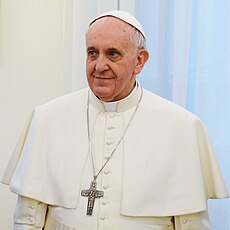
Vatican Removes Controversial Papal “Interview” From Its Website

Here’s what looks to be the final update on that interview Pope Francis gave to Eugenio Scalfari of the Italian newspaper La Repubblica this fall. Readers of this website will recall that the interview quotes Pope Francis as saying, among other things, that “proselytism” is “nonsense” and that, with respect to conscience, everyone must follow his own idea of good and evil. Progressives swooned; traditionalists grumbled; everyone wondered what it all meant.

Shortly after the interview ran, it emerged that Scalfari had reconstructed the pope’s words from memory. Scalfari had not tape recorded the pope nor taken notes during the meeting . In other words, the La Repubblica “interview” was not an interview at all. Why a respected newspaper would publish an imaginative reconstruction as though it were a real interview is beyond me–but the Vatican stated at the time that the interview was basically “trustworthy,” if not verbatim. And the Vatican posted the interview on its website.

Last week, however, the Vatican decided to take the interview down. According to this report from the Catholic News Agency, Pope Francis became concerned that people might misunderstand the interview–particularly the discussion of conscience. According to a Vatican spokesman, “The information in the interview is reliable on a general level but not on the level of each individual point analyzed: this is why it was decided the text should not be available for consultation on the Holy See website.” The music was right, I guess, but the lyrics were bit off. Probably the interview is still available at La Repubblica, though.

Mannaggia!

You know that interview Pope Francis gave to Eugenio Scalfari of the Italian newspaper, La Repubblica? The one in which the pope made some puzzling comments about conscience and proselytism? The one that so many people, including me, have been poring over for insights into the pope’s thoughts on religion, politics, and law? It turns out it’s not an interview at all, but an after-the-fact reconstruction. Apparently, Scalfari neither tape-recorded his interview nor took notes at the time. Some errors have already begun to emerge. The Vatican has “confirmed the basic ‘trustworthiness'” of the interview–whatever that means. But, John Allen writes:

None of this, of course, is to excuse La Repubblica‘s sloppiness in not making clear to readers that what was being presented as the literal words of the pope was actually a reconstruction, not a transcript.

Barring further clarification from the Vatican, it’s now impossible to cite any particular lines or formulae from that interview and attribute them directly to the pope, since we don’t know quite where Scalfari ends and Francis begins.

Oh, well, never mind, then.

Is that any way to run a newspaper?

Conference: The Lateran Pacts and the Jews (Oct. 24-25)

On October 24-25 in New York, the Centro Primo Levi, the NYU Casa Italiana Zerilli Marim, and the Museum of Tolerance will co-sponsor a conference, “The Lateran Pacts, the Rights of Jews and Other Religious Minorities”:

In view of the upcoming 85th anniversary of the Lateran Pacts and the current debates on the position of the Church toward the Jews during Fascism and World War II, Centro Primo Levi has invited an interdisciplinary group of scholars to closely examine and discuss the legal, social, political and economic aspects of this redefinition of the relations between Church and State in Italy and in totalitarian Europe.
The conference will offer an overview of the Lateran Pacts, the background of negotiations between Mussolini and Pius XI as well as an analysis of the ways the Pacts affected Italian society, the rights of minorities vis-à-vis family law, education, public moral, protection of minority rights, with a particular focus on the subsequent re-organization of the Jewish communities. Scholars will present new research on the changes to the civil and penal codes brought about by the Pacts, as well as the reforms of key public institution that became necessary in order to make them compatible with a state religion.

Looks interesting. Details are here.

Vatican to UN: More Than 100,000 Christians Killed for Their Faith Each Year

For reasons I’ve discussed before, elite opinion in the West is uncomfortable with the idea of Christians as a persecuted minority. At least since the Enlightenment, Western intellectuals, as a class, have seen traditional Christians as adversaries to be resisted, not victims to be rescued. The idea that in some circumstances Christians might actually be victims complicates the narrative in unpleasant ways.

To be fair, traditional Christians in the West sometimes overstate their difficulties. There are worrisome signals, to be sure. In ways that one would not have imagined even 20 years ago, governments seem willing to require traditional Christians to give up their religious convictions as the price for entering the marketplace, or even doing charitable work. But that’s not persecution, exactly. No one is forcing Christians to the catacombs.

Persecution of Christians in other parts of the world is a fact, however, and one that needs repeating. Archbishop Silvano Tomasi, the Vatican’s Permanent Representative, thus deserves credit for raising the topic at a meeting of the UN’s Human Rights Council in Geneva yesterday. Tomasi deplored the fact that, according to credible estimates, more than 100,000 Christians around the world are killed each year because of their faith. Many others are subjected to rape, displacement, destruction of their places of worship, and the abduction of their leaders. As to that last item, the whereabouts of the two Orthodox bishops whom elements of the Syrian opposition kidnapped last month remain unknown.

It’s certainly true that other religious minorities suffer too; human rights advocates often give this as a reason for not singling out Christians in particular. But what sense does that make? One hears a great deal about the persecution of other religious minorities by name, and rightly so. It’s time the global human rights community spoke of the persecution of Christians, as Christians, as well.

Mayer, “The Roman Inquisition”

In January, the University of Pennsylvania Press published The Roman Inquisition: A Papal Bureaucracy and Its Laws in the Age of Galileo, by Augustana College history professor Thomas F. Mayer. The publisher’s description follows:

While the Spanish Inquisition has laid the greatest claim to both scholarly attention and the popular imagination, the Roman Inquisition, established in 1542 and a key instrument of papal authority, was more powerful, important, and long-lived. Founded by Paul III and originally aimed to eradicate Protestant heresy, it followed medieval antecedents but went beyond them by becoming a highly articulated centralized organ directly dependent on the pope. By the late sixteenth century the Roman Inquisition had developed its own distinctive procedures, legal process, and personnel, the congregation of cardinals and a professional staff. Its legal process grew out of the technique of inquisitio formulated by Innocent III in the early thirteenth century, it became the most precocious papal bureaucracy on the road to the first “absolutist” state.

As Thomas F. Mayer demonstrates, the Inquisition underwent constant modification as it expanded. The new institution modeled its case management and other procedures on those of another medieval ancestor, the Roman supreme court, the Rota. With unparalleled attention to archival sources and detail, Mayer portrays a highly articulated corporate bureaucracy with the pope at its head. He profiles the Cardinal Inquisitors, including those who would play a major role in Galileo’s trials, and details their social and geographical origins, their education, economic status, earlier careers in the Church, and networks of patronage. At the point this study ends, circa 1640, Pope Urban VIII had made the Roman Inquisition his personal instrument and dominated it to a degree none of his predecessors had approached.

The Rise of the “Stars and Stripes” Cardinals in Rome

The College of Cardinals began its pre-conclave meetings (the so-called Congregazioni Generali) this week in Rome, with 153 members in attendance. Of them, 115 are under the age of 80, and therefore eligible to participate in the papal election. The question popping up in every Italian newspaper article and commentary is, of course, the same: who will be the new Pope?

While, for obvious reasons, it is impossible to predict the most likely outcome of the cardinals’ decision, it is true that European, and especially Italian, media have devoted particular attention to Cardinal Timothy Dolan and to American cardinals in general. For instance, two days ago the daily Corriere della Sera, the most influential Italian newspaper, had a long interview with the Archbishop of New York . Yesterday, La Repubblica published a long article on the “Stars and Stripes cardinals” and how they are approaching the conclave.

Why are American cardinals receiving so much attention? One obvious, and superficial, reason is that they are much more skilled, as compared to other cardinals, in communicating and establishing relationships with the media. But there is another factor. The United States’ ability to preserve a vocal religious presence in the public sphere has always raised interest and curiosity in Rome, and especially now, in a time when the secularization of Europe is growing at an unprecedented level. It is not to reveal a secret to say that Benedict XVI himself, on many occasions, expressed appreciation for the “American model,” a model in which religious arguments in the public sphere are heard and debated much more than in Europe.

Why did this American model fit better with Benedict XVI’s approach and teachings? According to John L. Allen, Jr., Benedict XVI, contrary to the conventional narrative, tried to shape his teachings on the basis of an “affirmative orthodoxy.” In a conversation with Archbishop Dolan (A People of Hope, Image Books, 2011) Allen defined affirmative “in the sense of being determined to present the building blocks of orthodoxy in a positive key.” The emphasis would therefore be on “what Catholicism embraces and affirms, what it says ‘yes’ to, rather  than what it opposes and condemns.” This affirmative orthodoxy works much better in a social context, like America’s, which welcomes religion in the public sphere and in which religious arguments are heard.

Today, the real challenge for the Catholic Church, especially according to many European cardinals, is religious indifference and the coming of a post-Christian world represented by a new type of man: the homo indifferens. As a result, the American experience, which represents, in many accounts, a hopeful and affirming Catholicism,  is seen as a success story in Rome. This does not mean that in a few days we will have an American Pope. But  I’m sure, like it or not, that the “American model” will matter in discussions on the future of the Church.

Papal Resignation: The Canon Law

It just shows you. Even an institution as ancient and traditional as the papacy still retains the ability to shock. Pope Benedict’s announcement today that he will resign for health reasons, effective February 28, seems to have taken everyone, including Vatican insiders, by surprise. It is the first papal resignation since the year 1415.

Canon law on papal resignation is surprisingly – or, come to think of it, unsurprisingly – brief. Canon 332(2) of the current Code of Canon Law provides simply that ” If it happens that the Roman Pontiff resigns his office, it is required for validity that the resignation is made freely and properly manifested but not that it is accepted by anyone.” A leading commentary notes that Canon 332(2) does not specify the person or persons to whom a pope must manifest his resignation. Some scholars argue that the college of cardinals, as the body that elects the pope, is the proper recipient. But that’s not entirely clear; anyway, in Catholic understanding, the pope has authority to determine such matters for himself. Most likely, today’s announcement at a consistory, in which the Pope stressed that he was taking this step voluntarily and in full recognition of its gravity, will suffice. Anyway, the college of cardinals will no doubt have a chance to receive the resignation, if that action is required, before it elects Pope Benedict’s successor, most likely next month.

McAleese, “Quo Vadis? Collegiality in the Code of Canon Law”

This January, Columba Press will publish Quo Vadis? Collegiality in the Code of Canon Law by Mary McAleese (former President of Ireland). The publisher’s description follows.

 In her first book since leaving Aras An Uachtarain, Mary McAleese has produced a masterful and highly accessible study of how Vatican II’s teachings on collegiality, or how power and responsibility were to be shared between the Pope and the college of bishops within the Catholic Church, have either been sidetracked or not yet come to fruition, depending on how you interpret the events which followed the Council up to the present day.

Vatican II embraced a fresh new vision of the Church as the People of God, turning away from the rigidly hierarchic structure of the past. It left a clear picture of the Church as communio or community but no clear road-map of how to get there. While it sowed seeds of confusion it also infused into the Church an expectation of broader ecclesial participation and co-responsibility which has impacted in many different ways. Read more

.religion?

I’ve always been mystified by ICANN (the “Internet Corporation for Assigned Names and Numbers”), the US non-profit corporation that manages the internet. Somehow, and without governmental authority, ICANN has gotten users around the world to accept as authoritative its decisions on internet protocols and, in particular, “generic Top Level Domains,” or “gTLDs” — the familiar .com, .org, and .edu designations at the end of internet addresses. A good example of spontaneous ordering, I guess.

Anyway, this spring, ICANN invited proposals for new gTLDs. The organization is now taking public comments. Given the importance of religion on the web, it’s not surprising that many of the proposed new gTLDs involve religion, and that some of them are causing controversy. For example, the Vatican has requested that it receive a new gTLD, “.catholic.” Among the objectors to this proposal is Saudi Arabia, which points out that other Christian communions, for example, Eastern and Oriental Orthodox, also refer to themselves as “Catholic”; the designation would thus create confusion. Actually,  Saudi Arabia has objected generally to new gTLDs that name particular religions – for example, “.islam,” – on the ground that no one entity should be able to claim the internet identity for an entire religion. It’s an interesting point. ICANN will accept comments on proposed gTLDs until September 26. (H/t: Christianity Today).

Religious Freedom: How Others See Us

Before everyone starts emailing, let me quickly say that the state of religious freedom in America is qualitatively better than in many, many other countries.  And I am not in any way equating the HHS Contraception Mandate with the sort of religious persecution that exists routinely elsewhere. (The US does not imprison and abuse people for conducting prayer meetings, for example). Given the US’s habit of issuing annual reports that condemn threats to religious freedom in other countries, though, it might be helpful at least to read what outside observers say about us. Here are two statements, one an editorial on a Russian Orthodox Church website, and the other a public letter from the Vatican, arguing that the US has its own religious freedom issues to address. Of the two, the Vatican’s is better done — the Russian veers into anti-American agitprop — though even the Vatican’s letter is itself a little vague, speaking only of “concerted efforts … to redefine and restrict the exercise of the right to religious freedom,” and ” the unprecedented gravity of … new threats to the Church’s liberty and public moral witness” in America. The implication is clear, though. The Mandate may be compromising the credibility of the US’s voice on religious freedom around the world.