Cogan, “The Princess Nun: Bunchi, Buddhist Reform, and Gender in Early Edo Japan”

Next month, Harvard will publish The Princess Nun: Bunchi, Buddhist Reform, 9780674491977and Gender in Early Edo Japan, by Gina Cogan (Boston University). The publisher’s description follows.

The Princess Nun tells the story of Bunchi (1619–1697), daughter of Emperor Go-Mizunoo and founder of Enshōji. Bunchi advocated strict adherence to monastic precepts while devoting herself to the posthumous welfare of her family. As the first full-length biographical study of a premodern Japanese nun, this book incorporates issues of gender and social status into its discussion of Bunchi’s ascetic practice and religious reforms to rewrite the history of Buddhist reform and Tokugawa religion.

Gina Cogan’s approach moves beyond the dichotomy of oppression and liberation that dogs the study of non-Western and premodern women to show how Bunchi’s aristocratic status enabled her to carry out reforms despite her gender, while simultaneously acknowledging how that same status contributed to their conservative nature. Cogan’s analysis of how Bunchi used her prestigious position to further her goals places the book in conversation with other works on powerful religious women, like Hildegard of Bingen and Teresa of Avila. Through its illumination of the relationship between the court and the shogunate and its analysis of the practice of courtly Buddhism from a female perspective, this study brings historical depth and fresh theoretical insight into the role of gender and class in early Edo Buddhism.

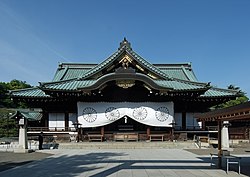
Yasukuni and Nice Distinctions

Photo from the International Business Times

Last week, Japanese Prime Minister Shinzo Abe fulfilled an oft-repeated wish to visit Tokyo’s Yasukuni Shrine while in office. In Shinto belief, the shrine houses the souls of millions who died in the service of the Japanese Empire. Abe has expressed regret that he did not visit the shrine during his last stint as prime minister, from 2006 to 2007.

You’d think a visit to such a shrine by a sitting prime minister would be entirely proper, like an American president visiting Arlington National Cemetery. Abe’s visit has caused great controversy, however, as Abe surely knew it would. Among the souls commemorated at the shrine are a thousand convicted war criminals who fought for Japan in World War II, including wartime Prime Minister Hideki Tojo. China and Korea, which both suffered greatly at Japan’s hands in that war, deeply resent official visits to Yasukuni and, naturally, objected to Abe’s visit. So, unusually, did the United States, which expressed disappointment “that  Japan’s leadership has taken an action that will exacerbate tensions with Japan’s neighbors.” Walter Russell Mead does a good job explaining the diplomatic implications.

For his part, Abe said he had not intended to offend Japan’s neighbors or send a crypto-imperialist signal. He did not visit Yasukuni to honor war criminals, he insisted, but to express to the souls housed there his determination “to create an age where no one will ever suffer from tragedies of wars.” In addition, Abe’s spokesman stressed that the prime minister had visited the shrine, and made a donation, strictly as a private citizen exercising his “religious freedom.” This last part is important for purposes of Japanese law. According to the Japanese Supreme Court, the constitutional “separation of state and religion” forbids officials from making financial contributions to Yasukuni for use in Shinto ceremonies.

So, is everything clear now? It was crucially important for Abe to visit Yasukuni while in office–but strictly in an unofficial capacity. A very lawyerly distinction, but one unlikely to persuade anyone in China or Korea. Maybe not even in Japan.

Religion and the Yasukuni Shrine Controversy

At Via Meadia, Walter Russell Mead has been doing a great job covering the controversy surrounding visits last week by top Japanese officials to the Yasukuni Shrine in Tokyo. Yasukuni is a Shinto shrine; in Shinto belief, it houses the souls of millions of people who died in the service of the Japanese Empire, including during World War II. Among the millions commemorated are approximately 1000 convicted war criminals, including wartime Prime Minister Hideki Tojo.

Japan’s neighbors, China and Korea, perceive official visits to the shrine as an outrageous insult and a sign that Japan has not fully repudiated the imperialism of its past. (In response to last week’s visits, China sent a fleet of patrol ships into Japanese territorial waters.) The latest controversy erupted when top officials in Prime Minister Shinzo Abe’s cabinet, as well more than 150 parliamentarians, visited the shrine for the annual Shinto Spring Ceremony–the largest official delegation in decades. In response to Chinese and Korean complaints, Abe doubled down, declaring in a parliamentary debate, “It’s only natural to honor the spirits of those who gave their lives for the country. Our ministers will not cave in to any threats.” Abe doubtless feels buoyed by opinion polls showing that he has a 70% approval rating from the Japanese public.

Official participation in ceremonies at Yasukuni have been controversial inside Japan as well. The Japanese Constitution, adopted after the war, disestablished Shintoism and effected, in the words of the Japanese Supreme Court, the “separation of state and religion.” In fact, in 1997 the Supreme Court ruled that the government officials could not make financial contributions to Yasukuni for use in Shinto ceremonies. With respect to this month’s visits, the officials involved were careful to point out that they were participating only as private citizens, not government officials, but that explanation has not satisfied critics. “”It doesn’t matter how or in what role Japanese leaders visit the Yasukuni shrine,” a Chinese spokesman said. “We feel it is in essence a denial of Japan’s history of militarist invasion.” And Japanese legal scholar Keisuke Abe (no relation to the Prime Minister, I believe) argues in a symposium in the St. John’s Law Review that most Japanese wouldn’t recognize the distinction, either. “Whatever the purpose of” a visit to the shrine, he writes, “the general public is likely to consider it as the government giving special support to Shintoism, associated with ancestor worship.”

DuBois’s “Religion and the Making of Modern East Asia”

Religion and the Making of Modern East Asia (CUP 2011) by Thomas David DuBois (National University of Singapore) looks like a wonderful book about religion’s contributions to the history, politics, and law of China, Japan, Korea, Vietnam, and other East Asian nations.  The publisher’s description follows.  — MOD

Religious ideas and actors have shaped Asian cultural practices for millennia, and have played a decisive role in charting the course of its history. In this engaging and informative book, Thomas David DuBois sets out to explain how religion has influenced the political, social, and economic transformation of Asia from the fourteenth century to the present day. Crossing a broad terrain from Tokyo to Tibet, the book highlights long-term trends and key moments, such as the expulsion of Catholic missionaries from Japan, or the Taiping Rebellion in China, when religion dramatically transformed the political fate of a nation. Contemporary chapters reflect on the wartime deification of the Japanese emperor, Marxism as religion, the persecution of the Dalai Lama, and the fate of Asian religion in a globalized world.